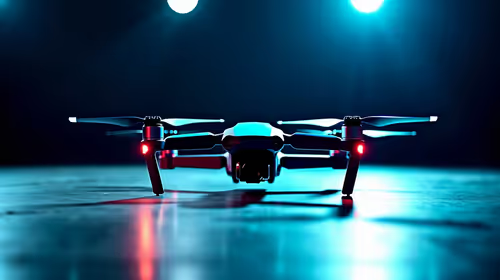
If you have shopped for a DJI drone, you have seen OcuSync in the spec sheet, now branded O4 on current models. It is the technology that carries a live video feed from the drone back to your controller, and it is the reason DJI's range and image stability tend to beat the competition. Understanding what it does makes the numbers on the box mean something when you choose a drone.
Quick Answer
OcuSync, called O4 in DJI's latest drones, is a proprietary video transmission system that streams 1080p live video to the controller with low latency over ranges up to 20km in ideal conditions. It switches intelligently between the 2.4GHz and 5.8GHz bands to keep the link stable and the feed clean.
What OcuSync Actually Does
Every camera drone needs to send what it sees back to the pilot in real time so you can frame shots and fly safely. OcuSync is DJI's answer to that, a long-range, low-latency digital link purpose-built for drones rather than a generic Wi-Fi stream.
Two qualities make it stand out. First, range: in open, interference-free conditions the strongest versions reach distances measured in kilometres, with quoted figures up to 20km. Second, stability: it streams a crisp 1080p preview with minimal lag, so the image you fly by closely matches the moment in front of the drone.
How the Frequency Switching Works
OcuSync does not lock to one band. It uses the 2.4GHz and 5.8GHz frequencies and switches between them automatically, picking whichever offers the cleaner channel at that moment. In a busy area thick with Wi-Fi traffic, the system can hop to the less congested band to hold the link together. That adaptability is what keeps the feed steady where a fixed-frequency system would stutter or drop.
The quoted maximum range assumes open space with no obstructions or interference. Real-world distance is shorter once buildings, trees, and competing signals enter the picture, which is exactly the situation the dual-band switching is designed to manage.
What O4 Improves Over Older Versions
O4 is the current generation of the system and refines what earlier OcuSync versions delivered: longer dependable range, a more robust connection in cluttered radio environments, and smoother high-resolution transmission. The branding shifted from the OcuSync name to the O-number naming as the technology matured, so a drone listed with O4 is running DJI's latest transmission tech rather than an older revision. Drones equipped with it sit within the broader connected-device and smart-tech category at Evetech if you want to see which models carry it. For the controllers, spare batteries, and other add-ons that round out a drone kit, the wider accessories selection at Evetech is the place to look.
Frequently Asked Questions
Is OcuSync the same as O4?
Essentially yes. O4 is the current generation of what was originally branded OcuSync. DJI moved to the O-number naming as the system evolved, so a drone listed with O4 uses the latest version of this transmission technology.
Does a drone really reach 20km of range?
That figure is a best-case maximum in open, interference-free conditions. In normal flying with buildings, trees, and other signals around, the usable range is shorter, which is why the dual-band switching exists to keep the link stable.
What resolution is the live feed?
OcuSync streams a 1080p live preview to the controller with low latency. That is the feed you fly and frame by; the footage the drone records to its storage can be at a higher resolution than the live transmission.
Why does OcuSync use two frequencies?
Using both 2.4GHz and 5.8GHz lets the system switch to whichever band is cleaner at any moment. In congested areas that automatic switching keeps the video link stable where a single fixed frequency would drop or stutter.
Want a drone with a rock-solid live feed? Explore the drones and supporting accessories at Evetech and pick a model running DJI's latest O4 transmission for reliable range and a clean picture.