


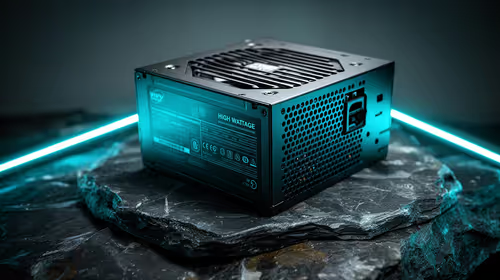
550W PSU Planning for RTX 5080 Super Builds in SA
550W for RTX 5080 Super needs a full-build check, not a simple yes. Review GPU guidance, CPU draw, transient load, connectors, PSU quality, and upgrade plans before deciding.
Read moreThe best ZAR value comes from features that repeatedly reduce splitting, tuning time or surface-handling friction. At R9,399, the Neptune 4 Max offers a large build envelope, Klipper speed control, a 300C nozzle and dual-sided plate.

A feature offers value when it removes repeated cost, delay or uncertainty from maker projects. Ranking 3D printer features for the best value in ZAR requires build volume, Klipper speed, nozzle range and plate handling to earn their own place.
For makers, the strongest ZAR features are usable 420x420x480mm volume, 121-point levelling, 300C material range and controllable Klipper speed.
Give the highest weighting to the feature that solves the most frequent expensive constraint. The R9,399 Neptune 4 Max puts 420 x 420 x 480mm of capacity beside Klipper motion reaching 500mm/s. A 300C hot end and plate usable on two sides complete the comparison, but none should dominate without repeated use.
Measure prepared models and record which axis causes splits, scaling or another production route. Estimate the labour added by assembly, alignment and finishing. Extra envelope earns ZAR value when it removes those steps often.
Browse large 3D printers at Evetech using the same project file set. Do not calculate value from raw cubic millimetres; usable orientation and function matter more.
For batch work, count acceptable completed pieces from a tested layout. A broad bed receiving more items is not automatically more productive.
The Neptune's Klipper platform supports operation up to 500mm/s. Compare complete job time from an identical file, including detail moves, failure, inspection and rework. A faster profile has value only when the accepted result arrives sooner.
Separate draft, prototype and finished-part profiles. One maximum setting cannot represent every quality or fit requirement. Repetition across regular jobs converts a time saving into a defensible benefit.
A 300C nozzle earns value when a named filament process needs the range and the complete printer route supports that material. Temperature alone cannot declare compatibility, finished properties or workspace requirements.
Review filament options from Evetech with exact part purpose and spool guidance available. Unused heat headroom should receive little score.
Keep storage, preparation, plate and operator requirements in the material line. The feature is more than a maximum number when it creates a repeatable approved process.
The dual-sided plate provides another face for controlled use. Confirm construction, cleaning and removal before assigning convenience. A second surface gains value when it preserves a baseline or reduces a proven changeover.
Compare the general Evetech 3D printing range after measuring exterior size and operating clearance. Build volume does not reveal footprint, so installation belongs in total value.
Create a weighted ZAR score with frequency, labour saved and pass importance beside each feature. Review it against an ordinary month. The best value package is the one that improves routine accepted output, not the one with every row marked largest.
Add a zero-use test. Any feature that did not participate in a real or committed project receives no current value, even if it may be useful later. Put future potential in a separate column with a date and named project. This prevents possible work from receiving the same weight as proven daily needs. Review the zero-use column after a normal month and remove features that still lack any named production role or accountable owner.
The R9,399 machine also adds dual-gear direct drive, resonance sensors, 8GB storage and a dual-sided plate. Rank those features against actual projects: prop builders may lead with volume, small businesses with batch time, and material experimenters with nozzle capability. A feature earns value when it reduces joins, failures or accepted-part time, not simply because it expands the specification list.
The capability solving the buyer's most frequent costly bottleneck should rank highest; there is no universal winner for every maker.
It can remove repeated splits, contain committed large parts or support a validated batch layout that improves usable yield.
When controlled faster profiles repeatedly shorten complete accepted jobs and the recovered time has a practical use.
Attach it to a verified material workflow needing the thermal range. Do not score it from an assumed filament list.
It supplies two separately managed faces that can support distinct proven routines or preserve a clean alternative.
The ELEGOO Neptune 4 Max costs R9,399, creating a specific Rand reference for the combined feature set.
No single figure should. Capacity, rate, temperature and plate design all need project-backed use before earning weight.
Ready to score printer features by repeatable ZAR value? Compare FDM machines and filament at Evetech with project frequency, labour saved and accepted output on the worksheet.
The capability solving the buyer's most frequent costly bottleneck should rank highest; there is no universal winner for every maker.
It can remove repeated splits, contain committed large parts or support a validated batch layout that improves usable yield.
When controlled faster profiles repeatedly shorten complete accepted jobs and the recovered time has a practical use.
Attach it to a verified material workflow needing the thermal range. Do not score it from an assumed filament list.
It supplies two separately managed faces that can support distinct proven routines or preserve a clean alternative.
The ELEGOO Neptune 4 Max costs R9,399, creating a specific Rand reference for the combined feature set.
No single figure should. Capacity, rate, temperature and plate design all need project-backed use before earning weight.
550W for RTX 5080 Super needs a full-build check, not a simple yes. Review GPU guidance, CPU draw, transient load, connectors, PSU quality, and upgrade plans before deciding.
Read more
8000Hz polling is overrated for most SA gamers because gains can be tiny next to battery drain and monitor limits. Mbombela players should weigh mouse feel, game support, and system stability before chasing the number.
Read more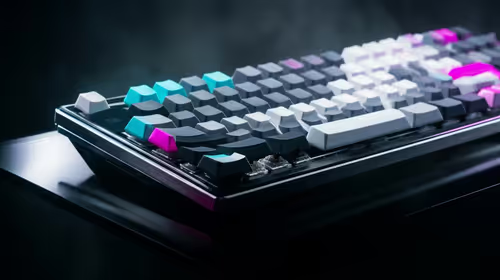
Magnetic switches are taking over SA gaming keyboards because actuation can be tuned. For Sandton gamers, rapid trigger, reset control, and profile depth can help, but layout, key feel, and software quality still matter.
Read more
Polokwane oled monitor value questions need cautious SA context because pricing can move with availability, exchange rates, specs, and warranty support. Treat the trend as a planning signal, not a fixed price promise.
Read more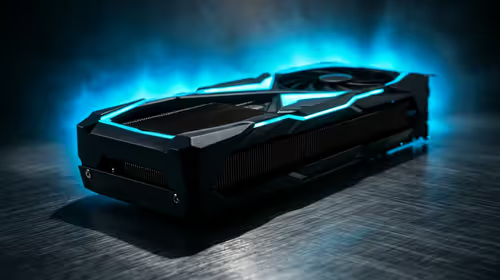
Arc B580 budget builds for Midrand gamers can shift with exchange rates, supply, specs, and model tier. Treat the title as a buying prompt, then compare SA warranty, timing, and build priorities.
Read more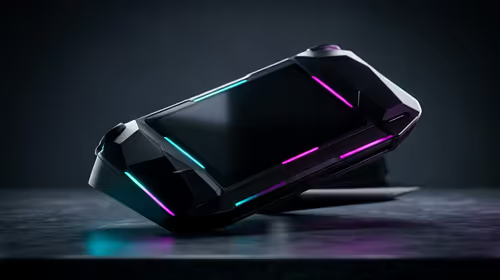
ROG Ally X may beat the LCD Steam Deck for SA gamers who value stronger handheld performance, more memory, and Windows flexibility. Compare battery life, controls, game libraries, and Polokwane support needs before deciding.
Read more
Minisforum's M2 Pro pairs Core Ultra X7, Arc B390 graphics and 32GB onboard memory in 1.8 litres. SA buyers should weigh its fixed memory and $1,439 launch offer against local mini PCs.

Lenovo says Legion Go failures linked to BIOS N3CN42WW are not user error. Affected SA owners should stop retrying the update, preserve proof and open a support case.

Smart monitors can add apps and convenience, but they also add privacy settings and unwanted-software risk. SA buyers should audit the operating system before paying for extras.

A fake 113GB GTA VI ISO reportedly used empty padding around a small malware payload. SA gamers should delete unofficial builds, keep Windows security active and wait for official channels.

ASUS calls the ROG GT-BN98 the first Wi-Fi 8 gaming router. SA buyers should fix coverage and client limits before paying for a future wireless standard.

Apple's M6 Mac mini adds faster AI, graphics and networking in the same compact format. SA buyers should wait for a rand listing before comparing value.

The Vulcan II XP adds hot-swappable switches, sound damping and gaming controls to a full-size wired board. SA buyers should compare feel before features.

Microsoft says Windows on Arm now has over 7,000 verified apps and games. SA buyers should still check each driver, game and work tool before switching.
550W for RTX 5080 Super needs a full-build check, not a simple yes. Review GPU guidance, CPU draw, transient load, connectors, PSU quality, and upgrade plans before deciding.
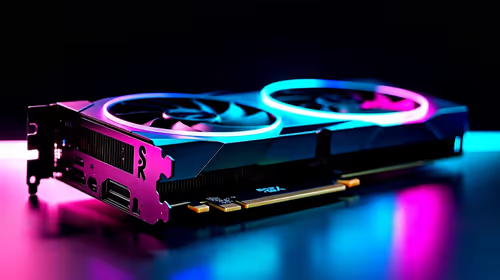
Skyrim HD texture packs that actually run on RX 9070 helps SA readers plan hardware, settings, compatibility, and upgrade trade-offs. Check GPU, CPU, RAM, storage, monitor, and stability needs without risky performance claims.
8000Hz polling is overrated for most SA gamers because gains can be tiny next to battery drain and monitor limits. Mbombela players should weigh mouse feel, game support, and system stability before chasing the number.

Wi-Fi 7 or Wi-Fi 6e for streaming on twitch and youtube should be judged by fit, not a single winner. Compare compatibility, latency, capacity, upgrade path, cost planning, and South African setup needs.