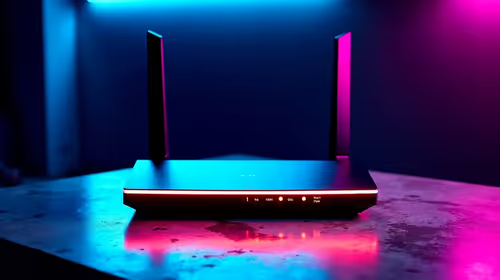
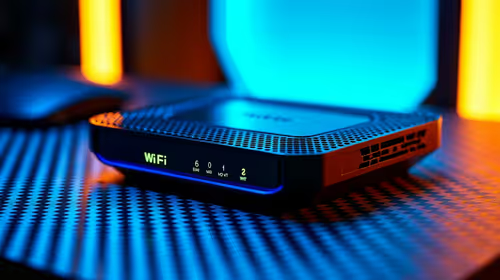
A modern home is not short on Wi-Fi speed so much as short on calm. Smart plugs, sensors, doorbells, a couple of streaming sticks, phones, headsets, and a laptop all fight for the same airtime, and the network gets flaky long before it gets slow. Wi-Fi 8 is being designed around exactly that problem, aiming to keep dozens of devices reliably connected in a crowded home rather than chasing a bigger peak speed number.
Quick Answer
Wi-Fi 8, the IEEE 802.11bn standard, targets reliability in dense, congested environments rather than raw speed. Its theoretical top rate stays around 23Gbps, the same as Wi-Fi 7, but it adds features built to keep many devices stable at once. Certification is expected around 2028, so products are still a few years out. In the meantime you can plan your network with current gear from the networking range at Evetech.
Reliability, not a bigger speed number
This is the headline shift. Wi-Fi 8 keeps the same maximum channel width, the same top modulation, and the same roughly 23Gbps theoretical ceiling as Wi-Fi 7. The official focus is Ultra High Reliability, which is the engineering goal of delivering wired-like stability even when the airwaves are crowded and devices are moving around. The standard is explicitly about making the connection dependable in tough conditions, not about a faster headline figure.
That matters because most homes already have more speed than they use. The frustration is not the download rate, it is the smart bulb that lags, the video call that stutters when someone else streams, and the sensor that drops off the network. Wi-Fi 8 is aimed at those failures.
Why device density is the real target
The number of connected devices is climbing fast, with industry projections putting active IoT devices well past 40 billion within the next decade. A single household contributes a growing share of that: lights, plugs, cameras, speakers, wearables, and headsets all want airtime on the same router. Past a certain point the issue is no longer how fast any one device can go, but how many can stay reliably connected at once without interfering with each other.
Wi-Fi 8 attacks this with coordination features rather than brute speed. Multiple access points can work together instead of competing, resources are shared more cleverly across devices, latency is trimmed for responsiveness, and power is managed dynamically so battery devices behave better. The combined effect is a network that holds steady when 30 or more connections are live at the same time, which is precisely where today's busy smart homes start to wobble.
When it arrives, and what to do now
The standard is on track to be finalised around 2028, with broad consumer availability expected to follow after that. In practical terms, you will not be buying a Wi-Fi 8 router for a while yet, and the first products will carry an early-adopter premium when they do land.
The sensible move for a busy smart home today is to build on a strong current foundation. A capable Wi-Fi 7 setup already supports operating across multiple bands at once for better stability, and pairing it with multi-gig wiring where it counts gives you a base that carries forward cleanly. If your home is packed with devices and you are feeling the strain now, current-generation gear from the best-selling accessories and the wider networking lineup solves the problem today, while leaving you well placed for the Wi-Fi 8 transition later.
Frequently Asked Questions
Is Wi-Fi 8 faster than Wi-Fi 7?
Not meaningfully. The theoretical top speed stays around 23Gbps, the same as Wi-Fi 7. Wi-Fi 8 focuses on reliability and handling many devices at once rather than raising peak throughput.
When will Wi-Fi 8 products be available?
The standard is expected to be certified around 2028, with consumer products following after that. So Wi-Fi 8 routers are still a few years away from store shelves.
How many devices is Wi-Fi 8 built for?
It is designed for dense environments where dozens of connections run at once, the kind of home with 30 or more simultaneous devices across IoT, streaming, and wearables. That density is its main target.
Should I wait for Wi-Fi 8 to fix my crowded network?
No. Wi-Fi 8 is years out, and a current Wi-Fi 7 setup already improves stability in a busy home today. Building on strong current gear now gives you a foundation that carries into the Wi-Fi 8 era.
Got a home full of devices fighting for airtime? Browse current routers and mesh gear in the Evetech networking range to steady your network now and set up cleanly for what comes next.