


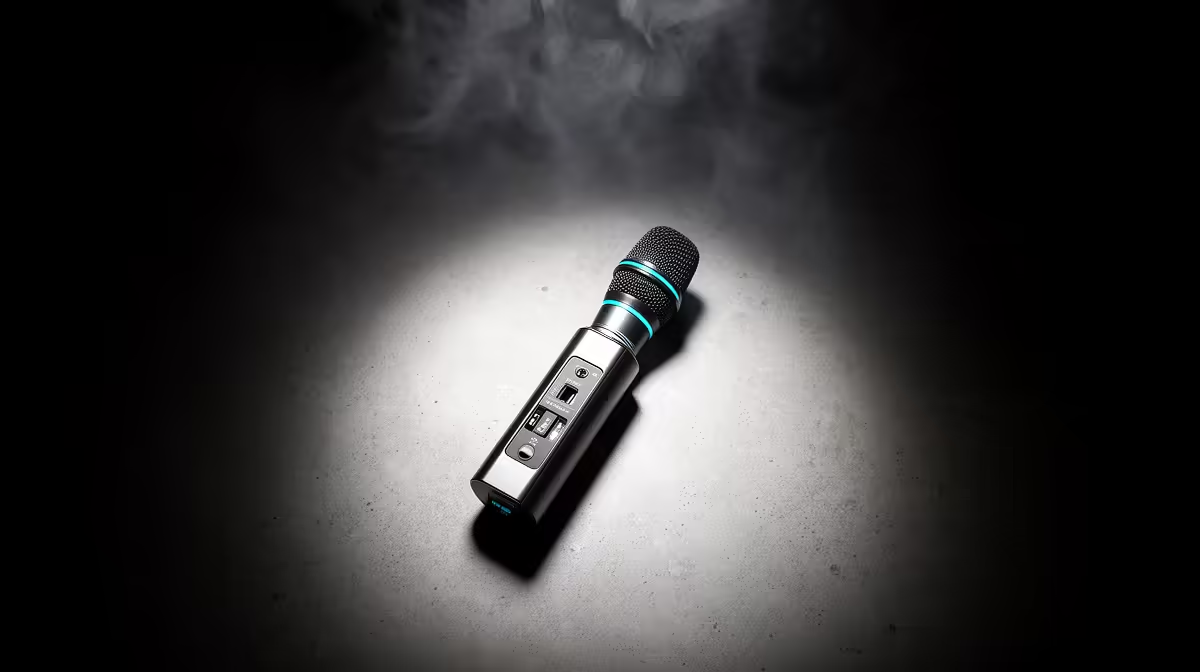
Every wireless microphone box carries a range figure, and almost every buyer discovers it means less on the actual shoot than the packaging implied. Wireless microphone transmission range is not a guarantee. It is a best-case distance measured in conditions that rarely match the rooms, bodies, and competing signals of a real environment.
Quick Answer
The quoted range is a clear line-of-sight measurement taken in open air with no obstacles. Walls, human bodies, and Wi-Fi congestion typically reduce that figure to between 30 and 50 percent of the stated maximum in indoor locations. Buy for the buffer, not the ceiling.
📡 What the Box Number Actually Measures
Manufacturers test transmission range outdoors, with the transmitter and receiver at the same height and nothing between them. That setup removes every variable that degrades real-world wireless performance. The resulting figure is the absolute upper limit the hardware is capable of under ideal physics, which is a useful comparison between products but not a prediction of what you will experience on set.
The number is still meaningful. A unit rated at 200m will consistently outperform a 50m-rated unit in identical conditions because the underlying radio hardware is more powerful. The ceiling tells you about relative capability. It does not tell you what percentage of that ceiling you will reach on a specific shoot.
🔧 The Obstacles That Cut Real Range
Walls are the most predictable attenuator. A single interior plasterboard wall takes a measurable slice off a 2.4GHz signal. A concrete or brick wall, common in older Cape Town and Joburg buildings, takes substantially more. Venues with multiple rooms between the presenter and camera can reduce a 200m-rated system to an effective 40m link through structural material alone.
Human bodies are the variable most people underestimate. At 2.4GHz, the water content in a person's torso absorbs signal efficiently. A single person standing directly between the transmitter and receiver creates a meaningful drop. A crowd of twenty people between them can cut usable range by more than half. This is why outdoor events with an audience often perform worse than indoor conference rooms with fewer bodies in the path.
Competing radio traffic adds a third layer. A venue running Wi-Fi routers, Bluetooth speakers, and multiple wireless mic systems simultaneously creates interference that degrades signal stability even before physical obstacles enter the equation. Consumer 2.4GHz bands are particularly crowded at venues where many devices are active at once.
🎯 How to Recover Lost Range on a Real Shoot
Antenna position is the first and cheapest fix. Keeping the receiver antenna vertical, unobstructed, and elevated to chest or head height rather than buried behind a camera bag recovers a meaningful portion of the range lost to poor placement.
Keep the transmitter antenna clear of the speaker's body too. A unit clipped to a collar with the antenna pointing upward transmits more efficiently than one tucked under a jacket. Walking planned shooting positions before an event and noting where the signal meter dips gives you a map of the problem zones before a take is at risk.
Frequently Asked Questions
Why does a 200m wireless system only reach 60m inside a venue?
Indoor environments strip away every condition that produced the 200m test figure. Walls, bodies, and competing Wi-Fi combine to reduce usable distance well below the open-air measurement. A 200m-rated system at 60m still has range headroom; a 100m-rated unit in the same space may already be at its practical limit.
Does the frequency band change how far the signal travels?
Yes, different bands behave differently in practical environments. The 2.4GHz band reaches well in open space but is absorbed strongly by water and competes with most consumer Wi-Fi. Some proprietary wireless systems use dedicated UHF bands that travel differently through material and face less consumer interference, though they may require licensing in South Africa for certain frequencies. Check the relevant ICASA regulations for broadcast use at events.
Can I improve range by repositioning the receiver?
Meaningfully, yes. Elevating the receiver above obstructions, keeping its antenna vertical, and pointing it toward the transmitter can recover 20 to 40 percent of distance lost to poor placement. A receiver sitting on the ground behind a camera bag is surrendering range for no reason. Small position changes often produce the clearest signal improvement available without changing hardware.
Is the quoted range ever achieved in practice?
On open ground with no obstructions, little competing radio traffic, and both antennas correctly oriented, rated range figures are generally accurate. Outdoor video shoots in open South African landscapes, game drives, or open-air sports events can approach the rated distance if those conditions are met. Enclosed venues almost never replicate the test environment closely enough to reach the ceiling.
Ready to choose a wireless mic system that holds its link where you actually shoot? Browse the wireless microphone range at Evetech and find a system with the range headroom to stay clean in every indoor and outdoor location on your schedule.










