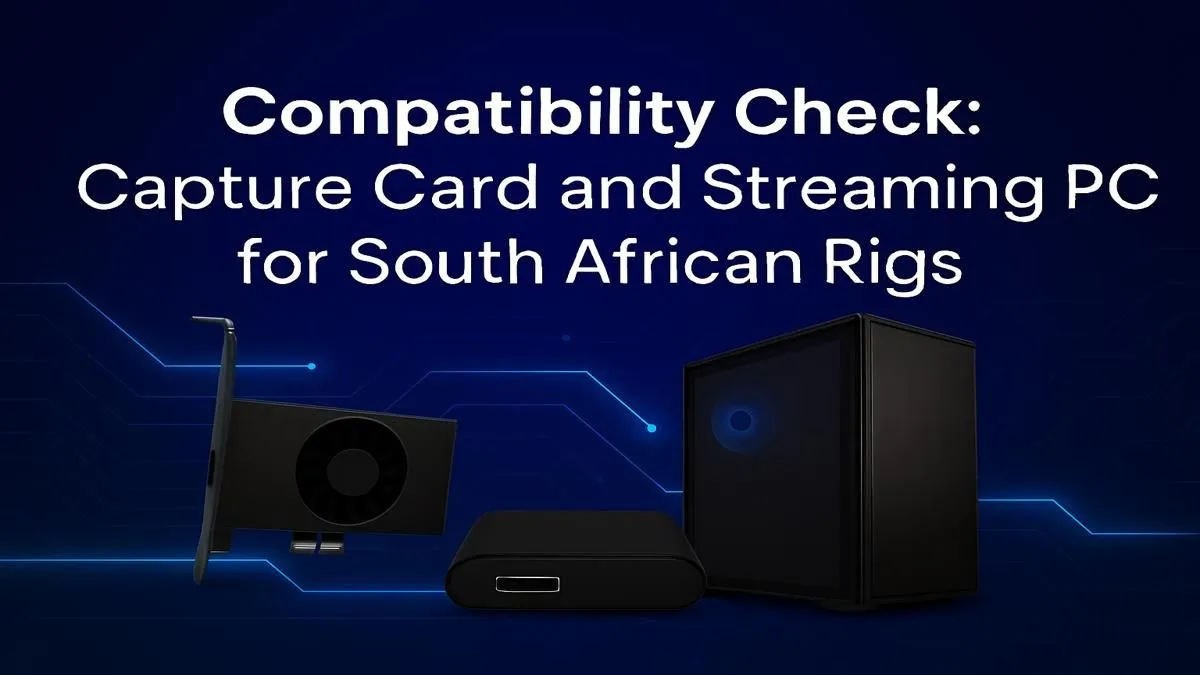
You're in the final circle, victory is moments away... and your stream starts dropping frames. Your viewers see a slideshow, and your PC groans under the load. For any serious South African streamer, this is the ultimate frustration. It sparks the big debate: what’s the smarter upgrade for flawless content creation? Is it a high-end capture card, or is it time to invest in a dedicated streaming PC for the best long-term value? Let's break it down.
Understanding the Capture Card Approach
A capture card is a piece of hardware that plugs into your gaming PC (internally via PCIe or externally via USB). Its main job is to capture your gameplay video and audio feed, compressing it so your CPU can more easily handle the task of encoding it for platforms like Twitch or YouTube.
Think of it as a helpful assistant. It takes some of the video-capturing workload off your graphics card, but the heavy lifting of encoding—the process that bundles your stream for the internet—still falls on your computer's processor.
Pros and Cons of a Capture Card
For many streamers, a capture card is the logical first step. It's a significant improvement over using software-only capture (like OBS Game Capture) on a mid-range machine.
- The Good: It's a more affordable initial investment than a second PC. It helps reduce in-game stuttering caused by GPU overload during capture.
- The Catch: It doesn't eliminate the strain on your CPU. If you're playing a CPU-intensive game like Warzone or Valorant, your processor is still doing double duty: running the game and encoding your stream. This can still lead to dropped frames, especially if you're aiming for high-quality 1080p 60fps output. It’s a great solution if you already have one of these powerful gaming PCs under R20k and just need a little boost.
Leveling Up: The Dedicated Streaming PC Setup 🚀
This is the setup you see the pros use. A dual-PC configuration involves using two separate computers: one is your dedicated gaming rig, optimised for maximum frames and zero compromise, and the second is a dedicated streaming PC.
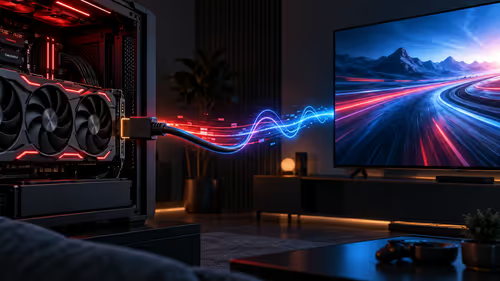
The gaming PC runs the game and nothing else. Its video output is sent (usually via a capture card installed in the second PC) to the streaming rig. This second PC handles 100% of the streaming workload: encoding the video, running OBS with all your scenes and alerts, managing chat, and sending the final, polished broadcast to the internet.
The True Value of a Two-PC Stream
The benefit is simple and profound: absolute separation of tasks. Your gaming PC is free to deliver the highest performance possible, ensuring your gameplay is buttery smooth. Your streaming PC can then use its CPU resources to encode the stream at a much higher quality (like the coveted x264 'Slow' preset in OBS) without ever impacting your game.
This is the ultimate solution for quality and reliability. Building a second PC doesn't have to break the bank either; many of our pre-built PC deals provide incredible value and are perfect for the job.
Capture Card vs Streaming PC: The South African Showdown
So, how do you decide? The "Capture Card vs Streaming PC South Africa" debate really comes down to three things: performance impact, quality ceiling, and long-term ambition.
Performance & Quality
With a single PC and a capture card, you're always balancing game performance against stream quality. To get a smoother stream, you might have to lower your in-game settings. To get better frames in-game, you might have to lower your stream's bitrate or encoding quality.
With a dedicated streaming PC, there is no compromise. You can run your game on Ultra settings while simultaneously streaming at the highest fidelity your internet connection can handle. This is because the encoding load is completely offloaded. Whether you're running on high-performance Intel gaming PCs or prefer the multi-core power of versatile AMD Ryzen builds, dedicating it solely to gaming unlocks its full potential. ✨
Pro Streamer Tip ⚡
Before buying a capture card for a two-PC setup, try NDI (Network Device Interface). It's a free software tool that sends your gameplay feed over your local network to your streaming PC. While a capture card offers the most stable, high-fidelity connection, NDI is a fantastic, no-cost way to test the waters of a dual-PC setup and see the performance benefits for yourself!
Cost & Long-Term Value
A top-tier internal capture card can cost several thousand Rand. While a second PC is obviously more expensive, it's a far more versatile and future-proof investment. It's not just a streaming machine; it can be a video editing workhorse, a server for your friends, or a backup PC. As you grow your channel, the flexibility of a second PC becomes invaluable. It allows you to create more complex productions without ever worrying about your game's performance.
Which Upgrade Path Is Right For You?
Choosing between a capture card and a dedicated streaming PC in South Africa depends entirely on your goals.
Go for a Capture Card if:
- You're a hobbyist or just starting your streaming journey.
- You have a powerful, modern single PC (e.g., a recent Core i7/Ryzen 7 or better).
- Your budget is your primary concern right now.
Invest in a Dedicated Streaming PC if:
- You are serious about content creation and plan to grow your channel.
- You refuse to compromise on either your in-game performance or your stream quality.
- You see streaming as a long-term investment and want a setup that will grow with you.
Ultimately, a capture card is a fantastic tool for enhancing a single-PC setup. But a dedicated streaming PC is a statement of intent—it's the foundation for building a professional, high-quality broadcast.
Ready to Build Your Streaming Empire? The capture card vs streaming PC debate comes down to your ambition. For ultimate quality and zero performance loss, a dedicated streaming rig is the professional's choice. Explore our massive range of PC deals and find the perfect machine to power your stream.