Tired of the cable spaghetti behind your desk? That tangled mess is not just ugly… it’s a productivity killer. For South African professionals and gamers with multi-monitor setups, there’s a cleaner, smarter way to connect your screens. It’s called a DisplayPort daisy chain, and it’s the ultimate trick for a minimalist workspace. This guide will show you exactly how to achieve that one-cable dream.
What is a DisplayPort Daisy Chain?
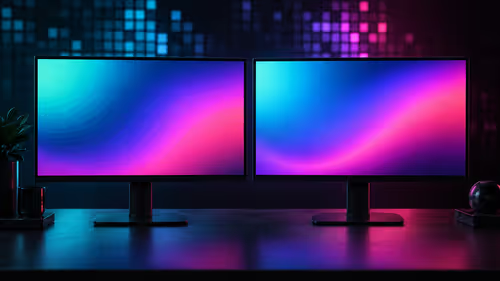
Simply put, a DisplayPort daisy chain lets you connect multiple monitors using a single cable from your PC. Instead of running a separate cable from your graphics card to each screen, you run one cable to the first monitor, and then a second cable from the first monitor to the second, and so on.
The magic behind this is a technology called Multi-Stream Transport (MST), a feature built into the DisplayPort 1.2 standard and newer versions. MST allows a single DisplayPort connection to carry multiple independent video streams to different displays. It’s a beautifully simple solution to a very common problem.
The Big Benefits of Daisy Chaining Your Monitors
Why bother setting up a DisplayPort daisy chain? The advantages go beyond just looking neat.
- Minimal Cable Clutter: This is the most obvious win. Fewer cables running from your PC means a cleaner desk, better airflow, and easier cable management. ✨
- Frees Up GPU Ports: Most graphics cards have a limited number of video outputs. Daisy chaining uses only one DisplayPort on your GPU, leaving the others free for a VR headset, a dedicated streaming monitor, or other peripherals.
- Simplified Setup: Connecting and disconnecting your laptop or PC is much easier when you only have to worry about a single video cable.
What You'll Need to Get Started 🔧
Before you start unplugging things, you need to make sure your gear is ready for a DisplayPort daisy chain. There are three key requirements.
1. A Compatible Graphics Card & PC
Your PC's graphics card (or integrated graphics) must support DisplayPort 1.2 or a newer version, and it must support Multi-Stream Transport (MST). The good news is that most graphics cards and laptops released in the last several years already have this built-in.
2. The Right Kind of Monitors
This is the most crucial part. Not all monitors can be daisy-chained. To make it work, your monitors (except for the very last one in the chain) must have both a DisplayPort input and a DisplayPort output. The DP-Out port is the key. When shopping, look for "MST" or "Daisy Chain" support in the specifications. Whether you're after stunning 4K monitors for creative work or immersive curved monitors for better focus, always check for that DP-Out port.
3. Quality DisplayPort Cables
Don't let a cheap cable be your weak link. A poor-quality cable can cause flickering, signal loss, or prevent the daisy chain from working at all. Invest in certified DisplayPort cables and other quality monitor accessories to ensure a stable connection.
Check the Specs Before You Buy! ⚡
When browsing for a new monitor, always look at the detailed specifications for "DisplayPort Out" or "MST Support". It's usually listed under the 'Connectivity' or 'Ports' section. A few minutes of checking can save you a huge headache later.
How to Set Up Your DisplayPort Daisy Chain
Got all the right gear? Awesome. Setting up is straightforward.
- Connect PC to Monitor 1: Plug a DisplayPort cable from your computer's DisplayPort output into the DisplayPort input on your first monitor.
- Connect Monitor 1 to Monitor 2: Plug a second DisplayPort cable into the DisplayPort output of the first monitor and connect the other end to the DisplayPort input of your second monitor.
- Enable MST on Your Monitor: On your first monitor, go into the On-Screen Display (OSD) menu. Find the setting for "DisplayPort 1.2," "MST," or "Daisy Chain" and make sure it is enabled or turned on. This tells the monitor to pass the video signal along to the next screen.
- Configure in Your OS: Your computer should now detect all the connected monitors. Go to your display settings in Windows or macOS to arrange them and set your preferred resolutions.
Are There Any Limitations?
A DisplayPort daisy chain is fantastic, but it's not without limits. The main constraint is bandwidth. A single DisplayPort 1.2 connection has enough bandwidth for two 1440p monitors at 60Hz or four 1080p monitors. However, if you're trying to chain multiple high-refresh-rate gaming monitors or 4K screens, you might have to lower the refresh rate or resolution. For the absolute best performance in competitive gaming, a direct connection from the GPU to each monitor is still king. 🚀
Is a DisplayPort Daisy Chain Right for You?
If your goal is maximum productivity with a clean, professional desk setup, the answer is a resounding yes. It’s perfect for developers, designers, office workers, and anyone who juggles multiple applications. It creates a seamless, multi-screen workspace without the usual cable chaos. While it might not be the top choice for elite gamers, it's a far more elegant solution for a fixed workstation than relying on a portable monitor for extra screen real estate.
Ultimately, decluttering your workspace can seriously boost your focus and productivity. If you're ready to make the switch, it's a great time to check out our latest monitor deals and find the perfect MST-enabled screens for your setup.
Ready to Build Your Ultimate Workspace? A DisplayPort daisy chain is the secret to a powerful and pristine multi-monitor setup. Explore our massive range of PC monitors and find the perfect MST-compatible screens to conquer your workflow.