Quick Answer
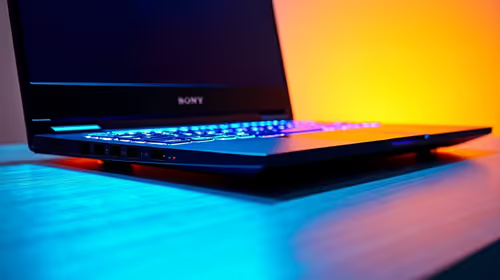
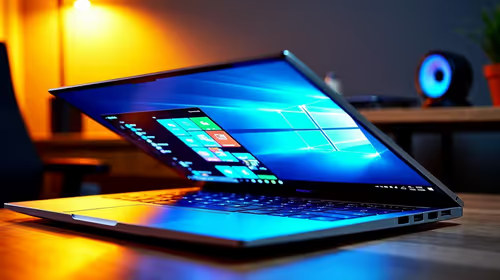
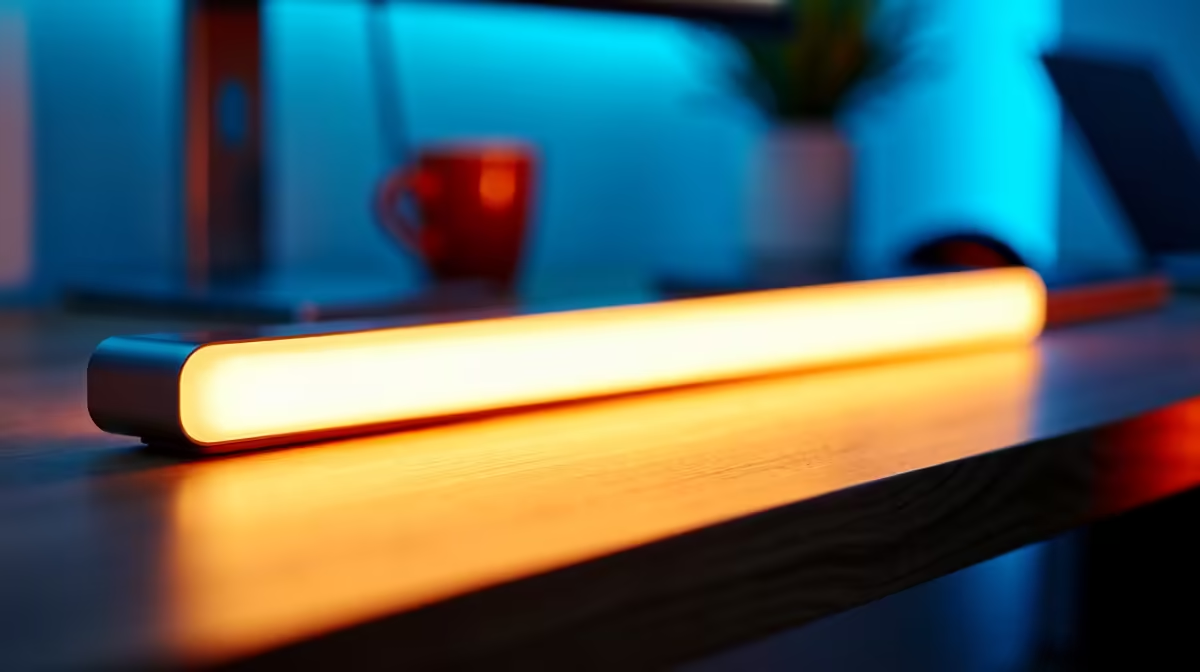
The Glowbar is an illuminated strip on the exterior of every Googlebook laptop. It lights up when the device powers on and serves as Google's unified hardware identity across all five OEM partners (Acer, ASUS, Dell, HP, Lenovo). It's the Googlebook equivalent of Apple's glowing logo era - a deliberate brand signature designed to make Googlebooks instantly recognisable.
What Is the Glowbar?
The Glowbar is a horizontal lit strip integrated into the lid (exterior) of every Googlebook. When you power on a Googlebook, the strip illuminates - providing both a functional power indicator and a visual brand mark.
Google has mandated the Glowbar as part of the Googlebook design specification. Every OEM must include it. Acer, ASUS, Dell, HP and Lenovo all signed on to the requirement, even though it constrains their industrial design freedom.
Why Google Insisted on It
Three strategic reasons:
1. Brand Recognition Across OEMs
Google is not building Googlebook hardware itself. With five OEMs producing devices in different shapes, sizes and price points, there's a real risk that no two Googlebooks look like Googlebooks - they just look like a Dell, an HP, an ASUS.
The Glowbar solves that. From across a coffee shop, cafe or boardroom, you'll be able to spot a Googlebook. That visual consistency is what made the glowing Apple logo era so powerful for Mac.
2. Signalling "AI Inside"
The Glowbar isn't decoration. It's signalling: this laptop is alive, this laptop has Gemini. When you open a Googlebook in public, the Glowbar communicates that the user has chosen the AI-first platform.
This is identical to how the glowing Apple logo communicated creative professional in the 2000s, or how the Intel Inside sticker communicated premium silicon in the 90s. Brand semiotics.
3. Premium Positioning
Budget laptops don't have signature lights. The Glowbar - by virtue of being a deliberate, polished design element - pushes every Googlebook into premium territory. That's consistent with Google's broader Googlebook pricing strategy.
What We Know About How It Works
Google has not released the technical specification publicly, but based on the announcement coverage:
- Lights up at boot
- May indicate Gemini activity (rumoured, not confirmed)
- May indicate notifications or AI-driven events (rumoured, not confirmed)
- Possibly customisable colour/animation (unconfirmed)
- Energy-efficient implementation (no significant battery impact)
As of writing, Google has not detailed exactly when and how the Glowbar lights up beyond the boot sequence.
OEM Implementation Differences
While every Googlebook has a Glowbar, OEMs will likely differ in placement and finish:
- Acer / ASUS may experiment with bolder colour treatments
- Lenovo will likely take a restrained ThinkPad-style approach
- Dell will fit it to the XPS-style understated industrial design
- HP sits in the middle
We'll know more as individual models are revealed closer to launch.
Is the Glowbar a Good Idea?
Arguments for:
- Strong brand differentiation in a sea of similar-looking laptops
- Functional secondary display potential (notifications, AI activity)
- Helps Google retail strategy - products that look distinctive sell better
Arguments against:
- Some users find lit branding cheap or distracting
- Apple itself dropped the glowing logo in 2015 for a reason (battery, structural)
- Locks all OEMs into a design constraint
- Could feel gimmicky if not implemented well
Our take: It depends entirely on execution. A subtle, well-implemented Glowbar - like a thin amber line that softly pulses with Gemini activity - could become an icon. A garish RGB strip would feel like a 2015 gaming laptop. Google's choice of OEMs (none of them are RGB-first brands) suggests the subtle direction.
What This Tells Us About Googlebook's Strategy
The Glowbar is a small detail, but it reveals a big strategic decision: Google is taking back design authority from OEMs.
For the past decade, Google let OEMs do whatever they wanted with ChromeOS hardware. The result was a fragmented, inconsistent Chromebook lineup. With Googlebook, Google is enforcing design language at the platform level - and the Glowbar is the first proof point.
This is closer to the iPhone/Mac model than the Android model. It's a meaningful shift.
The Bottom Line
The Glowbar is a small thing that says a big thing: Google is building a coherent laptop brand, not just an OS. Whether it becomes iconic or forgettable will depend on how the first wave of Googlebooks executes it. But the intent - visual unity across five OEMs, premium signalling, AI-presence indicator - is clearly thought through.
We'll have hands-on impressions of every Glowbar implementation when first review units land at EveZone.
Frequently Asked Questions
What is the Glowbar on a Googlebook?
The Glowbar is an illuminated horizontal strip on the exterior lid of every Googlebook laptop. It lights up when the device powers on, serving as both a functional indicator and Google's unified visual identity across all five OEM partners.
Will every Googlebook have a Glowbar?
Yes. Google has mandated the Glowbar as part of the Googlebook design specification. All confirmed OEM partners (Acer, ASUS, Dell, HP and Lenovo) have agreed to include it on their Googlebook models.
Can I turn off the Glowbar?
Google has not confirmed customisation options for the Glowbar at launch. It is expected to light up at minimum during boot, but on-off control and brightness settings have not been publicly detailed.
Final Take
Googlebook Glowbar is worth tracking, but buyers should wait for official model specifications, confirmed SA availability and Rand pricing before making a platform decision.
Compare current AI-ready laptop options while Googlebook availability is still pending: https://www.evetech.co.za/ai-laptop-finder