1000R vs 1500R vs 1800R: Monitor Curve Radius Explained
Quick Answer
The R number is the radius of the circle the screen curve follows, measured in millimetres. A 1000R monitor follows a tighter one-metre radius, while 1800R is a gentler 1.8-metre curve.
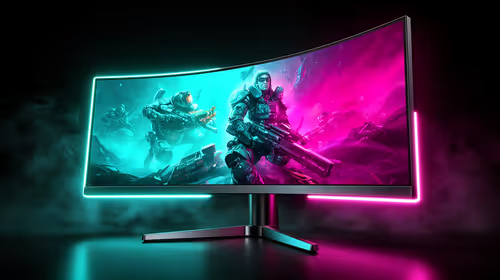
Choose radius from width, viewing distance and work. A tight curve can wrap a 49-inch ultrawide around one central viewer. The same 1000R curve on a smaller screen can feel more obvious than useful.
Curve does not add frame rate or reduce input lag. It changes geometry and how consistently the edges face you.
Step 1: Picture the Circle
Imagine extending the panel until it forms a full circle. The stated radius describes the distance from that circle's centre to its edge.
Lower number means tighter bend. Higher number means flatter.
The rating does not tell you screen size, aspect ratio or how much the physical edges move towards you. You need all three.
Step 2: Compare 1000R
One thousand R is an aggressive common gaming curve. It can make a wide VA panel's edges face a central viewer more directly.
On a large ultrawide, it fills peripheral vision and keeps edge distance under control. On a 27-inch panel, some buyers find the bend unnecessary.
Sit near the intended distance and check whether the curve feels enveloping or bent. Preference matters.
Step 3: Compare 1500R
Fifteen hundred R sits between strong immersion and gentle everyday use. It appears across 27-inch, 32-inch and ultrawide gaming monitors.
The curve remains visible without wrapping as sharply as 1000R. It can suit a desk used for games and ordinary documents.
Panel width changes the effect. A 34-inch 1500R ultrawide shows more physical arc than a narrower screen with the same radius.
Step 4: Compare 1800R
Eighteen hundred R is gentler and can disappear from attention after a short adjustment. It suits buyers who want some edge wrap without a strong cockpit effect.
On an ultrawide, it keeps the format comfortable while preserving a flatter-looking desktop. On a small panel, the difference from flat can be modest.
It is not an inferior curve. It serves another room, screen and preference.
Step 5: Match Viewing Distance
The radius gives a geometric reference, not a compulsory seating distance. Sitting near the nominal radius can make edge distance feel balanced.
Move too close and a large screen fills too much of your vision. Move too far and the curve adds little.
Start from a comfortable screen-size distance, then adjust until text and corners are easy to see without head movement.
Step 6: Account for Aspect Ratio
A 16:9 27-inch monitor is much narrower than a 21:9 34-inch or 32:9 49-inch screen. Curve brings greater value as width grows.
Ultrawide edges can sit far from your eyes on a flat panel. A suitable curve turns them in.
For competitive 16:9 gaming, many players prefer flat because the whole screen already fits a compact view.
Step 7: Check Panel Type
VA viewing angles can shift contrast and colour towards wide edges. Curve helps keep more of the panel facing you.
IPS has broader viewing consistency and needs curve less for that reason. Curved IPS still adds immersion and edge-distance control.
OLED ultrawides use curve for format and immersion rather than correcting an LCD backlight limitation.
Step 8: Consider Design Work
The panel displays straight digital lines as straight; the physical surface bends their path relative to your eyes. Designers can perceive geometry differently on a strong curve.
For CAD, layout or architecture, test straight lines and grids. A flat secondary screen can serve final geometry checks.
For coding and timelines, a curve can keep wide columns easier to see. Work type decides the trade.
Step 9: Measure the Desk
Curved monitors can have deep stands. Measure from the wall to the front feet and to the centre of the panel.
The edges project forward and can collide with speakers or a second screen. A VESA arm needs the correct weight and curve support.
Check how far the monitor can sit from your eyes after the keyboard and mouse are placed.
Step 10: Compare Exact Screens
Browse current curved and flat monitors and compare popular display choices.
Shortlist the same size and resolution in two curve radii. Check physical depth, response, contrast and stand adjustment.
Do not pay for a curve while accepting a weaker panel. The image and motion remain more important.
Step 11: Run a Simple Viewing Test
Open a wide game, spreadsheet and grid. Sit at your normal distance and look from centre to corners.
Check whether the edges feel closer, whether reflections change and whether straight work feels comfortable.
Give yourself a day to adapt. Reject a curve that still draws attention after the content should have taken over.
FAQ
What does the R number mean?
It is the curve's radius in millimetres. Lower numbers describe tighter curves.
Is 1000R the tightest available?
It is a common aggressive option, but product ranges can include other radii. Check the exact model.
Does a bigger screen need a tighter curve?
Wider screens gain more from edge wrap, but the preferred radius still depends on distance and use.
Can 1800R suit 27 inches?
Yes. It creates a gentle effect that some buyers prefer over a stronger bend.
Does curve improve gaming performance?
No direct frame-rate or latency gain exists. It changes immersion, edge distance and viewing geometry.
Measure panel width and viewing distance, then compare 1000R, 1500R and 1800R with one game and one work grid before choosing.