


Stuck Pixel Checks for a Mechanical Keyboard Setup
Stuck pixel on a Mechanical Keyboard is likely a display symptom around that setup, not the part itself. Check the monitor, cable, GPU output, drivers, and warranty path first.
Read moreTop SSD Under R4000 picks evaluated on performance, value & SA availability with current Rand pricing from Evetech.

Storage prices in South Africa have dropped considerably over the past two years, and the R4,000 budget now gets you access to fast, high-capacity SSDs that were premium territory not long ago. Whether you are upgrading a gaming PC, building a student workstation, or adding storage to a laptop, there is a strong SSD available at this price point in 2026.
The best SSD under R4,000 in South Africa in 2026 is the Samsung 990 Pro 2TB for performance, or the Kingston NV3 2TB for value-focused builds. Both deliver Gen4 speeds that exceed what most gaming and productivity workloads can saturate.
The R4,000 ceiling in 2026 comfortably covers Gen4 NVMe drives up to 2TB, which is the sweet spot where price-per-gigabyte and performance intersect. Below R2,000 you are typically looking at Gen3 NVMe or high-capacity SATA options. Between R2,000 and R4,000, Gen4 NVMe drives with DRAM cache become accessible - these deliver the best sustained write performance for large file transfers and game installations.
For most users, the practical difference between the fastest Gen4 SSDs and mid-tier Gen4 options is invisible in daily use. Sequential read speeds beyond 5,000 MB/s do not translate to faster game load times in meaningful ways - the real advantage comes in sustained writes, which matter when copying large video projects or game libraries.
Browsing the full SSD range gives you current stock and pricing across the full capacity spectrum.
Samsung 990 Pro 2TB - The benchmark leader for this budget. Sequential reads of 7,450 MB/s and writes of 6,900 MB/s put it at the top of Gen4 performance. The DRAM cache ensures sustained write speeds hold up during large transfers. Samsung's reputation for long-term reliability and their consistent driver support through Magician software make this the safe premium choice. Priced in the upper half of the R4,000 budget.
WD Black SN850X 2TB - The gaming-specific alternative. WD's SN850X includes a gaming mode that prioritises low-latency random reads, which is the access pattern games use most. Heatsink variants are available and recommended for enclosures with limited airflow. Performance is essentially matched against the 990 Pro, making it a preference decision based on software ecosystem.
Kingston NV3 2TB - The value champion. Without a DRAM cache, sustained writes are slower than the Samsung or WD alternatives, but for game storage and operating system drives the real-world impact is minimal. Sequential reads hit 6,000 MB/s, which far exceeds what any game engine can utilise for loading. The cost saving over the 990 Pro is significant and better directed toward other components.
Crucial P3 Plus 2TB - A budget Gen4 option with solid everyday performance. Suitable for secondary storage drives where cost per gigabyte matters more than peak throughput. Not recommended as a primary boot drive on a high-performance build, but excellent value as a game library expansion drive.
Gen4 NVMe drives require a PCIe 4.0 compatible M.2 slot. AMD Ryzen 5000 and later, plus Intel 12th Generation and later platforms, all support Gen4. Older platforms will run Gen4 drives at Gen3 speeds - still functional, but the performance premium is wasted.
Thermal throttling is a consideration with high-performance Gen4 SSDs. If your motherboard M.2 slot lacks a heatsink, adding an aftermarket thermal pad or purchasing a heatsink-included drive variant is worthwhile for sustained workloads. Throttling rarely affects gaming, but it matters for video editing and large file copies.
For laptops, verify that your M.2 slot accepts 2280 form factor drives and supports Gen4 before purchasing. Some older laptop designs cap M.2 slots at Gen3 regardless of the drive installed.
For a primary gaming and OS drive, 1TB is the minimum comfortable capacity in 2026 given modern game install sizes. A single AAA title can occupy 100–150 GB, meaning a 1TB drive fills up with six to eight games plus the operating system. At the R4,000 budget, 2TB Gen4 options are accessible, making the capacity trade-off unnecessary.
For productivity users handling video production, the DRAM-cached drives (990 Pro, SN850X) are worth the premium because sustained write speeds directly affect render export times and large project copy speeds. Gamers and students can save by choosing the Kingston NV3 and directing the difference toward a better GPU or more RAM.
Q: Is a Gen4 SSD noticeably faster than Gen3 for gaming? A: In most gaming scenarios, the load time difference between Gen3 and Gen4 SSDs is under two seconds. The generational leap is far more impactful for content creation, large file transfers, and video editing workflows than for gaming.
Q: How long do SSDs last compared to HDDs? A: Modern SSDs from reputable brands have TBW (Terabytes Written) ratings that far exceed typical consumer use. A 2TB drive with a 1,200 TBW rating writing 100 GB per day would last over 30 years. For practical purposes, SSDs outlast most hardware refresh cycles.
Q: Can I use an SSD in an external enclosure? A: Yes. An NVMe SSD in a USB 3.2 Gen 2 or Thunderbolt enclosure gives you a fast portable drive. Note that the USB interface caps speeds regardless of the SSD's native throughput, so a Gen3 SSD in a quality enclosure performs identically to a Gen4 model through USB.
Q: Do I need to format a new SSD before use? A: New SSDs are typically unformatted. In Windows, use Disk Management to initialise the drive as GPT and format it as NTFS. For a boot drive, the Windows installer handles formatting automatically.
Upgrade with All SSDs or Graphics Card Deals — all available at Evetech with fast SA delivery.
Ready to Find Your Perfect Match? Explore relevant Evetech options, compare current South African pricing, and choose hardware that fits your setup. Shop now
Best SSD Under R4000 in South Africa 202 available at Evetech.co.za with local warranty and fast delivery.
Best SSD Under R4000 in South Africa 202 - check Evetech for latest stock and SA pricing.
Depends on your use case. Best SSD Under R4000 in South offers good value at current Rand pricing.
Stuck pixel on a Mechanical Keyboard is likely a display symptom around that setup, not the part itself. Check the monitor, cable, GPU output, drivers, and warranty path first.
Read more
How to fix stuck pixel Windows 11 USB DAC issues starts with display-only tests. Check HDR, scaling, monitor input, USB cable movement, and safe South African support options before connecting the pixel issue to audio hardware.
Read more
Windows 11 Steam Deck monitor issues often start with display mode, USB-C output, drivers, or dock power. Use this how to fix monitor not detected windows 11 steam deck checklist for SA handheld PC setups.
Read more
Stalker 2 Heart of Chornobyl PC build planning at R100,000 should stay cautious about parts and settings. Balance GPU, CPU, RAM, storage, cooling, and upgrade room before picking a South African gaming PC.
Read more
RX 9070 XT build stuttering needs a step-by-step check before replacing parts. Review drivers, settings, thermals, power, background apps, display limits, cables, and game options before changing hardware.
Read more
GTA 6 on R15,000 needs careful part balance. This SA build guide frames CPU, GPU, RAM, SSD, cooling, and upgrade trade-offs without promising live prices, stock, or exact FPS.
Read more
NVIDIA lists 550W required system power for the RTX 5060 reference specification, based on a high-end test system. A quality 550W unit can be enough, but CPU draw, transient load, connectors and ageing decide real headroom.
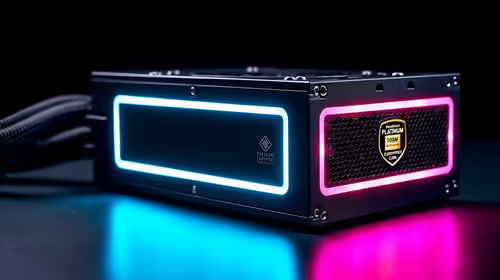
80+ Gold vs 80+ Platinum for couch co-op gaming is about PSU efficiency, heat, fan behaviour, quality, and wattage headroom, not direct FPS. SA buyers should compare the whole build.
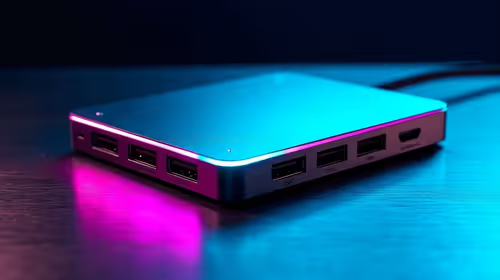
Upgrade your setup with the best USB-C hubs for creators. Discover why high-capacity card readers and dual 4K output are essential for professional South African content production. 🚀💻

B850 motherboard FPS drops needs a methodical troubleshooting pass. Review drivers, thermals, power settings, background apps, cables and game settings before replacing parts in an SA gaming setup.
NVIDIA lists 550W required system power for the RTX 5060 reference specification, based on a high-end test system. A quality 550W unit can be enough, but CPU draw, transient load, connectors and ageing decide real headroom.

OpenRGB's master branch now carries changes labelled for 1.0 final, including translation and platform work, but the official tags page still lists 1.0rc3.1 as the newest packaged release. Stable users should wait for the signed release channel.

A motherboard can remain useful for many years when power, cooling and connectors stay healthy. Replace it for confirmed faults, damaged power delivery or a blocked platform need, not simply because the calendar reaches a fixed age.
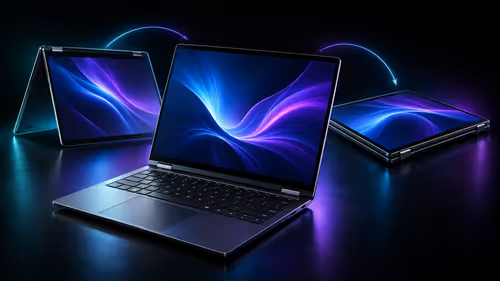
The VAIO T combines a 13.3-inch display with a multi-flip mechanism for laptop, tablet and outward-facing viewing modes. Orders begin in Japan on 18 September; South African availability is unconfirmed.

The smallest ATX case 2026 buyers should choose is the smallest chassis that still fits their exact graphics card, cooler, power supply and airflow plan. ATX support alone does not prove a case has the smallest footprint or volume.
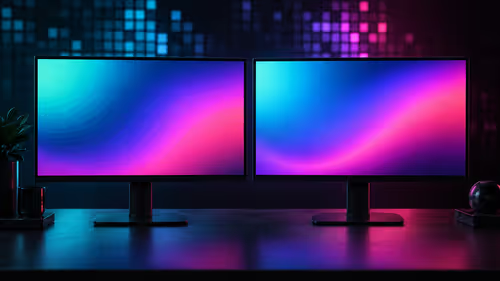
In a 6 bit + FRC vs 8 bit comparison, native 8-bit panels can produce 256 levels per colour channel directly, while 6-bit plus FRC rapidly alternates nearby values to approximate the wider palette. Panel quality still depends on more than bit depth.

The UGREEN LinkStation Pro eGPU dock combines Thunderbolt 5 and OCuLink connections with an integrated 850W ATX 3.1 power supply and up to 140W laptop charging. South African availability is unconfirmed.
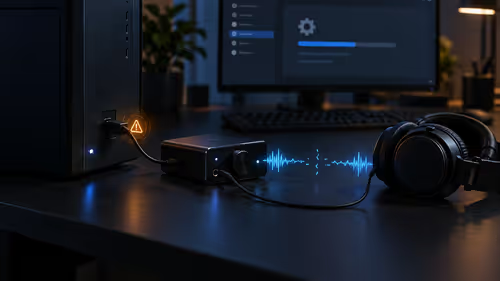
Windows 11 KB5124008 can leave some USB Audio Class 1.0 devices with no sound, Code 10 or failed multichannel output. Microsoft confirms the issue and says switching to two-channel stereo can restore audio for some users.