Quick Answer
A 240Hz rig for 3D modelling and rendering needs a strong multi-core CPU above all else — rendering in Blender, Cinema 4D, or 3ds Max is CPU/GPU compute-bound, not refresh-rate-bound. A Ryzen 9 7950X or Intel Core i9-13900K paired with an RTX 4070 and 64GB DDR5 RAM covers both high-fps esports gaming at 1080p–1440p 240Hz and professional 3D rendering, for a total build cost of around R60,000–R75,000.
Why CPU Matters More Than Monitor Refresh Rate Here
Blender CPU rendering (Cycles) scales nearly linearly with core count. A Ryzen 9 7950X (16 cores, R14,500) renders a typical product visualisation scene roughly 2.4× faster than a 6-core i5-13600K. For GPU rendering (EEVEE or Optix), the RTX 4070 12GB (R16,000) handles scenes with up to 8 million polygons without running out of VRAM — the 8GB limit on the RTX 4060 Ti can become a bottleneck on complex architectural scenes.
The 240Hz display doesn't accelerate rendering, but it does make viewport navigation in Blender feel significantly more fluid — rotating a high-poly mesh at 240fps gives real-time feedback that a 60Hz panel simply can't match.
RAM: 64GB is the Practical Floor for 3D Work
Blender, 3ds Max, and Cinema 4D all cache scene data in RAM. A 50-million-polygon scene with 4K textures can occupy 24–40GB of RAM during a render pass. Starting at 64GB DDR5-5600 eliminates out-of-memory crashes and lets you keep reference images, the 3D app, and a browser open simultaneously without paging to disk.
Storage for Render Caches
Render output (PNG sequences, EXR files) at 4K generates 100MB–200MB per frame. A 2TB PCIe 4.0 NVMe (R1,600) as the project drive and a 4TB HDD (R1,400) for completed render archives is the practical local setup for SA creators working without cloud storage.
Sample Build: ~R65,000
- CPU: Ryzen 9 7950X — ~R14,500
- Motherboard: MSI X670E CARBON WiFi — ~R6,500
- RAM: 64GB DDR5-5600 — ~R4,800
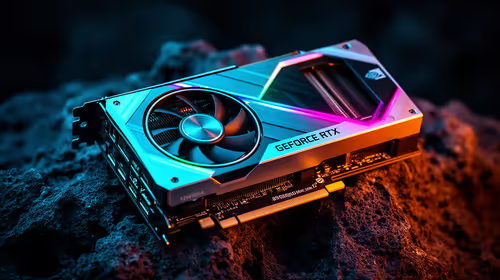
- GPU: RTX 4070 12GB — ~R16,000
- SSD: 2TB PCIe 4.0 NVMe — ~R1,600
- HDD: 4TB — ~R1,400
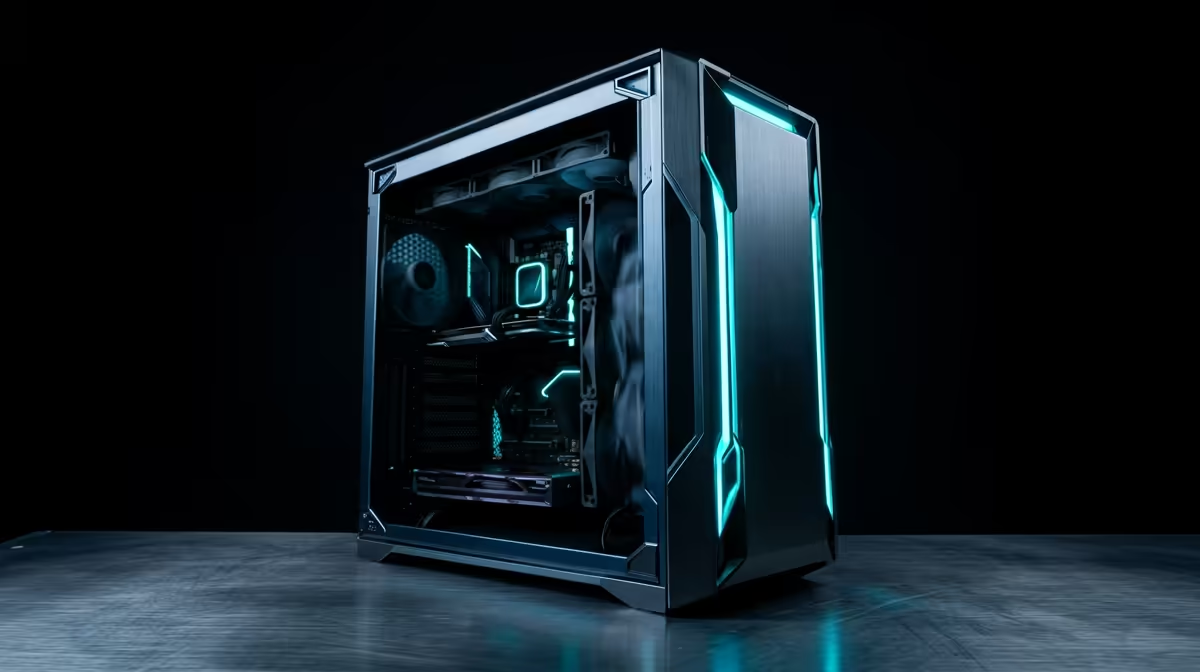
- Case + 850W 80+ Gold PSU — ~R3,800
- Monitor: 24" 1080p 240Hz IPS — ~R4,500
- Total: ~R53,100 (add R10,000 for a 1440p 240Hz display)
FAQ
Should I use GPU or CPU rendering in Blender for a 240Hz gaming rig?
Use GPU rendering (EEVEE or Optix) for interactive work and previews — it's 3–8× faster than CPU for most scenes. Switch to CPU-only for final renders of complex volumetric or hair simulations where VRAM limits the GPU.
Is 64GB RAM enough for large architectural visualisations in Revit?
For most residential and light commercial BIM projects, 64GB is sufficient. Large mixed-use developments with detailed landscaping can push into 48–60GB of working memory; 128GB is the upgrade target for that scale of work.
What's the minimum GPU VRAM for 3D modelling at a professional level?
8GB VRAM handles most mid-complexity scenes in Blender and Cinema 4D. 12GB on the RTX 4070 gives comfortable headroom for 4K texture baking and large particle simulations without splitting the scene.
enable "GPU Compute" under Render Properties → Device and check that all GPU tiles in Preferences → System are active — a common mistake is leaving the CPU tiles enabled alongside the GPU, which slows Optix renders by forcing CPU synchronisation.