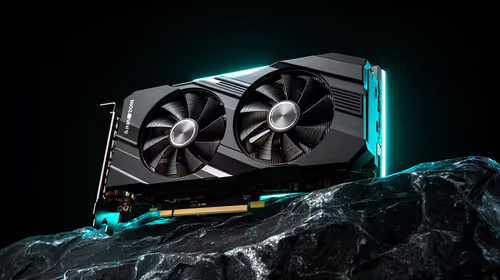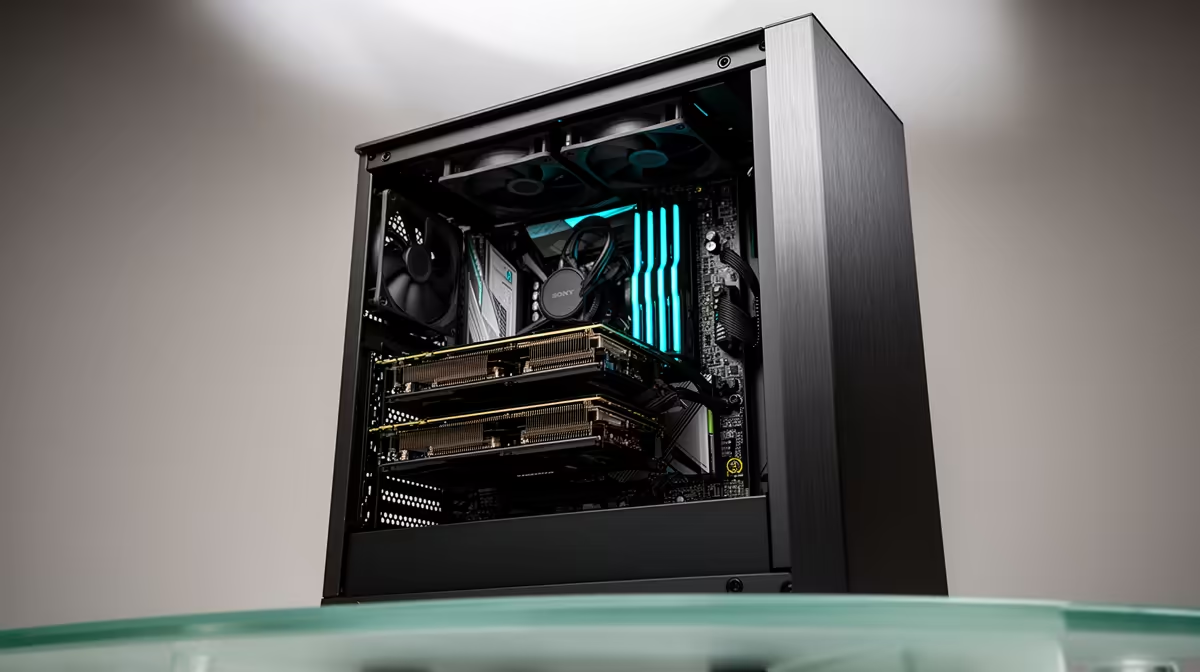
Remote creative work in South Africa comes with its own set of demands: client deadlines that do not care about local connectivity issues, deliverables that need to render or export reliably overnight, and a machine that cannot afford unplanned downtime. Building around that reality starts with the graphics card, and specifically a 24gb creator graphics card that can carry editing, rendering and the occasional AI-assisted task without becoming the weak link.
Quick Answer
A dependable remote-work creator PC needs a graphics card with enough memory to hold full timelines and render jobs without stalling, backed by adequate system RAM and fast storage to keep files moving. Building around the ASRock Pro B60 Creator at R14,399 adds 24GB of GDDR6 plus Xe2-HPG architecture, giving daily production work the headroom it needs without requiring a second machine. That combination covers editing, rendering and AI tasks from a single reliable build.
🏗️ Starting The Build With The Graphics Card
Why GPU Choice Comes Before Everything Else
For remote creative work, the graphics card determines how much of a project can be handled locally without waiting on cloud rendering or a studio connection. A 24GB GDDR6 pool means large timelines, dense 3D scenes and AI-assisted passes can all stay resident in memory rather than triggering slow reloads mid-session, which matters most when a deadline does not allow for a machine that stumbles.
Matching The Rest Of The Build To The GPU
A capable graphics card still needs enough system RAM and fast storage around it to avoid creating a different bottleneck. For remote work specifically, reliable storage speed matters as much as raw capacity, since project files, cache data and exports are constantly being written and read throughout a working day.
🌐 Reliability Considerations Specific To Remote Setups
Remote workers rarely have quick access to a technician if something goes wrong mid-project, which makes component maturity and driver support genuinely important rather than a nice-to-have. Intel's Xe2-HPG architecture, paired with DirectX 12 Ultimate compliance, keeps compatibility broad across the editing and rendering software most freelancers already rely on, reducing the chance of a driver conflict interrupting a deadline.
Handling Overnight Renders Without Supervision
A render or export left running overnight needs a system that will not silently run out of memory partway through. With 24GB on tap and a 192-bit memory bus feeding it, the card can hold an entire render job in memory rather than swapping to slower system resources unattended.
⚙️ Where XMX Engines Fit A Remote Production Workflow
Onboard XMX AI engines handle tasks like noise reduction, upscaling and generative fill separately from the card's main rendering pipeline, which is useful for remote creators who often need to compress a full production workflow, capture through export, onto one machine rather than splitting tasks across separate hardware. Running at a 2400 MHz clock, the Xe2-HPG core keeps standard rendering and playback smooth alongside whatever AI task is active.
Why This Matters More For Solo Remote Workers
Studios can sometimes split heavy AI tasks and rendering across multiple machines; a solo remote creator usually cannot. Having both handled well on one card removes a real constraint rather than a theoretical one.
Full specifications for this configuration are on this card's product page, with similar options listed in the workstation GPU shelf. Anyone wanting to compare across the brand can also check ASRock's full card range before finalising a build.
Frequently Asked Questions
What is the most important component for a remote creator PC?
The graphics card, since it directly determines how much editing, rendering and AI-assisted work can be handled locally without relying on cloud resources or a studio connection.
How much VRAM is realistic for a dependable remote build?
24GB comfortably covers most freelance and small-studio workloads, including 4K and 6K editing alongside moderate 3D rendering, without needing a second machine.
Is driver maturity a real concern for a newer architecture like Xe2-HPG?
It is worth checking, though ongoing driver updates combined with DirectX 12 Ultimate compliance already cover most current editing and rendering software reliably.
Can this build handle an overnight render without crashing?
A 24GB memory pool with a 192-bit bus is built to hold large render jobs entirely in memory, reducing the risk of a crash from running out of space unattended.
Do I still need fast storage if the graphics card is strong?
Yes, storage speed affects how quickly project files, cache data and exports move, and a strong GPU cannot compensate for slow storage creating its own separate bottleneck.
Should a remote creator plan the whole build around the GPU first?
It is a sensible starting point, since the graphics card sets the ceiling for what can be handled locally, but system RAM and storage still need to be sized to match rather than treated as an afterthought.
Ready to build a creator rig that holds up at home? Browse the Pro B60 Creator card listed in Evetech's workstation graphics selection, tagged at R14,399, built to build a creator PC reliable enough for daily remote work.