AMD's Radeon Software Adrenalin 26.8.1 release notes now list a Radeon RX 9050 4GB under new product support. That official entry confirms the model, while current product coverage reports a 64-bit memory interface and 16MB of Infinity Cache. For South African buyers, the important number is not the product name but the 4GB memory ceiling.
Quick Answer
The Radeon RX 9050 4GB is now recognised by AMD's current Windows driver. AMD also warns that Cyberpunk 2077 recommends at least 6GB of graphics memory and advises 4GB users to lower or disable memory-heavy features. No confirmed local price was available. The exact in-stock Radeon sample on 23 August started at R7,899 for an 8GB Radeon RX 9060.
🎮 Four gigabytes sets the workload boundary
Graphics memory stores textures, frame buffers, geometry data and other assets that the GPU needs quickly. When a game asks for more than the available 4GB, it must reduce quality, move data through slower system memory or stutter while assets are exchanged. The result depends on the game, resolution and settings, so the card is not automatically unusable. It does require disciplined expectations.
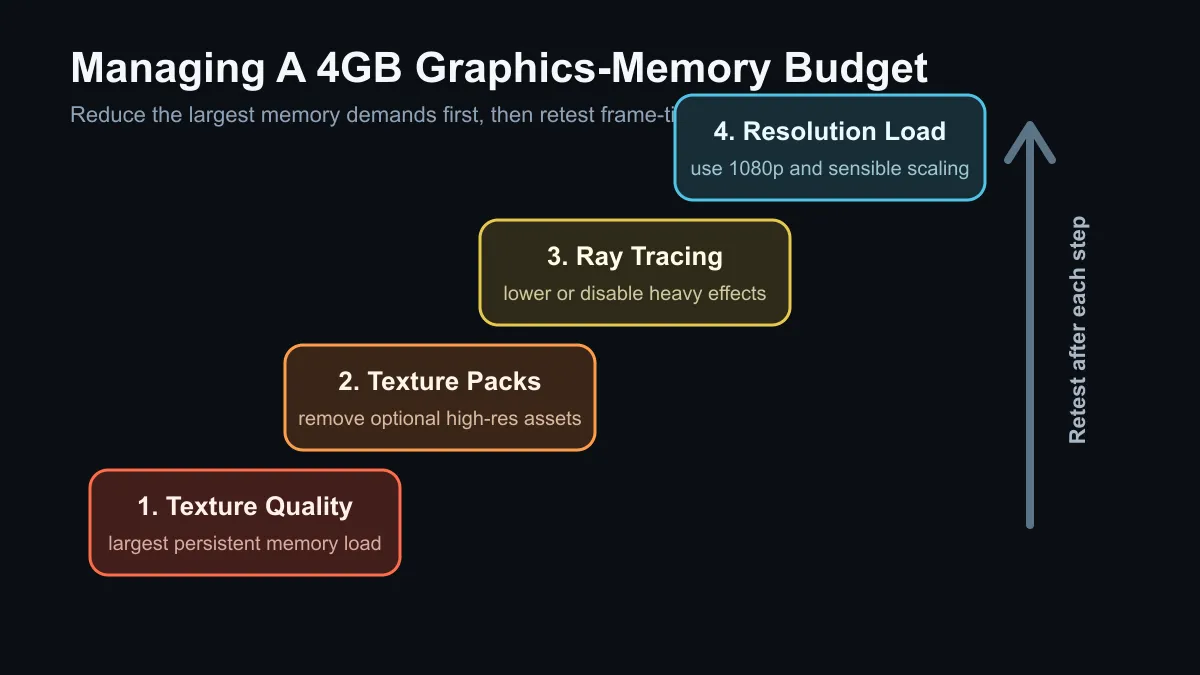
Start at 1080p and use a medium or low texture preset. Disable high-resolution texture packs, reduce ray-tracing features and watch the game's memory indicator where one exists. Upscaling can lower the internal rendering load, although it cannot make an oversized texture set fit by itself. A stable frame time is more valuable than one ambitious setting that repeatedly overflows the memory budget.
AMD's own note is unusually useful here. Cyberpunk 2077 recommends at least 6GB, and the company tells 4GB users to set memory-intensive features low or off. That warning should be treated as a practical limit, not hidden beneath the RX 9000-series name.
🧠 The narrowed memory system reinforces the caution
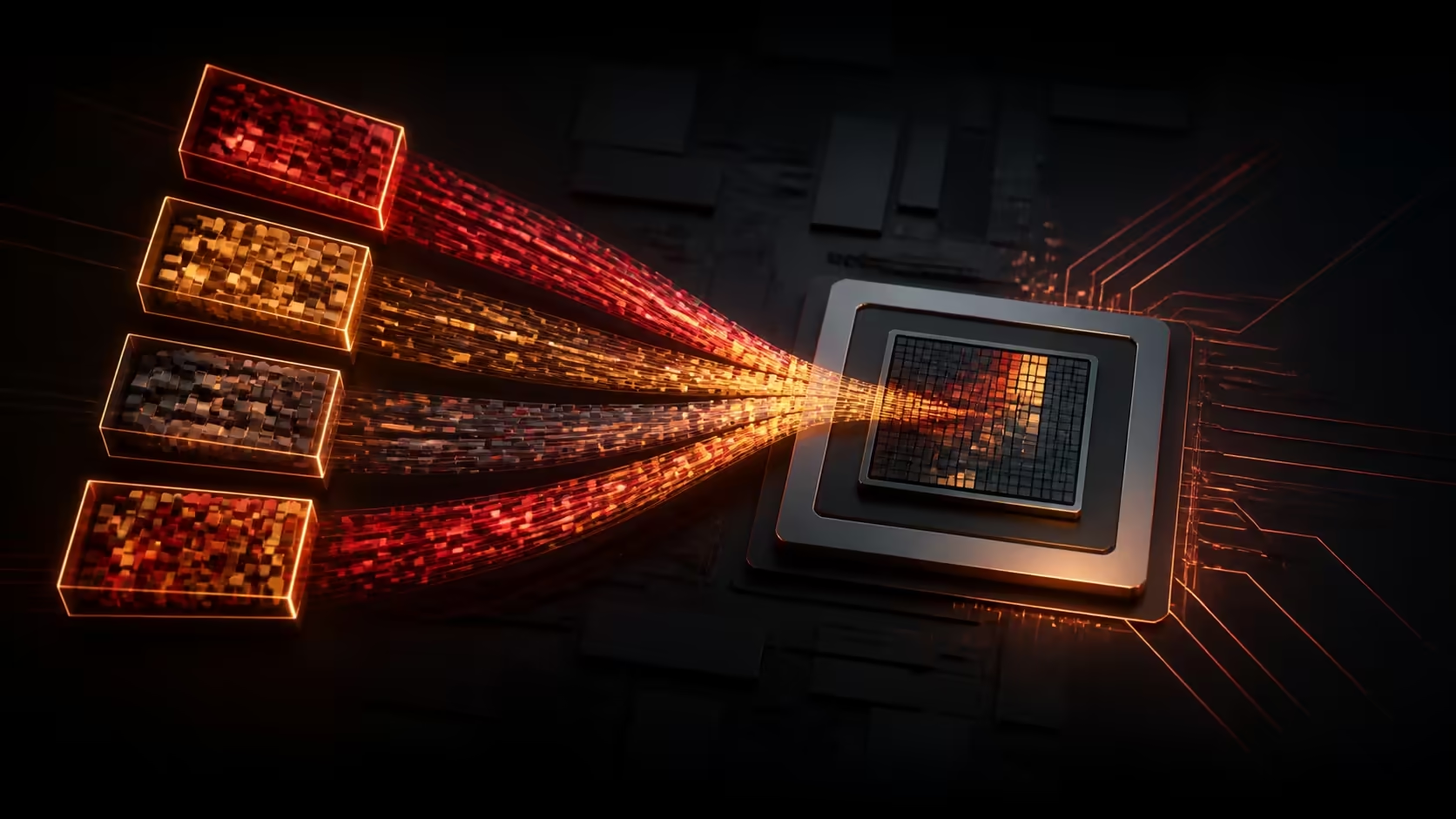
Current coverage reports a 64-bit memory interface and 16MB of Infinity Cache for the 4GB version. Those figures describe a tighter memory path than buyers may expect from higher models. They do not provide a complete performance result because clocks, game engines and the rest of the GPU still matter, but they strengthen the case for conservative settings.
Do not copy the 8GB RX 9050 product page's complete specification set onto the 4GB card. A shared family name does not prove every cache, power or frequency value is identical. The safe approach is to wait for a dedicated AMD product page, board specifications and independent testing of the exact 4GB model.
The AMD Radeon graphics-card range provides a local comparison once the desired resolution and games are clear. Check the memory amount on the exact card rather than assuming every RX 9050 listing has the same capacity.
💰 Current local prices make the trade-off measurable
The timestamped Evetech sample found an 8GB Radeon RX 9060 at R7,899. Sampled 16GB RX 9060 XT cards ran from R9,999 to R10,999, while a 16GB RX 9070 XT appeared at R13,999. These prices can change, and they are not claims about the unlisted RX 9050 4GB. They establish the local alternatives that its eventual price must beat.
A small saving can disappear if the buyer later replaces the card because a favourite game will not hold the desired textures. At the same time, a 16GB card is poor value when the system has a low-power CPU, a basic 1080p display and only light esports workloads. Match the memory spend to the intended lifespan and titles.
Compare the broader graphics-card category for competing memory capacities and cooling designs. The best choice is the least expensive card that meets the real games, display resolution, power-supply limit and warranty requirement without relying on an unconfirmed future optimisation.
✅ Buy on tested settings, not the badge
The 4GB RX 9050 could suit an entry build for lighter esports, older games and restrained 1080p settings if its local price is low enough. It is a weaker fit for high-resolution texture packs, ray tracing or buyers expecting several years of demanding releases without adjusting quality. That distinction should be visible in the purchase plan before a benchmark chart appears.
Wait for three pieces of evidence: the full official 4GB specification, independent game tests with frame-time data, and a confirmed South African listing. Then compare the total card cost, cooler quality, power requirement and local warranty. The graphics-card deals page is the right place to test whether a larger-memory alternative has entered the same budget.
Buy only if those checks show that the discount compensates for the hard 4GB limit. If the price sits close to an 8GB model, the extra memory is likely the safer long-term purchase for a general gaming PC.
Frequently Asked Questions
Is the Radeon RX 9050 4GB official?
Yes. AMD's Adrenalin 26.8.1 release notes list the card under new product support.
Can a 4GB graphics card run modern games?
Some games will run at lower texture and rendering settings, but titles that recommend more memory can stutter or require visible compromises.
Is a South African price confirmed?
No confirmed Evetech listing or rand price was available in the captured catalogue snapshot.
What should buyers compare first?
Compare tested frame times, VRAM use, the exact local price and nearby 8GB alternatives before judging the model name.
Building an entry-level gaming PC? Set the games and display target first, then choose enough graphics memory for stable settings and a sensible lifespan.