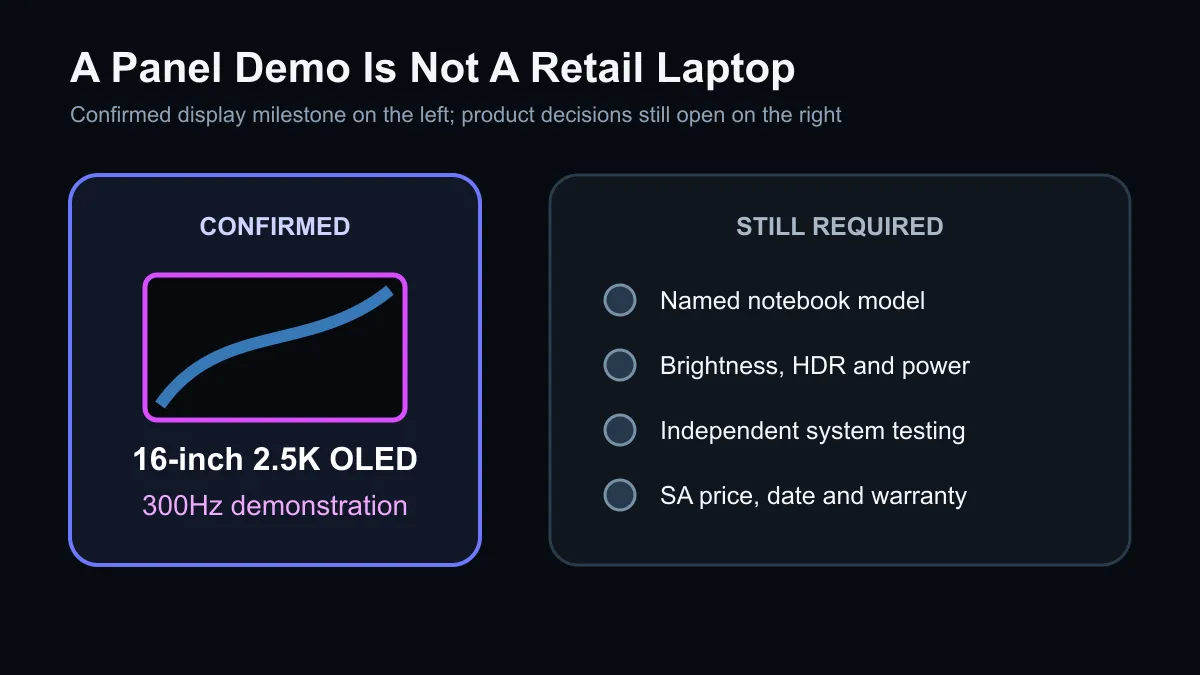
Samsung Display has demonstrated a 16-inch 2.5K OLED notebook panel running at 300Hz. It is a meaningful display milestone, but it is not a complete laptop announcement. There is no named notebook, customer, launch date or South African price, so buyers should focus on the missing system details rather than planning around the panel alone.
Quick Answer
The demonstrated panel combines a 16-inch size, 2.5K resolution class, self-emissive OLED pixels and a 300Hz refresh rate. Full brightness, HDR, power-use and exact pixel-resolution details remain unconfirmed. An exact OLED text search returned no rows in the captured Evetech notebook snapshot, while the sampled gaming-laptop rows started at R18,999 on 23 August.
🖥️ OLED and 300Hz solve different display problems
OLED pixels create their own light, allowing deep blacks and very fast pixel response without a separate backlight. A 300Hz refresh rate lets the panel present up to 300 new images each second. The first improves contrast and motion transitions; the second raises the ceiling for extremely high frame-rate play. Neither guarantees that a laptop can drive a demanding game at 300 frames per second.
The 2.5K resolution class adds more image detail than Full HD, but it also asks the GPU to shade more pixels. Competitive games with light rendering loads may approach the panel's refresh ceiling, while cinematic titles will usually favour higher visual quality at a lower frame rate. A good notebook should offer sensible refresh controls and variable-refresh behaviour rather than forcing one target for every game.
Pixel response is also separate from end-to-end input delay. Keyboard or mouse polling, CPU frame preparation, GPU rendering and the game's own queue all contribute. The panel can remove one bottleneck, but it cannot repair an underpowered system or an unstable frame rate.
🔍 The panel demo leaves critical specifications open
The demonstration did not attach an exact pixel count, peak brightness, sustained brightness, HDR certification, colour coverage or power figure. Those numbers influence outdoor visibility, creative work, battery life and whether highlights look convincing. A notebook vendor can also tune the same panel differently through firmware, colour profiles and power modes.
Burn-in protection and warranty terms need model-level answers. Modern OLED notebooks use pixel shifting, panel refresh and brightness controls to manage uneven wear, but the implementation belongs to the finished product. Buyers should confirm whether the local warranty covers panel faults and whether the machine exposes usable protection settings.
The cooling design matters as much as the screen. A 300Hz gaming laptop needs a CPU and GPU that can sustain high frame rates without excessive fan noise or power throttling. Panel efficiency may help, but no battery-life claim can be made until the complete notebook and battery capacity are known.
💰 A real notebook needs a real local comparison
The timestamped local control sample began at R18,999 for an ASUS TUF Gaming A15 configuration. Several RTX 5050 gaming notebooks appeared around R20,999 to R21,999. Those rows do not use the new Samsung panel and should not be presented as direct alternatives. They show the current entry point for a complete gaming laptop with a known model and local price.
Start with the gaming-laptop deals and decide whether the workload values competitive speed, image quality, portability or battery life most. The gaming laptops under R20,000 page frames the tighter budget, while gaming laptops above R20,000 lets buyers compare stronger GPUs and displays without pretending they carry this unannounced panel.
The empty exact OLED text query is evidence about the captured snapshot, not proof that no OLED notebook can ever be ordered or that every live page uses the same wording. Stock and catalogue text can change. Verify the panel type on the exact product page before buying.
⚡ Wait for the notebook, then test the whole system
A buyer with a capable current laptop loses little by waiting for named models, full specifications and independent measurements. The panel could become attractive for esports players who also want OLED contrast, but the final value depends on GPU performance, cooling, ports, battery life and local warranty.
Buy an available laptop now when the present machine blocks work or play and the new panel has no delivery path. Wait when 300Hz OLED is a priority and the current system remains useful. When products do appear, compare motion clarity at realistic frame rates, brightness in a normal room, fan noise, battery runtime and the price premium over a strong 240Hz alternative.
The demonstration tells buyers what is technically possible. A retail decision starts only when a notebook manufacturer turns that panel into a balanced machine and a South African listing supplies the exact configuration, price and support terms.
Frequently Asked Questions
Is Samsung selling a 300Hz OLED laptop?
No. Samsung Display demonstrated a panel; no complete notebook model or customer was announced.
Does 300Hz mean every game runs at 300fps?
No. The laptop's CPU, GPU, settings and game engine must produce frames quickly enough to use the refresh rate.
Are brightness and HDR details available?
No complete brightness, HDR, power-use or exact pixel-resolution specification accompanied the demonstration.
Is a South African launch confirmed?
No notebook, local price or release date has been confirmed for the panel.
Shopping for a faster gaming-laptop display? Compare the complete GPU, cooling, brightness and warranty package once named 300Hz OLED models reach local listings.