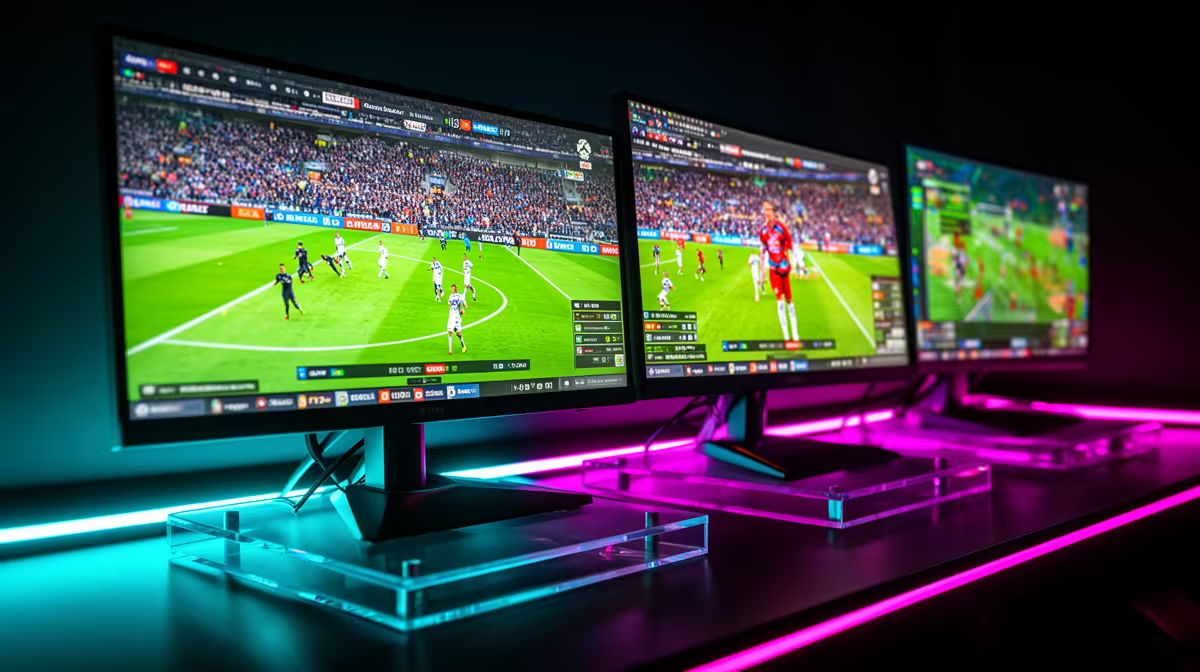
An esports broadcast lives or dies on whether the viewer feels the pressure. A single locked camera showing the screen is fine for a recording. A production that cuts between the player's face, a wide view of the stage, and a tight shot of hands on the keyboard is something people actually want to watch. Dynamic QHD multi-camera angles bring that broadcast-level feel to esports events while keeping the technical overhead manageable, because 1440p sits at a sweet spot that delivers arena-screen sharpness without the bandwidth and storage demands that full 4K multi-cam creates.
Quick Answer
Three angles cover an esports broadcast well: a face-cam for player reactions, a wide stage shot for crowd and atmosphere, and a tight hands shot for mechanical play. Running each at 1440p keeps the feed sharp on arena screens while staying roughly 55 percent lighter on bandwidth than equivalent 4K angles.
🎯 The Three-Angle Architecture That Works
Three camera positions form the backbone of a professional-feeling esports broadcast, and each earns its place for a different reason.
The face-cam is the most emotionally loaded angle. A 1440p tight crop on a player's expression during a close elimination round, or the slight exhale after a defuse, carries more viewer tension than any screen capture. This camera needs to be close enough to read facial detail, positioned so the monitor glow becomes a natural fill light rather than a blown-out background.
The wide stage shot establishes context. It shows the team arrayed at their stations, captures crowd reaction when an audience is present, and gives the director a neutral cut that works between any two other angles. It also doubles as coverage during technical pauses when neither the face-cam nor the hands shot offers anything interesting.
The hands shot is the mechanical authenticity angle. Seeing a player's movement speed during a spray transfer or a precise scroll-wheel timing is something the game screen alone cannot communicate. A 1440p crop tight on the keyboard and mouse shows the physical technique that separates competitors and rewards informed viewers.
⚡ Why 1440p Makes Sense Over 4K for Multi-Cam
4K offers more pixels, but for a three-camera esports setup the cost in bandwidth and hardware is significant. Three 4K feeds at typical streaming bitrates push 45 to 60 Mbps across the network simultaneously, challenging venue connections and demanding more capable switching and encoding hardware.
Three 1440p feeds at around 10 Mbps each total approximately 30 Mbps. That fits comfortably on a dedicated network connection at most venues. The visual difference between QHD and 4K, viewed on a typical arena display or a viewer's monitor, is marginal at normal broadcast compression. The reliability and cost difference is not.
There is also a practical camera budget consideration. QHD cameras capable of clean broadcast output cost considerably less than equivalent 4K broadcast cameras. Running three quality 1440p cameras is more achievable, and in a multi-cam setup having three well-placed angles matters more than having fewer angles at a higher resolution.
Pro Tip ⚡
White-balance all cameras together before the event starts using a grey card under your actual stage lighting. Even with different camera models, matching colour temperature means cuts between angles feel seamless rather than jarring when broadcast conditions change.
🔧 Switching and Timing Across Three Angles
A switcher with at least three inputs handles this setup, and transitions should almost always be a hard cut rather than a dissolve. Esports is fast-paced and a dissolve reads as slow when the action is immediate.
The switching rhythm should track the action rather than a clock. Follow a clutch by cutting to the face-cam. A team wipe is the moment to cut wide for crowd reaction. Use the hands shot during lull periods to build anticipation. For a team event with multiple players on face-cam, plan positions so the operator can cut between faces without confusion about which angle covers which competitor.
🌐 Network Planning for a Three-Camera Event
Three simultaneous QHD streams need a dedicated access point with the cameras isolated from the venue network. Venue Wi-Fi at an esports event is shared with player machines, spectators, and organisers, and that traffic volume cannot coexist with live broadcast feeds.
Set each camera on its own non-overlapping 5GHz channel at a bitrate between 8 and 10 Mbps per camera. If the venue has wired infrastructure at any fixed position, the wide stage camera is the best candidate for an Ethernet connection since it is typically static throughout the event.
Frequently Asked Questions
How many camera angles does a competitive esports broadcast need?
Three positions give a complete broadcast: a face-cam for player reaction, a wide angle for stage and crowd context, and a hands shot for mechanical detail. These three cover every meaningful moment in a match and give a switcher enough options to follow the action without leaving dead air between cuts.
Why choose QHD over 4K when running multiple cameras?
The operational trade-off is the deciding factor. Three 1440p feeds sit at around 30 Mbps combined, which a standard venue connection handles reliably. Three 4K feeds at equivalent quality push closer to 60 Mbps and create encoding and switching demands that increase cost and complexity. The visual gain on a typical screen is small relative to that production overhead.
Do all three cameras need to be the same model?
No. White-balancing all cameras under the same lighting conditions before the event brings them close enough that cuts between angles look consistent. A 1440p face-cam cuts cleanly against a different-model wide camera when both are calibrated together.
Which angle drives the most viewer engagement?
The face-cam. Tight 1440p crops of player expressions during high-pressure moments carry emotional weight that gameplay footage cannot replicate. Viewers who follow a specific player watch for those reactions, and holding on a face during a tense round builds tension more effectively than any other single angle.
How should camera positions be planned before the event?
Walk the stage before setup and identify where each angle needs to frame subjects cleanly. The face-cams should be close enough to fill the frame with the player without showing the full competition desk. The wide shot needs an unobstructed sightline to the full stage. The hands camera needs a clear top-down or side view of the primary competitor's input devices.
Ready to build a proper esports broadcast setup? Browse the QHD streaming camera and multi-camera switching range to find the equipment that brings your production together.