The quickest path to an ergonomic laptop desk setup is to lift the display until the top edge is level with your eyes, and pair it with a detached keyboard and mouse so your hands stay low. Set the chair first, because a good seat position makes everything else easier to place.
Quick Answer
Sit with your feet flat, knees near 90 degrees and elbows close to 90 degrees at the desk. Lift the laptop on a stand so the top of the screen is at eye level, roughly an arm's length away. Use a separate keyboard and mouse, and a docking station if you want one cable to connect everything.
🪑 Start with the chair and the desk height
Everything follows from the seat. Adjust the height until your feet rest flat on the floor, with thighs roughly level and knees near 90 degrees. Your elbows should hang by your sides and bend near 90 degrees when your hands reach the keys, so the desk surface and your forearms are about level.
If the chair is too low for the table, a firm cushion fixes it, and a box or a stack of books under your feet fixes the opposite problem. Many students in res or digs work at a dining table that is simply a bit high for typing. That is solvable with a cushion and a separate keyboard, which lets you keep your shoulders relaxed.
Sit back so your lower back touches the backrest. A small rolled towel behind the spine makes a cheap lumbar support.
🖥️ Raise the screen to eye level
A laptop screen sits low because the keyboard is attached. Looking down for hours bends your neck and strains the upper back. Lift the laptop so the top edge of the display is at eye level, with the screen about an arm's length from you. A riser stand does this, and so does a cooling pad with a raised angle, which also gives the fan clearer air.
Tilt the display slightly back so there is no glare from a window or lamp. A matte surface and a screen angled away from afternoon sun help during long sessions in a small Joburg flat.
⌨️ Keyboard, mouse and wrists
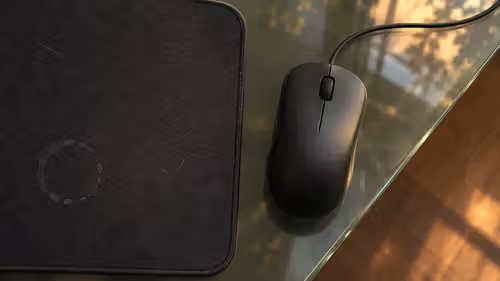
Once the screen is raised, the built-in keyboard is too high to type on comfortably, so use a separate one. A compact wired or wireless keyboard and a mouse let your forearms rest flat, with wrists straight rather than bent up.
Keep the mouse close to the keyboard so your arm does not reach out sideways. Put the keyboard far enough from the edge of the desk that your forearms are supported for part of their length. If your wrists ache, stop to check whether the keyboard is too high or too thick.
🔌 Let a dock tidy the cables
A docking station turns the setup into a single connection. Plug the keyboard, mouse, monitor and charger into the dock, then connect the laptop with one cable. You can lift it off the stand and walk away, and the desk stays clear of loose leads.
Check the dock's port types and power delivery against your laptop's USB-C or Thunderbolt port before you decide, because they differ between models.
A tidy desk also means a tidy habit. Route the cables behind the stand, keep the charger lead long enough that the laptop never gets tugged, and leave about 10 centimetres in front of the keyboard so your palms have somewhere to rest. Small changes like these cost almost nothing, and they make a long evening of assignments or work calls far easier on the body. If you share the table with family, a foldable stand packs away in seconds once you finish.
Frequently Asked Questions
Where do I start with an ergonomic laptop setup?
Start with the chair. Feet flat, knees near 90 degrees and elbows level with the desk. After that, lift the screen and add a separate keyboard and mouse.
How high should the laptop screen be?
The top edge should sit at eye level, about an arm's length away. A riser stand, or the raised angle of a cooling pad, gets it there without other hardware.
Do I really need an external keyboard?
If the screen is raised, yes. Otherwise your wrists and shoulders reach up to the keys, and that posture is what causes strain.
What does a docking station add to a desk?
One cable connects the keyboard, mouse, monitor and charger, so the laptop can sit on a stand and be lifted off easily. It also keeps the ports free.
How do I set up at a dining table or in res?
Use a firm cushion on the chair, a riser for the screen and a small keyboard. A wobbly shared table makes a stable base worth the effort.
How often should I take a break?
Every 20 minutes, look at something far away for 20 seconds, and stand and stretch each hour. Even a perfect setup tires you if you never move.
Ready to build a comfortable laptop desk?
Browse the laptop stands, cooling pads and docking stations in the Evetech components range to raise your screen and clear your cables.