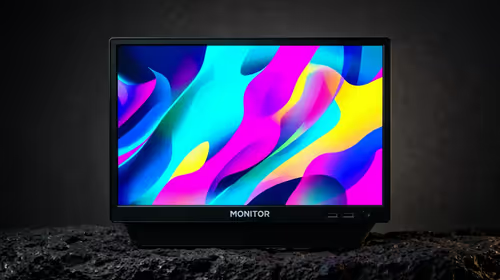
HDR can expose every weakness in an untuned picture: clipped clouds, grey blacks, harsh menus and colour that looks vivid but wrong. HDR10 picture setup on an IPS gaming monitor therefore starts with controlling the room and the signal, not pushing every slider upward. At R4,499, the Alienware AW2726DL brings HDR10, 93% DCI-P3 coverage, QHD resolution and a fast IPS panel into the same 27-inch display.
Quick Answer
Use HDR10 for content designed around it, set room light so reflections do not overpower dark detail, and calibrate with visible highlight and shadow patterns. Keep colour controls near neutral until the basic luminance range looks correct. The AW2726DL costs R4,499 and combines HDR10 with 93% DCI-P3, but a balanced preset will look better than an exaggerated one.
☀️ Match the screen to the room
Ambient light changes what your eyes perceive as black, grey and bright. A display facing a window may need more output during the day, yet that same setting can be tiring at night. Control direct reflections first by turning the screen or changing the desk angle, then set brightness for the actual seat and time of use.
The title's 400-nit reference is a useful class-level discussion point: a finite brightness budget means HDR impact comes from careful tone mapping and contrast placement, not from trying to imitate a far brighter television. Do not expect every specular highlight to dominate a sunlit room. Instead, aim to preserve detail in bright clouds, lamps and effects while keeping shadow objects distinct.
On the AW2726DL, use the height, tilt and swivel stand to reduce reflections without forcing an awkward neck position. IPS viewing angles help retain consistency, but placing your eyes square to the screen remains the best basis for judgement.
The all gaming monitors page is the practical place to compare HDR support alongside panel type, resolution and refresh rate.
🌓 Protect both ends of the tonal range
Start from a neutral picture preset. Display a dark scene with near-black detail and lower any black-enhancement control that turns distinct steps into one flat patch. Then use a bright scene to check that white clothing, clouds or interface panels still contain texture rather than becoming featureless blocks.
Windows and the game may each have an HDR calibration step. Complete the operating-system calibration first, then adjust the game's peak and paper-white controls while viewing its sample image. Paper white affects ordinary scene brightness and interface elements; pushing it too high can make the whole presentation look washed out even when highlights remain visible.
Avoid judging HDR from the desktop alone. Some SDR applications are mapped into the HDR output and can look different from native HDR content. Use an HDR game with a known calibration screen, then return to a familiar SDR image as a reference. If SDR is your main use, it is reasonable to switch HDR off between HDR sessions.
🎨 Restrain colour before refining it
The AW2726DL covers 93% of DCI-P3, a wider colour space associated with richer HDR material. Coverage does not mean the saturation slider should be raised. Excess saturation can merge nearby shades, make skin tones unnatural and hide team-colour distinctions that matter in a game.
Leave colour temperature near a neutral setting and disable strong dynamic-colour modes during calibration. Compare grass, skin, sky and neutral grey objects rather than relying on a single neon scene. If the monitor offers different gamut modes, select one that fits the content rather than assuming the widest setting is always correct.
IPS is well suited to mixed gaming and everyday work because colour and brightness remain relatively stable across reasonable viewing angles. The 2560x1440 resolution also gives fine UI detail at 27 inches. Neither benefit compensates for a crushed black level or clipped white point, which is why tonal setup comes before fine colour preference.
For a market comparison, open the current monitor deals and note which competing feature combinations fit your budget. Price only becomes meaningful when paired with the picture capability you will actually use.
🎮 Keep HDR and competitive speed as separate choices
The AW2726DL's 280Hz refresh and 1ms GTG specification address motion, while HDR10 and DCI-P3 address the image's tonal and colour range. They can operate together, but each game may make a different trade. A competitive shooter might benefit more from a clear SDR preset and maximum frame stability; an atmospheric title may justify HDR with heavier visual settings.
Create two named profiles if the monitor or graphics software supports them. In the competitive profile, favour legibility, neutral processing and consistent response. In the HDR profile, retain the calibrated black, peak and paper-white choices. Do not change overdrive merely because HDR is active; test motion separately at the frame rates each profile produces.
The monitor best-sellers collection gives another useful lens on which display features shoppers combine in practice. Use it to shortlist, then assess HDR support in the context of panel, refresh and ergonomics.
Finish with three real scenes: a dark interior, a bright outdoor area and a colourful effect-heavy sequence. If each retains detail without causing eye discomfort, the profile is doing its job. Screenshot comparisons are unreliable when the capture and viewing chain are not both HDR, so trust direct observation on the calibrated display.
Frequently Asked Questions
Should HDR stay enabled in Windows all day?
Only if your usual applications look comfortable through the SDR-to-HDR mapping. Switching HDR on for native HDR games and off for ordinary desktop work is a valid, simple workflow.
Does 93% DCI-P3 guarantee accurate colour?
No. Gamut coverage describes reach, while accuracy depends on how closely displayed values match their targets. Neutral controls and suitable content modes still matter.
Why do dark HDR scenes look grey on an IPS panel?
Room reflections, excessive black-level adjustment and the panel's contrast behaviour can all lift dark areas. Reduce ambient glare and restore neutral shadow controls before increasing saturation.
Will HDR reduce the monitor's 280Hz capability?
HDR and refresh rate describe different parts of the display path. Confirm the active resolution and refresh after enabling HDR, then test the game's performance rather than assuming the setting changed it.
Ready to build an HDR profile that keeps detail instead of flattening it? Compare Evetech's monitor choices by panel, refresh and colour capability, then tune the selected screen for the light in your own room.