


Stuck Pixel Checks for a Mechanical Keyboard Setup
Stuck pixel on a Mechanical Keyboard is likely a display symptom around that setup, not the part itself. Check the monitor, cable, GPU output, drivers, and warranty path first.
Read moreLearn how to enable 180Hz refresh rate settings in Windows and GPU drivers to unleash your monitor's full potential. 🖥️ Don't settle for 60Hz smoothness when you paid for speed! Follow our guide to fix display bottlenecks and optimize gameplay. 🚀

You've just unboxed that brand new 180Hz monitor, plugged it in, and are ready for some silky-smooth gaming. But hold on... does the gameplay feel as fluid as you expected? Often, high-refresh-rate monitors default to a standard 60Hz setting right out of the box. Don't worry, you haven't been short-changed! You just need to tell Windows and your graphics card to unleash the full power. This guide shows you exactly how to enable your 180Hz refresh rate. 🚀
Think of it this way: your PC is trying to be efficient. By default, Windows often chooses a 60Hz refresh rate because it works with nearly any screen and uses less power. It doesn't automatically know your new screen is a high-performance beast. To get the competitive edge and visual smoothness you paid for, you need to dive into the settings and manually select the correct refresh rate. It's a quick, one-time fix that unlocks your monitor's true potential.
Most modern PC monitors with high refresh rates require this simple tweak to perform at their peak.
Getting your monitor running at its advertised speed is straightforward. Just follow these steps in Windows, and you'll be enjoying buttery-smooth visuals in no time.
And that's it! You've successfully told Windows to use the full 180Hz. This simple change makes a massive difference across all gaming monitors, from standard flat panels to immersive curved screens.
Are you not seeing 180Hz as an option? Make sure you're using a high-quality DisplayPort 1.4 cable. While some HDMI 2.1 ports can handle it, DisplayPort is the most reliable way to guarantee you can enable the full 180Hz refresh rate, especially at resolutions like 1440p. An older cable can be a hidden bottleneck!
For peace of mind, it's a good idea to double-check that your graphics card software is also on the same page. Both NVIDIA and AMD have control panels where you can verify and adjust these settings.
This step is crucial for all types of high-performance screens, whether you're gaming on stunning 5K & 4K monitors or ultra-immersive curved monitors.
If you've followed the steps and still can't enable your 180Hz refresh rate, don't panic. Here are a few things to check:
Even the growing market of portable monitors is seeing higher refresh rates, but they all rely on the same principles: the right software settings and the right physical connection. Having the correct monitor accessories, like a certified cable, can make all the difference. ✨
Ready for Buttery-Smooth Gameplay? A high refresh rate monitor is one of the biggest upgrades you can make to your gaming setup. From lightning-fast esports panels to immersive ultrawides, we've got the screen that will give you the edge. Explore our massive range of gaming monitors and find the perfect display to conquer your world.
Monitors often default to 60Hz. You must manually enable 180Hz refresh rate in Windows Display Settings or your GPU control panel to unlock the intended speed.
Yes, typically. HDMI 2.0 may limit bandwidth. Use a DisplayPort 1.2 or 1.4 cable to ensure sufficient bandwidth for 180Hz at 1080p or 1440p resolutions.
Navigate to Settings > System > Display > Advanced display. Under 'Choose a refresh rate,' select 180Hz from the dropdown menu to apply the changes immediately.
It depends on the resolution and HDMI version. HDMI 2.1 handles it easily, but older HDMI ports may cap out at 120Hz or 144Hz depending on the monitor's specific specs.
Ensure GPU drivers are updated and you are using a high-bandwidth cable. Sometimes, you must enable specific overclocking modes in the monitor's physical OSD menu first.
It drastically improves motion clarity and reduces input latency, provided your GPU can output 180 FPS to match the refresh rate.
Stuck pixel on a Mechanical Keyboard is likely a display symptom around that setup, not the part itself. Check the monitor, cable, GPU output, drivers, and warranty path first.
Read more
How to fix stuck pixel Windows 11 USB DAC issues starts with display-only tests. Check HDR, scaling, monitor input, USB cable movement, and safe South African support options before connecting the pixel issue to audio hardware.
Read more
Windows 11 Steam Deck monitor issues often start with display mode, USB-C output, drivers, or dock power. Use this how to fix monitor not detected windows 11 steam deck checklist for SA handheld PC setups.
Read more
Stalker 2 Heart of Chornobyl PC build planning at R100,000 should stay cautious about parts and settings. Balance GPU, CPU, RAM, storage, cooling, and upgrade room before picking a South African gaming PC.
Read more
RX 9070 XT build stuttering needs a step-by-step check before replacing parts. Review drivers, settings, thermals, power, background apps, display limits, cables, and game options before changing hardware.
Read more
GTA 6 on R15,000 needs careful part balance. This SA build guide frames CPU, GPU, RAM, SSD, cooling, and upgrade trade-offs without promising live prices, stock, or exact FPS.
Read more
NVIDIA lists 550W required system power for the RTX 5060 reference specification, based on a high-end test system. A quality 550W unit can be enough, but CPU draw, transient load, connectors and ageing decide real headroom.
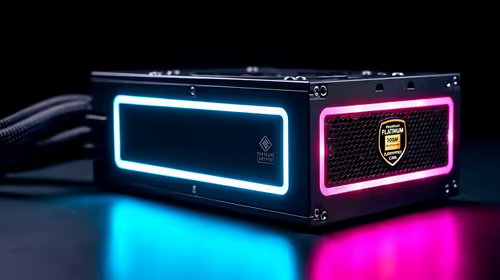
80+ Gold vs 80+ Platinum for couch co-op gaming is about PSU efficiency, heat, fan behaviour, quality, and wattage headroom, not direct FPS. SA buyers should compare the whole build.
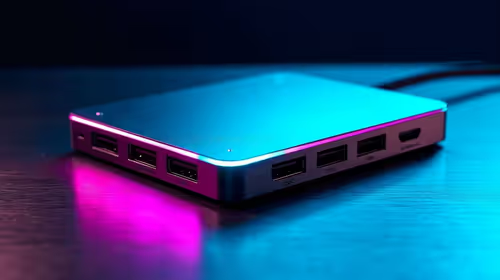
Upgrade your setup with the best USB-C hubs for creators. Discover why high-capacity card readers and dual 4K output are essential for professional South African content production. 🚀💻

B850 motherboard FPS drops needs a methodical troubleshooting pass. Review drivers, thermals, power settings, background apps, cables and game settings before replacing parts in an SA gaming setup.
NVIDIA lists 550W required system power for the RTX 5060 reference specification, based on a high-end test system. A quality 550W unit can be enough, but CPU draw, transient load, connectors and ageing decide real headroom.

OpenRGB's master branch now carries changes labelled for 1.0 final, including translation and platform work, but the official tags page still lists 1.0rc3.1 as the newest packaged release. Stable users should wait for the signed release channel.
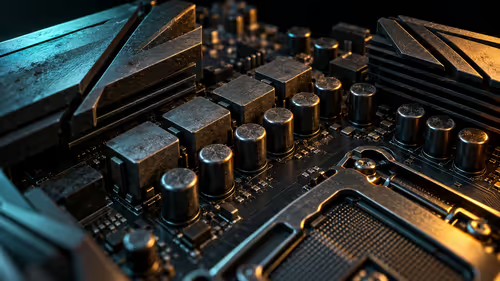
A motherboard can remain useful for many years when power, cooling and connectors stay healthy. Replace it for confirmed faults, damaged power delivery or a blocked platform need, not simply because the calendar reaches a fixed age.
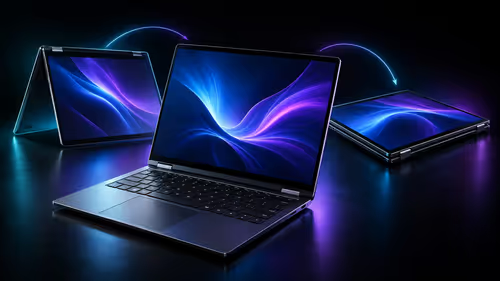
The VAIO T combines a 13.3-inch display with a multi-flip mechanism for laptop, tablet and outward-facing viewing modes. Orders begin in Japan on 18 September; South African availability is unconfirmed.

The smallest ATX case 2026 buyers should choose is the smallest chassis that still fits their exact graphics card, cooler, power supply and airflow plan. ATX support alone does not prove a case has the smallest footprint or volume.
In a 6 bit + FRC vs 8 bit comparison, native 8-bit panels can produce 256 levels per colour channel directly, while 6-bit plus FRC rapidly alternates nearby values to approximate the wider palette. Panel quality still depends on more than bit depth.

The UGREEN LinkStation Pro eGPU dock combines Thunderbolt 5 and OCuLink connections with an integrated 850W ATX 3.1 power supply and up to 140W laptop charging. South African availability is unconfirmed.
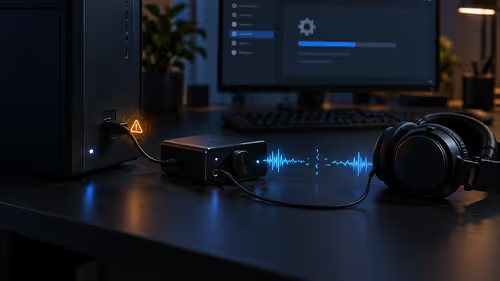
Windows 11 KB5124008 can leave some USB Audio Class 1.0 devices with no sound, Code 10 or failed multichannel output. Microsoft confirms the issue and says switching to two-channel stereo can restore audio for some users.