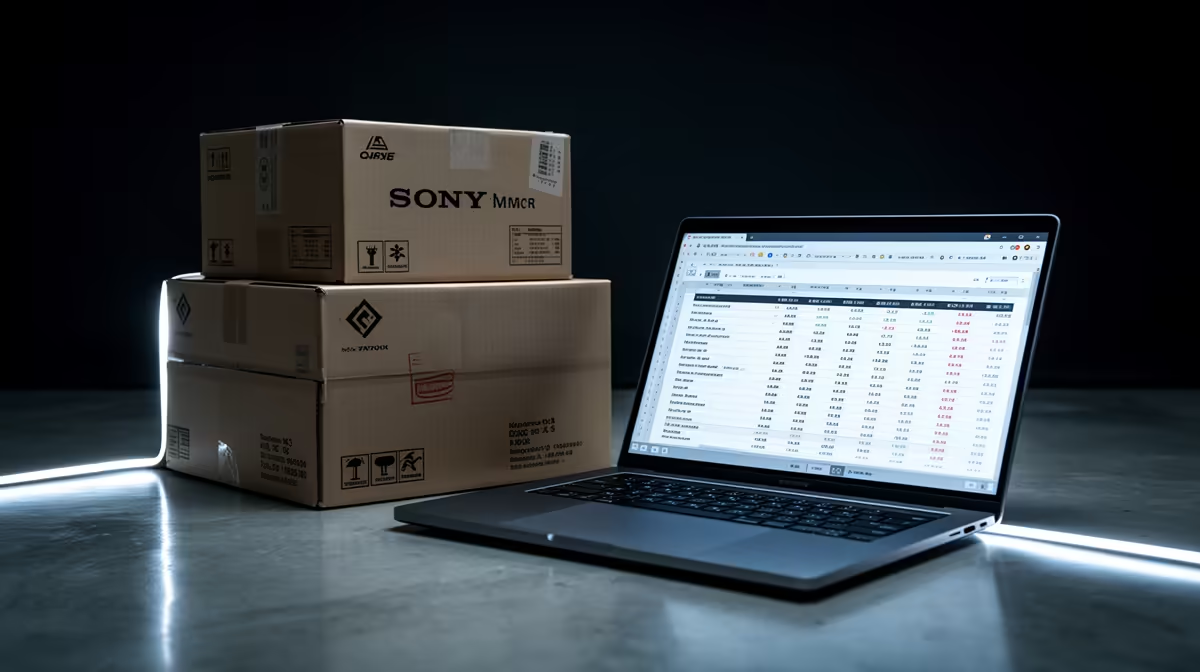
The foreign checkout total gets a PC part onto a courier. Landed cost gets it through South African customs and into your hands. Build the second number before ordering: product, freight, insurance, duty, import VAT, clearance and any forwarder charges. Then add the cost of delay and overseas warranty risk beside the arithmetic.
Quick Answer
Use a worksheet with one row per charge and keep every currency conversion visible. Determine customs value C under the applicable rules. Calculate duty D from the correct tariff and origin. Add the applicable import-VAT uplift U, then estimate VAT as 15% of C + D + U. Add freight or insurance not already in C as the rules require, plus courier clearance, disbursement and delivery fees. Compare the result with a local invoice for the exact model and support. Confirm the final method with SARS guidance or a customs professional.
1️⃣ Save the exact foreign offer
Record model suffix, seller, invoice currency, item amount, foreign tax, discount and shipping. Remove foreign sales tax only when the seller actually does. Do not assume a displayed export price survives checkout.
Confirm whether shipping is delivered-duty-paid or delivered-duty-unpaid. DDP can bundle border charges; DDU or similar arrangements leave them for collection.
For the local side of the eventual comparison, save the matching system from Evetech's PC best sellers or general best-seller page.
2️⃣ Establish customs value and exchange basis
Customs value is not a free-form estimate. It follows valuation rules and can include adjustments around freight, insurance or assists depending on the transaction. Record which costs the courier says are included in C.
Use the customs exchange treatment for the declaration rather than today's card-app spot rate. Keep a separate line for bank conversion and foreign-transaction fees paid at purchase.
3️⃣ Classify the item and calculate duty
Find the tariff code for the exact product. Many covered core computer components can have a zero rate, while peripherals and mixed goods may differ. Origin proof can affect preferential treatment.
Calculate D using the applicable customs value and rate. Ask for a written code on a high-value or ambiguous shipment.
4️⃣ Build the import-VAT base
Create a separate U line for the statutory uplift. For applicable goods from outside the Southern African Customs Union, the familiar uplift is 10% of customs value. Then calculate 15% on C + D + U.
Where D is zero and U equals 10% of C, the VAT result is 16.5% of C. Do not extend that shortcut to goods with duty or different origin treatment.
5️⃣ Add private logistics fees
Request the courier's clearance and disbursement schedule, including minimums. Add forwarding membership, local delivery, remote-area surcharge and storage contingency where relevant.
Insurance belongs in the decision even when it is optional. A high-value GPU shipped uninsured leaves a different risk from one covered door to door.
6️⃣ Add time and warranty exposure
Estimate customs delay, return courier and weeks without the part if it fails. Do not convert uncertainty into a fake precise rand amount. Write it as a risk note beside the landed total.
Check whether a South African service centre accepts the serial. If the component must return overseas, save that quoted courier cost separately.
7️⃣ Compare like with like
Match exact GPU memory, laptop configuration, bundled accessories and local warranty. A foreign listing without a charger or with a different keyboard is not the same product.
Compare the landed result with the local cash price and available support on the same date. A local alternative should not be burdened with import charges it does not create for the customer.
🧾 Keep a high and low scenario
The low case uses the confirmed zero duty and published courier minimum. The high case uses the plausible alternative classification, storage and currency movement. If the import only wins in the low case, the deal has little room for error.
Update the sheet on the day of payment. Tariffs, courier schedules and exchange treatment can change.
Frequently Asked Questions
What line items make up landed cost?
Product, freight, insurance, duty, import VAT, currency fees, clearance, disbursement, delivery and any storage or forwarding charge.
Why is invoice price alone a poor guide to real cost?
It often excludes South African border taxes, courier administration and the risk cost of overseas support.
How do you estimate freight before ordering?
Use the seller or forwarder's packed weight and dimensions, destination and insurance quote.
Does insurance change the landed cost calculation?
It adds cost and may form part of customs value under the applicable valuation rules, while reducing transit risk.
Is landed cost the same for every courier or forwarder?
No. Freight, minimum clearance, advancement and storage schedules differ.
Should landed cost include potential customs delays?
Record delay as time and risk. Add actual storage or backup-hardware costs where they can be supported.
What is the simplest way to compare landed cost to a local price?
Put the completed import total beside the exact local model on the same date, then compare warranty route and delivery time.
Ready to compare the parcel at your door with the product in a foreign basket? Complete all seven landed-cost rows, then place the result beside locally sold gaming PCs at Evetech.