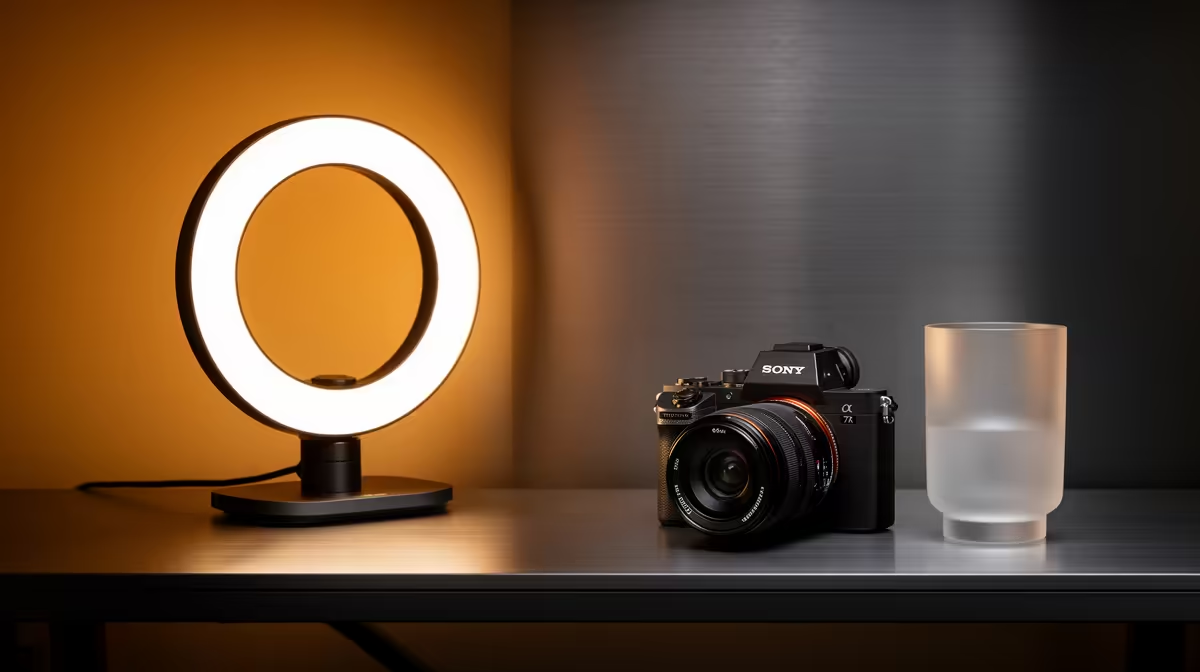
Harsh shadows on a streaming face are almost always a lighting placement problem, not a lighting budget problem. One reasonably powered LED, positioned and diffused correctly, can clean up the kind of flat, shadow-heavy image that makes a small room look like a basement. Webcam shadow reduction with a single LED is not a workaround for a real lighting setup. Understood properly, it is a real lighting setup.
Quick Answer
Place one 1000-lumen LED about 45 degrees off to one side and a touch above your eyeline, then diffuse it through a softbox, frosted panel, or even thick white paper. Bouncing it off a white wall opposite fills the shadow side without a second light.
🔧 Angle Is the First Variable to Solve
The position of the light source relative to your face determines the shape of every shadow your webcam sees. A light placed directly in front of you flattens out entirely, removing depth but also removing any directional shadow. It produces a clean but characterless image. A light placed directly to the side creates a dramatic split, with half the face in deep shadow. Neither extreme is what most streamers want.
The 45-degree position sits between those extremes. Measured from the centre of your face, the light source sits at roughly 45 degrees to one side and angled slightly downward from above eye level. This creates natural modelling on the face, the same shape that photographers call Rembrandt or butterfly lighting depending on the exact geometry, where shadows appear in organic places rather than cutting across features awkwardly.
For a small streaming room, "45 degrees" does not require a measuring tool. Place the light to whichever side gives you the most wall clearance, point it toward your face at roughly that angle, and adjust from there by watching the camera feed rather than guessing.
✨ Why Diffusion Changes Everything
A bare LED globe or panel is a small, concentrated light source. Small sources produce hard shadows because there is no spread to the light, every surface either sits in direct line of the source or it does not. The transition between lit and unlit areas is sharp, and sharp shadow edges on a face look harsh on camera.
Diffusion physically enlarges the apparent size of the source. A softbox fitted over the LED spreads the light across a large surface area before it reaches your face. A sheet of frosted acrylic, a panel of tracing paper held in front of the light, or even a layer or two of thick white A4 paper taped over the front of the unit all achieve similar results by forcing the light to scatter before it arrives.
The larger the apparent source, the softer the shadows and the more gradual the transition from highlight to shadow. You do not need an expensive softbox for this. Any material that scatters light evenly across a broad area serves the purpose, and the DIY options are good enough to dramatically change the quality of a stream image.
🔆 Filling the Shadow Side Without a Second Light
Once a main light is placed at 45 degrees, the opposite side of the face falls into shadow. In a perfectly lit studio, a second light or reflector fills that shadow. In a small streaming room, a second light is often impractical. The solution is the room itself.
If there is a white or light-coloured wall on the opposite side to the main light, some of the light bouncing off it naturally fills the shadow side. You can amplify this by placing a large white surface, a foam board, a sheet of white cardboard, or a white storage box, opposite the main light to catch and redirect what is bouncing around the room.
This fill method does not produce the same even result as a dedicated fill light, but it lifts the shadow side enough to eliminate the dark, hollow look that comes from a completely unlit half of the frame. Adjust the fill board distance to control how much lift you get.
Frequently Asked Questions
Where should a single LED sit for the best shadow reduction?
Roughly 45 degrees to one side of your face and positioned slightly above eye level. This angle creates natural shadow shapes that read as flattering rather than dramatic. Watching the camera feed while adjusting is more reliable than measuring, since room geometry varies and the goal is what the camera sees, not a precise geometric position.
Does diffusing the LED affect how bright it feels?
Yes, diffusion spreads the light over a larger area, which reduces the intensity at any specific point. A 1000-lumen LED diffused through a softbox will feel noticeably less intense than the same LED bare. To compensate, move the unit slightly closer or choose a higher-output LED if diffused brightness becomes limiting in your space.
Can bouncing off a white wall replace a second light?
Partially. Bouncing the main light off a white wall opposite the key light lifts the shadow side and softens the overall contrast. It will not fill as evenly as a dedicated fill unit, but the difference on a webcam feed is substantial compared to no fill at all. For most streaming setups, this approach is more than adequate.
What happens if the LED is too powerful without diffusion?
Direct high-output light flattens the face, bleaches detail in the highlights, and creates a washed-out look rather than a clean one. Raw luminosity is not the goal. A medium-output unit, around 800 to 1200 lumens, diffused and positioned correctly, produces better results than a powerful bare LED. Dial the unit to a comfortable output and adjust distance rather than maxing brightness.
Does ceiling height affect how the single LED works?
Yes in a small way. In a room with a low ceiling, even a light positioned at table height throws reflections off the ceiling that add a soft top fill. In a tall or dark-ceilinged space, there is no ceiling bounce and the room stays darker around the key light. Rooms with low white ceilings naturally assist a single-light setup more than rooms with high or dark ceilings.
Ready to clean up your stream image with the right light? Browse the LED streaming light range and find a unit with the output and diffusion options to transform a small space into a sharp setup.