Quick Answer
For running local LLMs as a Standerton creator, the GPU's VRAM is decisive: an RTX 4060 Ti 16GB (~R12,000) runs 7B–13B models comfortably, while 32GB system RAM and a fast SSD round it out. A complete local-AI rig costs R25,000–R40,000.
What local-LLM hardware delivers
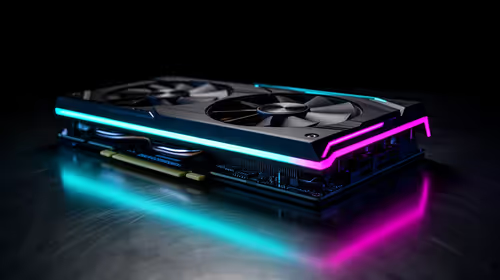
VRAM sets the ceiling. A 4-bit 7B model needs ~6GB, a 13B model 10–12GB, and bigger models require offloading or 24GB+ cards. That makes a 16GB card — the RTX 4060 Ti 16GB or RTX 4070 Ti Super 16GB — the value pick, since tokens-per-second crash the moment a model overflows VRAM into system memory. Pair it with a Ryzen 7 7700 and 32GB DDR5.
Storage and the full build
Model weights are large: a quantised 13B is 7–9GB, a 70B exceeds 40GB. A 2TB Gen4 NVMe (~7,000 MB/s) loads them fast and holds several. A 750W 80+ Gold PSU covers a 4070-class card with headroom for long inference runs.
Software and quantisation
Ollama and LM Studio make running local models nearly one-click, handling download and 4-bit quantisation automatically. Quantisation (Q4_K_M) is the key trick — it shrinks a model to roughly half its VRAM footprint with minimal quality loss, letting a 16GB card run models that would otherwise need 24GB+. Start with a 7B model to learn the tooling, then scale to 13B — the RTX 4060 Ti 16GB has the VRAM to handle both comfortably. A 2TB Gen4 NVMe loads large model weights quickly and holds several at once, since a quantised 13B runs 7–9GB and a 70B can exceed 40GB.
FAQ
How much VRAM do I need for local LLMs?
16GB is the SA value sweet spot — it runs 7B–13B models well and handles many 30B models when quantised.
Can I run local AI on CPU only?
Yes, but slowly — single-digit tokens per second on a 7B model. A 16GB GPU is many times faster.
Which GPU is best value for local AI?
The RTX 4060 Ti 16GB at around R12,000 gives the most VRAM per rand for mid-sized models.
4-bit quantised model (Q4_K_M) — it roughly halves VRAM use with little quality loss, stretching a 16GB card further.