One person's new game should not decide the other person's ranked match. To stop downloads causing gaming lag, control the queue at the router or launcher and prove the result with latency-under-load testing.
Quick Answer
A large download can fill the home line and build a queue that delays the other gamer's packets. Prove it by watching ping while the download starts. Then cap the download in its launcher or configure smart queue management or QoS from measured line rates. Device priority can help, but it must leave room for voice calls and other traffic. Ethernet removes Wi-Fi competition for the gaming device; it does not stop an internet queue. Agree on priority hours so the technical controls match how the household uses the line.
Recreate the exact problem
Connect the gaming PC or console by Ethernet and run a continuous ping to an approved destination. Start the other person's download and watch the change.
Repeat with upload and download separately. An install pulls data down, while cloud sync or peer update sharing can fill the upstream. Both directions can grow queues.
Record idle ping, loaded ping, line throughput and which app moved the file. This baseline tells you whether the fix works.
Use the launcher first
Steam, Xbox and other clients expose different bandwidth or schedule controls. Set a supported limit on the download-heavy device and repeat the ping test.
Choose a rate that leaves room for gaming, voice and normal browsing. A slower transfer that finishes overnight can be better than a fast transfer that ruins both users' evening.
Pause the queue during a tournament or ranked block when no setting keeps the line clean. Resume it afterwards and confirm the client did not start another title.
Configure queue control
Smart queue management shapes traffic below the real bottleneck so packets wait in a manageable router queue. Ordinary QoS can classify traffic or prioritise a device.
Measure stable upload and download rates. Enter values according to the router's current guidance. Limits above the real line fail to control the provider queue; very low limits waste capacity.
Retest idle and loaded ping. Watch both gamers play while one controlled download runs. Keep the setting only when it lowers delay without breaking useful traffic.
Avoid permanent king-of-the-house priority
Giving one console top priority all day can hurt calls, work and the second gamer. Use schedules or profiles where supported, and define the hours that matter.
Prioritise latency-sensitive traffic rather than every byte from a gaming PC when the router can make that distinction. A game launcher on the same PC can otherwise inherit the priority and fill the queue.
Review the client list after device replacement. Private addresses and renamed consoles can leave a rule attached to the wrong equipment.
Fix the local radio too
Wire the fixed gaming devices to the main router or a wired access point. If both users share Wi-Fi, put them on a clean 5GHz or 6GHz band with strong signal.
A wired gamer can still lag when the WAN is full, but the test becomes cleaner. Wireless retransmissions no longer hide the queue-control result.
Use wired backhaul for a mesh node when possible. A large download crossing a wireless relay can occupy both the backhaul and client radio.
Choose hardware around measured load
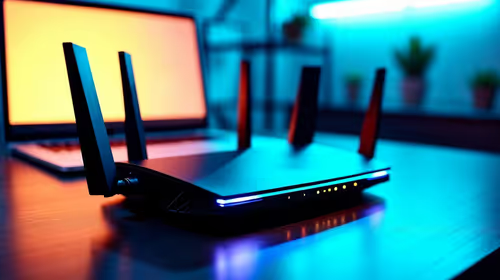
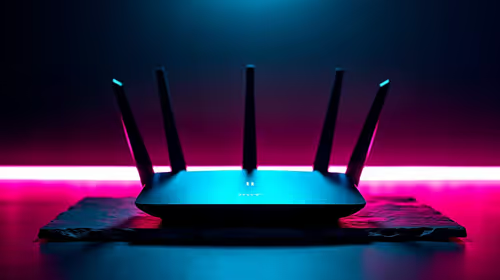
The router needs enough CPU and port speed to run its queue controls at your line rate. Some models lose throughput with QoS enabled, so read current specifications and independent tests.
Compare routers and networking systems for queue controls and client scheduling. Match the gaming stations with the right leads through popular accessories.
Make the household rule visible
Choose update hours, a ranked-play window and one person responsible for resuming paused queues. Keep a shared note beside the router app or launchers.
Review after a faster service or new console arrives. Old caps can become bottlenecks, while a new client can bypass a device-specific rule.
Check fairness with two live games
Run the final test with both household players in their usual titles and voice channels. Start one controlled download at the agreed rate. Watch the game overlays and ask each player for the same five-minute drill.
If one title stays clean and the other spikes, confirm their server regions and device rules before changing the whole queue. A local shooter and an overseas MMO begin with different base latency.
Save the working launcher cap and router profile. Name them for the line speed and date. If somebody resets the router, you can restore a proven arrangement instead of guessing during the next match.
FAQ
Does QoS stop the download?
It can slow or shape it while keeping latency-sensitive traffic moving. The exact behaviour follows the router and settings.
What if the router has no QoS?
Use launcher limits, schedules and manual pause. A replacement earns its place when loaded-latency tests prove the missing control matters.
Will Ethernet solve the whole problem?
It removes wireless variation. A saturated WAN queue still needs a download cap or working traffic management.
Recreate the lag with one controlled download, cap that queue and keep the first setting that lets both gamers finish a clean session.