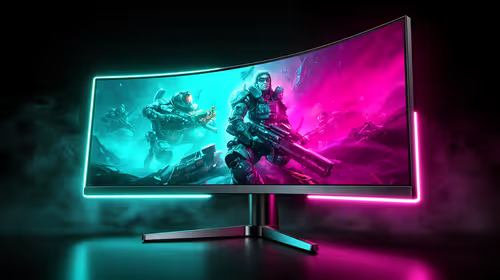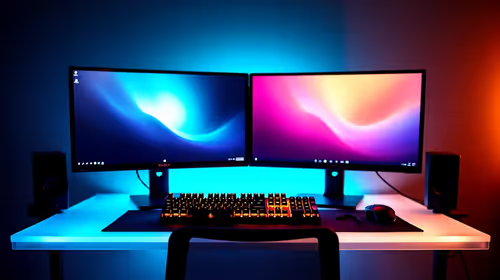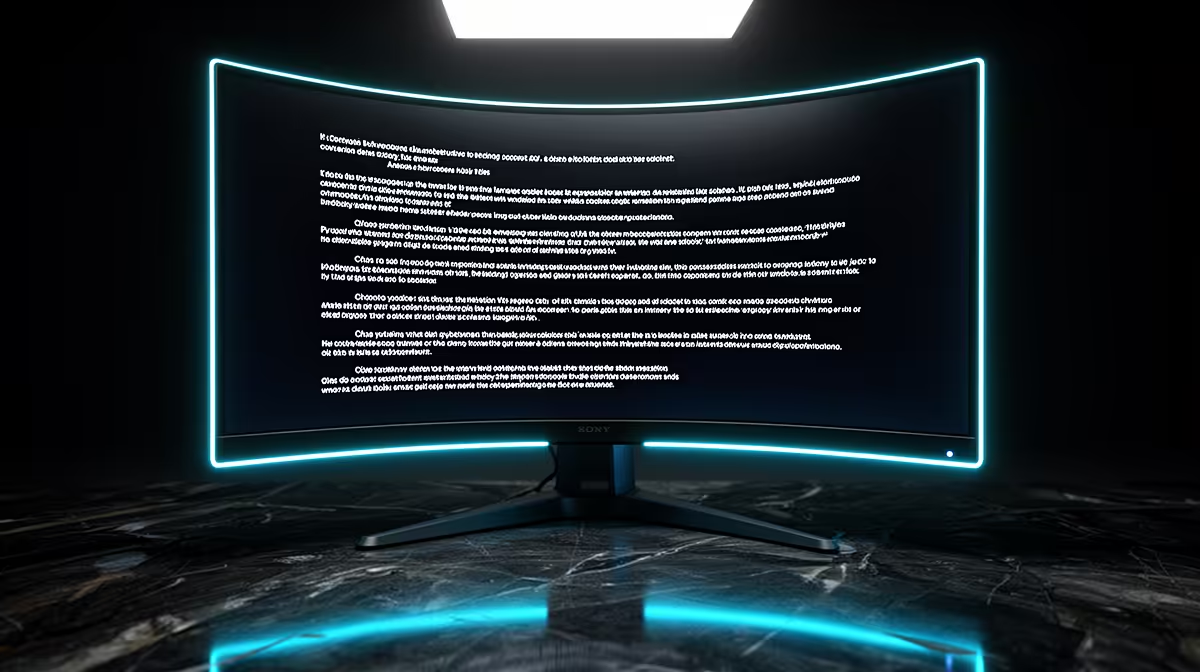
Fine text can look fuzzy or show coloured edges on an OLED monitor even while games look razor sharp. Many OLED panels arrange their red, green and blue elements differently from the stripe assumed by Windows text rendering. The screen may be working exactly as designed. This OLED text clarity fix starts by separating physical subpixels from settings trouble.
Quick Answer
Run the monitor at native resolution, select a comfortable Windows scaling level and complete ClearType again from your normal chair. Test the actual application because browsers, Office and code editors can render fonts differently. Higher pixel density reduces visible fringing; software cannot fully change a physical subpixel arrangement. If text remains uncomfortable after setup, choose a denser OLED or an IPS monitor for an office-heavy desk.
🔎 Confirm the monitor is receiving its native image
Open Windows Display settings and select the panel's native resolution. Check scaling and make sure the GPU is not applying an unusual custom resolution. A 4K screen sent 1440p will look soft for reasons unrelated to OLED.
Inspect the cable path if the correct mode is missing. Connect a desktop monitor to the graphics card rather than the motherboard and use an input that supports the full resolution and refresh.
See current native resolutions in Evetech's OLED monitor category before comparing text density.
🔤 Rerun ClearType without expecting magic
Search for "Adjust ClearType text" and work through the samples. Sit at your real distance, because the best choice from close inspection may not be the most comfortable at the desk.
ClearType changes how Windows colours edge subpixels. It can reduce fringing on some layouts but cannot rearrange triangular or non-standard physical elements. Save the clearest result, then sign out and back in before comparing apps.
🔍 Increase scaling instead of leaning closer
At 1440p, try 125% if small text exposes colour edges. At 4K, 125% or 150% often gives a comfortable work size while using the panel's high density. Scaling percentages are starting points; eyesight and viewing distance decide.
Keep browser zoom at 100% during the Windows comparison, then adjust it separately if web text remains too small. Layering several zoom controls can make diagnosis confusing.
Move the chair back by ten centimetres and read the same paragraph again. If the fringe disappears without making the font hard to read, distance and scaling may solve the desk more cleanly than another software toggle.
🧩 Test each application's rendering path
Some applications use greyscale antialiasing, others use subpixel colour and a few expose their own font-smoothing controls. Open the file or page you stare at for hours. Compare a browser, Windows Settings and your main work tool side by side.
Hardware acceleration can change browser rendering. Toggle it only as a controlled test, then restart the application. Keep the setting that improves text without introducing scrolling or video problems.
🎨 Remove picture settings that fake softness
Set sharpness to the neutral value specified by the monitor. Too little blurs edges; too much adds halos. Disable unnecessary image enhancement and confirm the PC uses an appropriate colour format.
HDR can make the SDR desktop look different without changing subpixel geometry. Balance SDR brightness inside Windows HDR mode or switch HDR off for a text-heavy work session.
Use Evetech's broader monitor category to compare an IPS RGB-stripe option if daily text remains the deciding factor. Current monitor best-sellers provide local size and resolution alternatives.
🧪 Distinguish a layout trait from a fault
Subpixel fringing should appear consistently around particular high-contrast text edges. A blurred patch in one area, lines, flicker or a colour defect may indicate another problem. Photograph the issue through software screenshots and a camera: if the screenshot looks clean on another display, the panel or signal path deserves attention.
Do not press or massage an OLED panel. Follow the seller's pixel and return policy if you suspect a defect.
Frequently Asked Questions
Why does OLED text look different from an IPS monitor?
Many OLEDs use a subpixel arrangement that differs from the standard RGB stripe common on IPS monitors and assumed by text software.
Does re-running ClearType fix fuzzy OLED text?
It can improve edge rendering, but it cannot completely remove effects caused by the physical subpixel layout.
Does scaling percentage affect OLED text sharpness?
Yes. Larger rendered text can make fringing less apparent, especially on a high-density panel.
Is fuzzy text a sign of a faulty OLED monitor?
Usually it is a rendering and layout interaction. Local blur, lines or inconsistent areas may indicate a different issue.
Do font smoothing settings in apps other than Windows matter?
Yes. Applications can use different rendering engines and may expose their own antialiasing or hardware-acceleration options.
Is OLED still good for reading and productivity despite this?
It can be, particularly at high pixel density. People vary in sensitivity, so read your real work on the exact model if possible.
Love the OLED game image but keep noticing colour around small letters? Compare higher-density OLED and IPS monitors at Evetech after running the native-resolution, ClearType, scaling and application checks on your current screen.