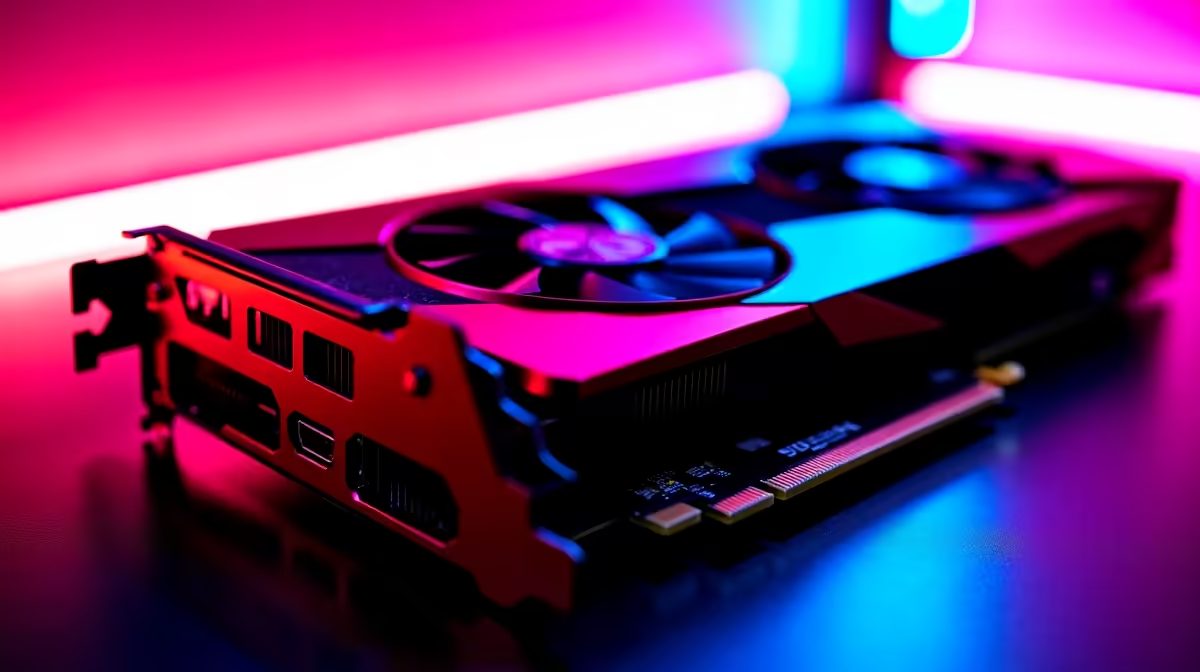
Quick Answer
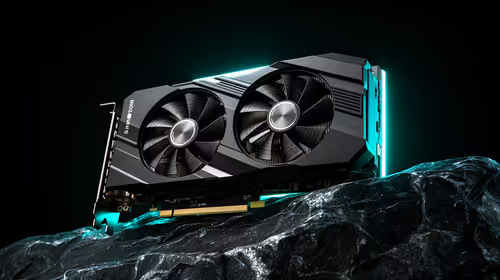
The RX 7800 XT runs Crimson Desert at 1440p high settings with average framerates between 65 and 85 FPS. With AMD FSR 3 Quality mode enabled, framerates climb to 90 to 110 FPS, making 1440p high settings comfortably playable on the RX 7800 XT in 2026. The card handles Crimson Desert's demanding open world environments well at this resolution.
RX 7800 XT Performance Breakdown in Crimson Desert at 1440p
Crimson Desert from Pearl Abyss is one of the more graphically ambitious open world releases of 2026, featuring expansive environments, advanced weather systems, and detailed character models with demanding cloth and hair simulation. At 1440p high settings, the RX 7800 XT averages 68 to 82 FPS across most gameplay scenarios. Dense populated areas and large-scale combat with numerous AI characters push frame times higher, bringing minimums to around 55 to 60 FPS. The RX 7800 XT's 16GB GDDR6 VRAM is a genuine asset in Crimson Desert. Other local retailers may also carry similar options. Dropping to medium textures while keeping other settings at high is unnecessary on the RX 7800 XT at 1440p, which is a meaningful advantage. Other local retailers may also carry similar options. ## FSR 3 Settings Recommendations for the RX 7800 XT
Crimson Desert supports AMD FSR 3 including Frame Generation on RDNA 3 hardware. With FSR 3 Quality mode (rendering at approximately 1080p, upscaling to 1440p), the RX 7800 XT averages 95 to 115 FPS. Frame Generation on top of this pushes displayed framerates to 140 to 170 FPS, with Crimson Desert's motion smoothness improving noticeably at these rates. For most players at 1440p 144Hz displays, FSR 3 Quality mode with Frame Generation is the ideal configuration: the upscaling quality at 1440p output is excellent at Quality setting, image sharpness is preserved, and framerates comfortably exceed the 144Hz target for smooth, tear-free gameplay with FreeSync enabled. FSR 3 Balanced mode at 1440p output renders at around 960p natively, and the upscaling quality does show more softness in Crimson Desert's fine foliage and distant terrain. Quality mode is recommended for this specific title. ## Thermal Performance and SA Climate Considerations
The RX 7800 XT has a TDP of 263W. In Crimson Desert at 1440p, sustained GPU power sits around 240 to 260W. A mid-range reference design card with dual or triple fans reaches 70 to 80 degrees Celsius at stock fan curves. In South African summer conditions in Gauteng, Western Cape, or KwaZulu-Natal where ambient temperatures are high, adequate case airflow is important to keep temperatures below 85 degrees Celsius where thermal throttling begins. For South African loadshedding resilience: at 260W GPU load, a 750W PSU is the minimum recommendation. A quality 850W unit is the practical choice, giving headroom for a Ryzen 7 or Core i7 platform without running the PSU at near-maximum capacity during extended gaming sessions. ## Frequently Asked Questions
Is 1440p 60 FPS locked achievable in Crimson Desert on the RX 7800 XT? Yes, comfortably at native 1440p high settings. Average framerates sit in the 65 to 85 FPS range, and FSR 3 Quality mode maintains framerates well above 60 FPS even in the most demanding scenes. A locked 60 FPS experience is very achievable. How does the RX 7800 XT compare to the RTX 4070 in Crimson Desert at 1440p? Both cards deliver similar average framerates in this title at 1440p. The RX 7800 XT holds a VRAM advantage (16GB vs 12GB) which prevents texture streaming issues at high settings. The RTX 4070 benefits from DLSS 3 quality upscaling which some players prefer over FSR 3. In raw rasterization performance in Crimson Desert, the two cards are within 5 to 8% of each other. Does Crimson Desert support AMD anti-lag for the RX 7800 XT? Yes. AMD Anti-Lag 2 is supported in Crimson Desert, reducing input latency during GPU-heavy scenes. This is particularly useful when Frame Generation is active, where additional latency from generated frames is partially offset by Anti-Lag.
Ready to Find Your Perfect Match? Shop AMD Radeon RX 7800 XT and other GPU options at Evetech and power up your 1440p gaming build.