Quick Answer
144Hz makes a real, visible difference in fast-paced games: motion is noticeably smoother, crosshair tracking feels more responsive, and screen tearing is easier to eliminate with adaptive sync. The step from 75Hz to 144Hz is one of the largest perceptible jumps in gaming monitor refreshes, much larger than going from 144Hz to 165Hz.
What the Numbers Actually Mean in a Game 🎮
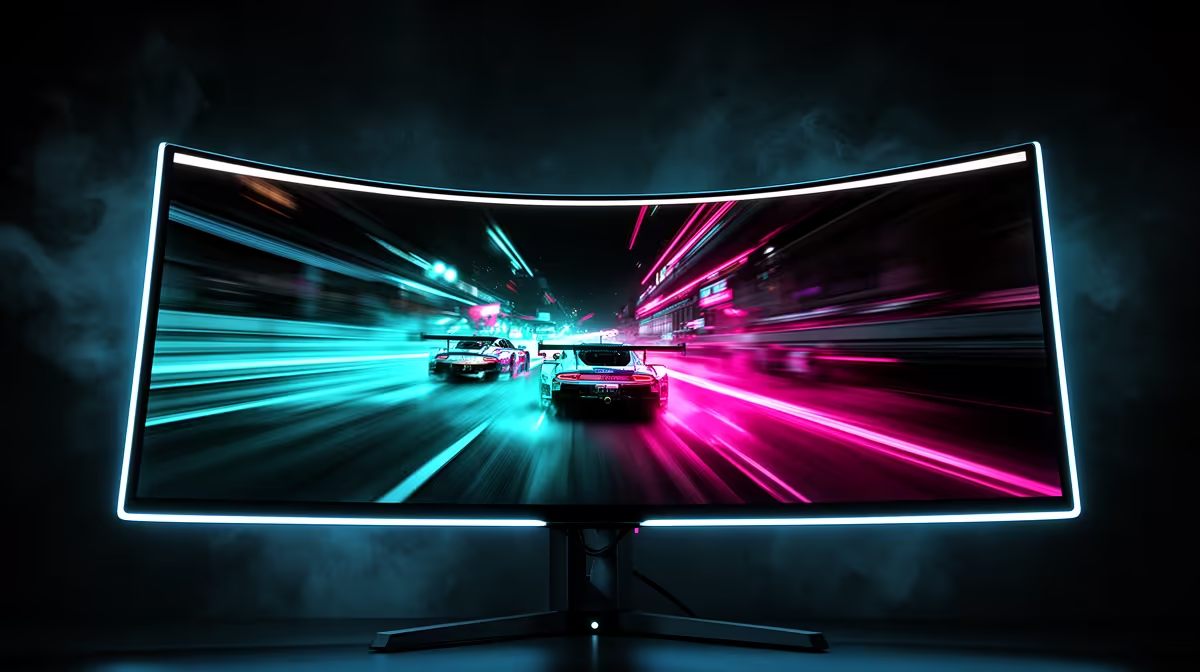
At 75Hz your monitor draws a new frame every 13.3 milliseconds. At 144Hz it draws one every 6.9 milliseconds. That halved frame interval means moving objects, such as an enemy player sprinting across your screen, appear at twice as many positions per second. In a shooter like CS2 or Apex Legends, this translates directly into sharper flick-shots and less perceived blur during fast turns. On a 49-inch ultrawide, the wide field of view amplifies peripheral motion, so the smoothness improvement at 144Hz is arguably even more noticeable than on a smaller display. Most SA gamers who switch from a 75Hz display report that going back feels immediately choppy.
GPU Requirements for 144Hz at 3840x1080 💻
Driving 3840x1080 at 144Hz takes meaningful GPU horsepower. An RTX 4070 or RX 7800 XT can reach near 144 fps in many titles at medium-to-high settings, while older mid-range cards like the RTX 3060 may average closer to 90 to 110 fps in demanding games. Adaptive sync (FreeSync or G-Sync Compatible) on 144Hz ultrawide monitors means even if your GPU delivers 80 to 120 fps variably, the display syncs to the actual frame rate and eliminates tearing without the stutter that fixed-refresh VSync introduces. This makes 144Hz ultrawide accessible without needing the absolute fastest GPU.
When 75Hz Is Acceptable 📺
If you primarily use your ultrawide for productivity, video streaming, and casual single-player games, 75Hz is genuinely adequate. Console gamers connecting a PS5 or Xbox Series X via HDMI to a 49-inch ultrawide are limited to that console's output refresh anyway. A 75Hz ultrawide monitor typically costs R2,000 to R4,000 less than a comparable 144Hz model, which is a meaningful saving in ZAR. The saved budget is better spent on a stronger GPU that can actually feed 144Hz rather than a high-refresh display paired with a card that cannot reach that frame rate.
FreeSync Range Check ⚡
When enabling FreeSync on a 144Hz ultrawide, confirm the sync range covers your typical in-game fps. Many monitors list a range of 48Hz to 144Hz, so if your GPU dips below 48 fps the adaptive sync cuts out and you see tearing. Adjust in-game settings to keep fps above the lower sync limit for consistent smoothness.
FAQ
Can I feel the difference between 75Hz and 144Hz without running a side-by-side test?
Yes. The jump is large enough that most people notice 144Hz feels smoother within seconds of switching, especially in any game with fast camera movement. It is one of the more immediately perceptible hardware upgrades available.
Does 144Hz drain battery faster on a laptop connected to an ultrawide?
The monitor's refresh rate does not directly drain the laptop battery since the monitor is AC-powered. However, maintaining 144 fps in-game does push the GPU harder, which increases laptop power draw and heat. This is a GPU load issue rather than a monitor issue.
What cable do I need to run 144Hz on a 49-inch ultrawide?
DisplayPort 1.4 is the correct cable. HDMI 2.0 on most current ultrawide monitors maxes out below 144Hz at 3840x1080. Confirm your GPU has a DisplayPort output and use a certified DP 1.4 cable.
Looking to move from 75Hz to 144Hz on an ultrawide?
Evetech stocks 144Hz ultrawide gaming monitors across multiple price points, find the upgrade that suits your GPU and budget.