Quick Answer
2.4GHz wireless is better for gaming. It delivers sub-40ms latency versus Bluetooth's typical 100ms to 200ms, bypasses codec compression, and avoids the crowded 2.4GHz Wi-Fi traffic common in South African apartment buildings. For casual listening or mobile use, Bluetooth is entirely adequate.
Why 2.4GHz Wins for Competitive Gaming 🎮
Dedicated 2.4GHz gaming dongles use proprietary protocols that bypass the Bluetooth stack entirely. This avoids the SBC or AAC codec compression Bluetooth applies, delivering near-lossless audio at 20ms to 40ms latency. In competitive titles where footstep and reload audio timing matters, that latency gap is tangible. The dongle holds a fixed wireless channel negotiated at pairing, so it does not compete with smartphones and smart TVs in the same room. In South African sectional title complexes and student residences where multiple households share 2.4GHz spectrum, Bluetooth audio dropouts during gaming are a common complaint that a dedicated dongle largely eliminates.
Where Bluetooth Earns Its Place 📱
Bluetooth's strength is convenience and universality. No USB dongle to carry, and it connects to phones, laptops, and consoles without a free USB-A port. Bluetooth 5.0 and later with aptX Low Latency or LC3 codecs brings latency to 40ms to 60ms, which is acceptable for casual gaming, music, and video calls. For a student moving between a laptop in res, a phone on campus, and a console at home, Bluetooth multipoint pairing to two devices simultaneously is a genuine practical advantage. Battery life is also 10 to 20 percent longer on Bluetooth versus 2.4GHz on the same headset.
Dual-Wireless Headsets: The Practical Answer 💡
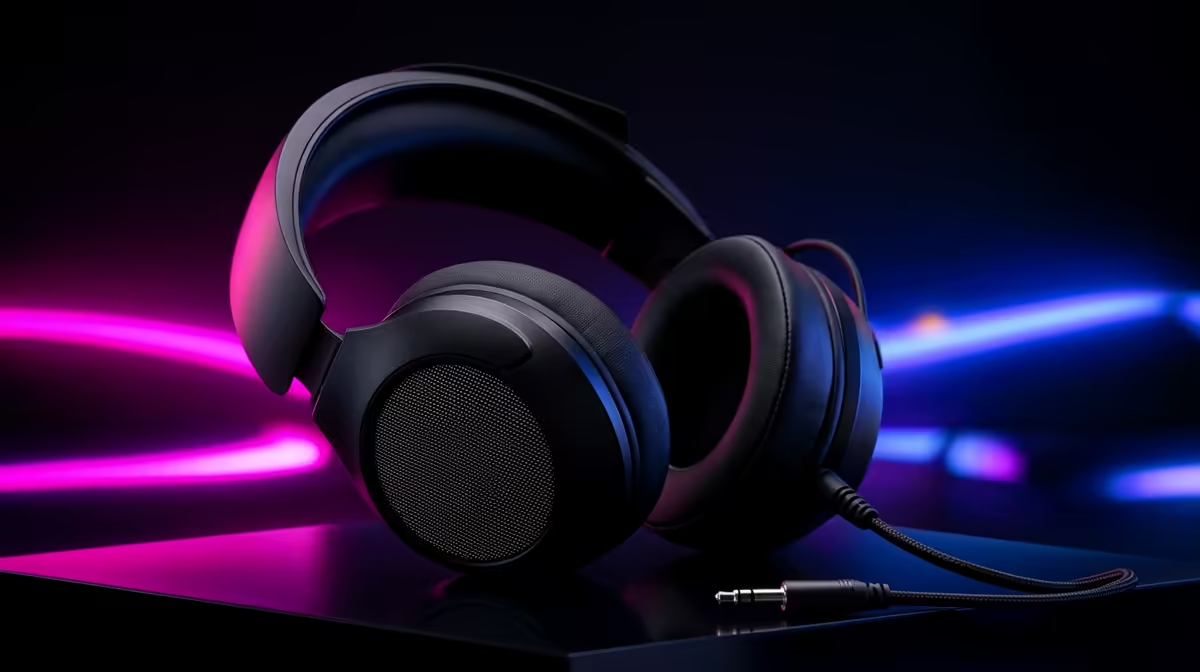
Several current-generation headsets offer both 2.4GHz and Bluetooth running simultaneously. This lets you keep gaming audio on the low-latency dongle while a Teams or WhatsApp call comes through on Bluetooth from your phone, with the headset mixing both streams. Headsets with this feature in the R2,500 to R4,000 range stocked at Evetech cover the full daily-use scenario for South African remote workers who game in the evenings without requiring any device swapping.
Dongle Placement for Best Range ⚡
Plug your 2.4GHz dongle into a USB port on the front panel of your case or use the extender cable to position it at desktop level near the headset. Clear line of sight between dongle and headset dramatically cuts dropout risk in signal-dense SA home environments.
FAQ
Does 2.4GHz wireless interfere with my Wi-Fi router?
Dedicated gaming dongles use dynamic channel selection designed to coexist with Wi-Fi. In practice, interference is rare unless your router runs a fixed channel that overlaps. Most modern routers auto-select and shift away from dongle traffic without manual configuration.
Can I use a 2.4GHz headset on a PlayStation 5?
Yes. Plug the dongle into one of the PS5's USB ports and the console recognises it as a USB audio device. Some headsets also support PlayStation's own wireless standard, a variant of 2.4GHz with official Sony certification.
Is Bluetooth 5.3 significantly better than Bluetooth 5.0 for gaming?
Bluetooth 5.3 improves stability and power efficiency but does not fundamentally reduce audio latency versus 5.0 unless the device also implements the LC3 codec. Codec support matters more than the version number on the box.
Want low-latency wireless audio for your next gaming session?
Evetech carries dedicated 2.4GHz and dual-wireless headsets to suit every setup, from entry-level to premium.