Quick Answer
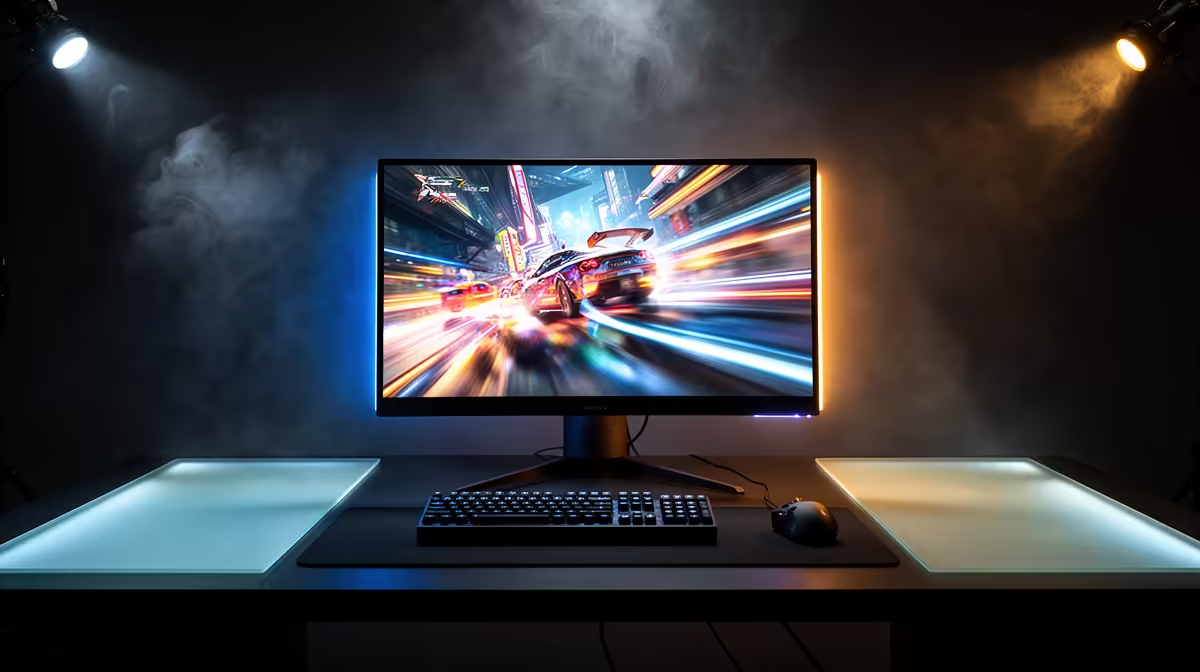
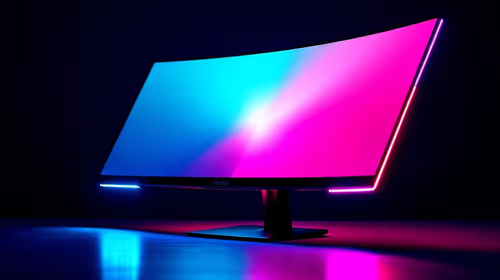
300Hz delivers a meaningfully smoother and lower-latency experience than 165Hz in fast-paced competitive games, provided your GPU can actually reach 300 fps in those titles. The difference is most noticeable in first-person shooters where target tracking and flick shots benefit from reduced motion blur per frame. If your GPU averages 180 fps, a 300Hz monitor delivers almost no advantage over 165Hz.
What the Numbers Mean for Motion and Latency 🎮
Refresh rate determines how frequently the monitor updates its image. At 165Hz, a new frame appears every 6.1 ms. At 300Hz, a new frame appears every 3.3 ms. That 2.8 ms difference represents how quickly the monitor can reflect a change in the game world, such as a target moving across the screen. In a game where mouse input produces a new rendered frame, a 300Hz panel displays that frame 2.8 ms sooner than a 165Hz panel, which is the direct source of the latency advantage. Professional CS2 players and Valorant players report that the smoothness of 300Hz at high frame rates allows finer micro-adjustment of aim during flick shots, though controlled studies put the measurable human performance benefit at the margins. For casual and semi-competitive play, the difference is noticeable but not transformative.
When 165Hz Is Sufficient and When 300Hz Pays Off 🖥️
A 165Hz monitor pairs well with GPUs in the RTX 4070 range (R10,000 to R20,000 in SA), which deliver 150 to 200 fps in most esports titles at 1080p or 1440p. A 300Hz monitor is justified when your GPU produces 250-plus fps consistently. The RTX 5080, RTX 5090, and RX 9070 XT make 300Hz worthwhile. 300Hz QHD monitors now start at R6,000 to R9,000 in the SA market.
Panel Type and Total Build Cost Considerations 🔧
Most 300Hz monitors use Fast IPS panels with 1 ms GTG response. Most 165Hz monitors come in IPS and VA; VA offers 3000:1 contrast versus 1000:1 for IPS at the cost of slower response. A 300Hz IPS suits competitive play; a 165Hz VA suits cinematic gaming. Budget carefully: the step from R4,500 to R7,000 to R9,000 costs R2,500 to R4,500 that might be better invested in the GPU tier that actually justifies 300Hz.
Match Your Frame Rate Target to Your Refresh Rate ⚡
Before deciding between 165Hz and 300Hz, run a benchmark of your main competitive game at your target settings and resolution. If the average fps is below 200, buy a 165Hz monitor and invest the saved budget in the GPU. If average fps consistently exceeds 240, the 300Hz upgrade delivers a real experience improvement.
FAQ
Is the jump from 165Hz to 300Hz more noticeable than from 60Hz to 165Hz?
No. The perceptual jump from 60Hz to 165Hz is far more dramatic because 60Hz has visible screen-tearing and sluggish motion. The jump from 165Hz to 300Hz is a real improvement but requires side-by-side comparison to appreciate fully, unlike the 60Hz to 165Hz change which is immediately obvious to almost anyone.
Do 300Hz monitors cost significantly more in South Africa than 165Hz models?
Yes, currently. Quality 300Hz QHD monitors start at around R6,500 to R9,000 in the SA market, while solid 165Hz QHD monitors are available from R4,000 to R6,500. The gap is narrowing as 300Hz panels become more mainstream.
Can I run a 300Hz monitor at 165Hz if my GPU cannot sustain 300 fps?
Yes. All 300Hz monitors support lower refresh rates via the OSD or Windows display settings. Running a 300Hz panel at 165Hz produces identical output to a native 165Hz panel. You lose nothing by doing this.
Deciding between a 165Hz and 300Hz monitor for your SA gaming setup?
Evetech stocks both refresh rate categories across multiple panel types and resolutions. Browse the monitor section to find the right match for your GPU and gaming goals.