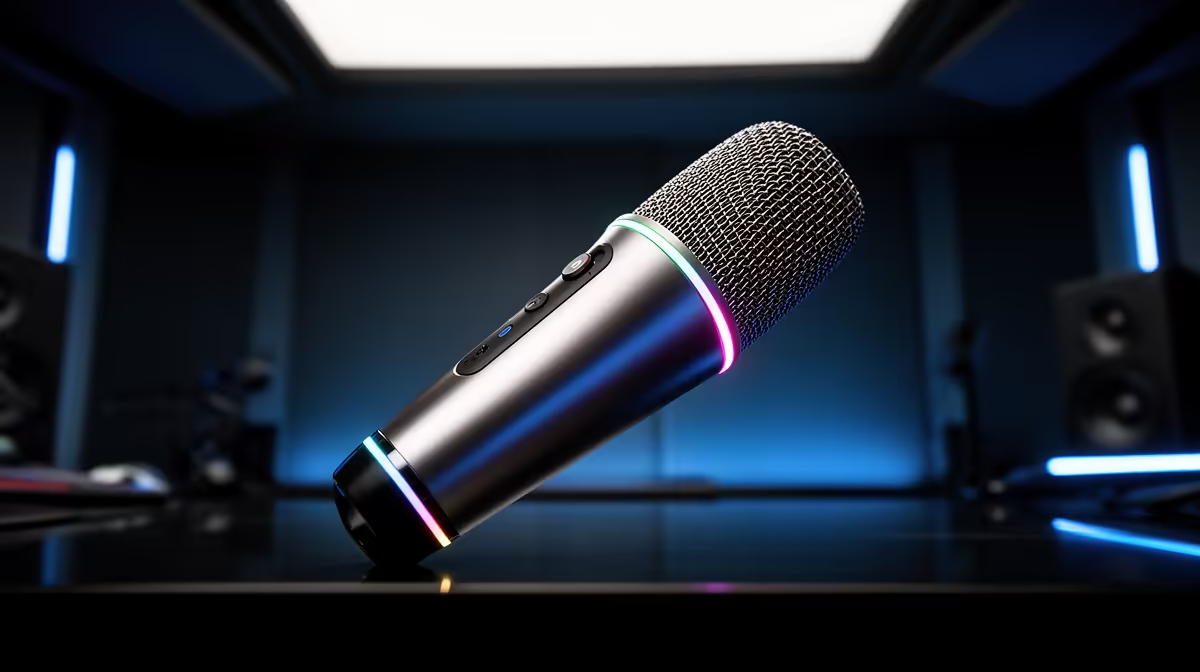
The moment a South African office installs a conference speaker on the boardroom table, the question immediately surfaces: is that 360-degree AI noise-canceling pickup actually better than the directional mic mounted near the primary speaker? Both can produce a clean call, but they solve fundamentally different problems, and choosing the wrong one means your colleagues hear either a hollow, echoey table or a muffled voice just centimetres outside the mic's sweet spot.
Quick Answer
Use a 360-degree AI pickup for meeting rooms where multiple people speak around a table. Use a directional microphone for a solo home-office desk where room noise needs to be excluded. Match the pickup pattern to the number of voices and the space they occupy.
🎙️ How a 360-Degree AI Pickup Actually Works
A 360-degree pickup is built on an omnidirectional capsule, or a tight ring of capsules arranged to cover the full horizontal plane. It listens in every direction simultaneously, which is exactly what you want when four colleagues are seated around a conference table and any one of them might speak at any moment.
The catch is that an omnidirectional design captures equally in all directions: the air conditioning unit in the corner, the printer that wakes up mid-call, the street noise through the window. That is where the AI layer becomes essential rather than a marketing afterthought.
Modern AI noise cancellation on a 360-degree pickup runs a trained speech model in real time. It identifies human voice patterns and treats everything else as noise to be suppressed. Because the omni capsule is pulling in far more ambient sound than a directional design would, the AI is working harder and its contribution to call quality is proportionally larger. A 360 pickup without meaningful AI processing tends to sound muddy in any real-world room. One with a well-implemented noise model can sound genuinely clean even in a busy shared office environment.
Coverage radius matters when you spec one for a room. Most meeting-room units quote effective pickup out to roughly two to three metres, which covers a standard six-seat table comfortably. For larger boardrooms, check whether the manufacturer offers units designed for wider spaces, since pushing a single capsule beyond its rated radius produces uneven volume across the far end of the table.
Beam-Forming Arrays and Intelligent Focus
A beam-forming array uses multiple microphone elements and DSP to steer a focused acoustic beam toward the active speaker. The array dynamically adjusts as different people speak, giving you the full coverage of a 360 design with much of the noise rejection of a directional one. For a high-value boardroom call, a beam-forming array with AI voice isolation is the current best-practice choice.
🔧 Why Directional Microphones Win at the Solo Desk
A directional microphone, typically a cardioid pattern, captures a focused zone directly ahead while the sides and rear of the capsule contribute almost nothing to the signal. For a single person working alone at a home-office desk in Joburg or Durban, this is a significant advantage.
The rear rejection is the key property. A cardioid mic ignores the city noise outside the window, the ceiling fan running overhead, and the other person on a call in the next room. You bring your voice right to the capsule, it captures you clearly, and everything behind you gets cut. No AI processing is required to achieve that rejection because the physics of the pickup pattern is already doing the work.
Distance discipline matters more than people expect. Maximum clarity arrives when the capsule sits 15 to 20cm from your mouth. Drift back and the mic picks up more of the room, gradually undoing the pattern advantage. A boom arm makes consistent positioning effortless across a long meeting.
When a Second Voice Appears
The directional mic scenario breaks down quickly when a second person enters the room and needs to be heard. A cardioid mic aimed at one speaker picks up someone sitting beside them at greatly reduced level, often too quiet for the far end to follow clearly. You either need a second mic, an omnidirectional model, or a beam-forming unit that can pivot between speakers.
This is the precise boundary between the two technologies. One person at a desk: directional. Two or more people in a space: 360-degree pickup or beam-forming array.
⚡ AI Noise Cancellation: Hardware Versus Software
Both 360-degree pickups and directional mics can arrive with AI noise cancellation built into dedicated hardware on the mic itself, or they can rely on software running on the host PC, such as an app-level filter or a plugin inside the conference software.
Hardware-based cancellation processes the signal on a chip inside the device before any audio reaches the USB cable. This has two practical advantages in a South African home office setting. First, the cleaned audio is available in every application simultaneously. Zoom, Teams, Discord and OBS all receive the same filtered signal with no per-app configuration required. Second, it spares CPU headroom on your PC. On a laptop juggling a screen share, a call, and a browser with twenty tabs, that freed processing overhead is not trivial.
Software filters are flexible and often receive updates that improve their models, but they depend on the host machine having enough headroom to run them. On a modest home-office machine under load, a software filter can occasionally lag, causing brief audio artefacts. A hardware chip is indifferent to what the CPU is doing.
Pro Tip ⚡
Before a high-stakes call, play back a 30-second test recording of your actual setup. Listen for echo tails and steady-state hum rather than just overall loudness. Those two artefacts are what the other party's ear locks onto in a long meeting, not the volume level.
🎯 Matching the Technology to the Real Setup
Map the technology to the physical situation and the answer is usually clear.
A single home-office worker on regular calls benefits most from a directional cardioid mic on a boom arm. The pattern does the heavy lifting before any AI is involved.
A small meeting room with three to six people around a table calls for a 360-degree pickup or a beam-forming array. Omni coverage ensures no voice is lost, and the AI layer handles the extra ambient noise the wider capture gathers.
Where budget allows a single purchase that must cover both scenarios, look for devices with a switchable mode: wide 360 coverage and a focused single-speaker beam toggled by software or a physical button.
Frequently Asked Questions
When is a 360-degree pickup the better choice?
In any room where more than one person speaks. The omnidirectional capsule hears voices anywhere around the table, out to roughly two to three metres on most units, so no participant ends up muffled. The AI layer then strips the extra ambient noise the wider coverage gathers.
Why pick a directional mic for solo calls?
A directional microphone narrows its listening zone to the area directly in front of the capsule, so everything off-axis contributes little to the signal. Your voice comes through cleanly while the room behind your chair, whether that is street traffic outside a Durban flat or a TV on in the background, stays out of the recording.
Does AI processing help the 360-degree pattern more than a directional one?
Yes, substantially. An omnidirectional capsule accepts sound from every direction, so it gathers significantly more ambient noise than a cardioid design. The AI is carrying a larger share of the rejection workload on a 360 pickup. Without solid AI processing, an omni unit tends to sound noticeably muddier than a well-positioned cardioid mic.
Can one device switch between both modes?
Some beam-forming array units can. DSP steers an acoustic beam toward the active speaker, and a software toggle or physical button switches between wide 360-degree capture and a focused lobe for a solo setup. If your use case shifts between both environments regularly, this switchable capability is worth prioritising.
Which setup suits a small two-person shared desk?
An omnidirectional mic with AI noise cancellation placed between both speakers, with both within about a metre of the capsule, is the simpler and more balanced choice. A beam-forming unit that can independently focus on whichever speaker is active handles this more elegantly if budget allows.
Ready to hear and be heard clearly on every call?
Browse the conference microphone and USB mic range to find the right pickup pattern for your desk or meeting room, whether you are a solo home-office worker or a full boardroom table.