Quick Answer
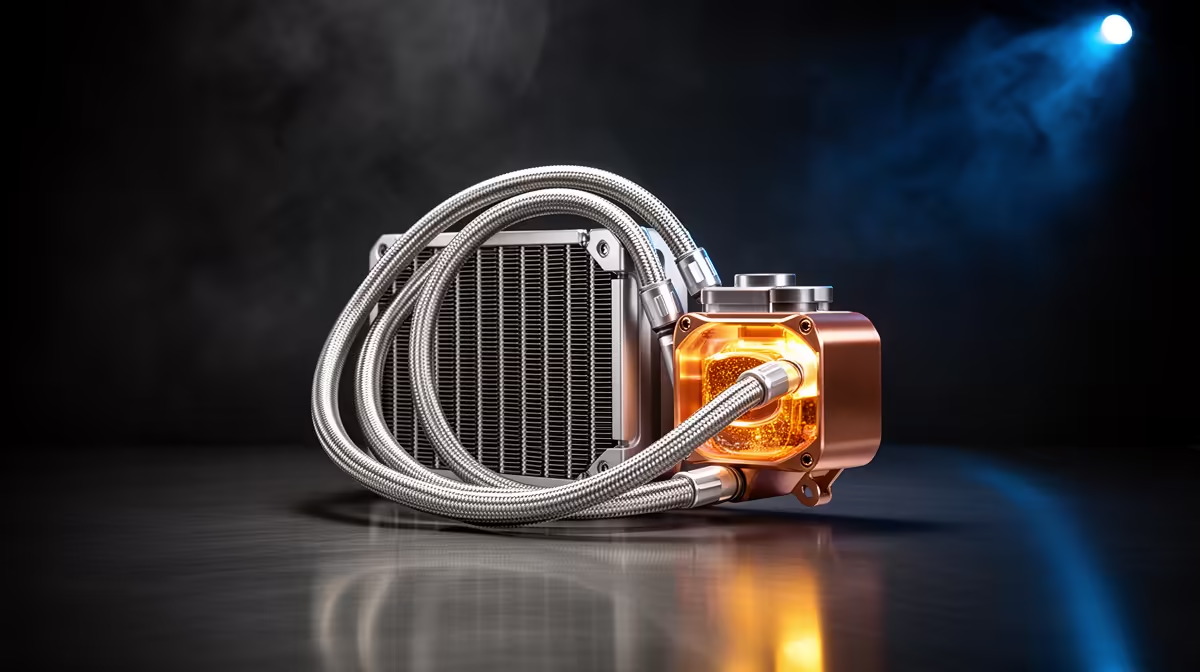
For high-end CPUs like the Ryzen 9 9950X or Core Ultra 9 285K, a 360mm AIO edges out even the best air coolers by 5 C to 10 C under sustained all-core loads. For gaming-focused builds with mid-range CPUs, a premium dual-tower air cooler like the Noctua NH-D15 performs within 3 C and costs less.
Thermal Performance Head-to-Head 🌡️
A 360mm AIO on a Ryzen 9 9950X all-core Cinebench R23 run typically achieves 82 C to 88 C junction temperature depending on fan speed and ambient temperature. A premium tower cooler (be quiet! Dark Rock Pro 5, Noctua NH-D15G2) hits 88 C to 95 C on the same task. The gap widens under sustained multi-hour renders where the AIO's liquid loop absorbs and distributes heat more consistently than air cooling's finite heatsink saturation. For pure gaming loads, where CPU utilisation rarely sustains full all-core TDP, the performance gap between 360mm AIO and premium air cooling narrows to under 3 C, which has no practical impact on frame rates.
Cost and Noise Comparison for SA Builders 💰
Premium dual-tower air coolers like the Noctua NH-D15 cost R1,200 to R1,800 in South Africa. A quality 360mm AIO runs R1,800 to R4,500 depending on tier. The air cooler wins on initial cost for equivalent thermal performance in gaming scenarios. Noise is more nuanced: large air coolers run near-silently at gaming loads (600 to 900 RPM), but a 360mm AIO at gaming loads also runs quietly at 800 to 1,200 RPM fan speeds. Under sustained stress, the AIO's fans ramp audibly, while the tower cooler's fans also spin up, making noise levels comparable at peak.
Why South African Builders Lean Toward AIOs for High-End Builds 🔧
South Africa's summer temperatures (30 C to 35 C ambient in Gauteng) push both solutions closer to their thermal limits. The AIO has more thermal mass in the liquid loop and maintains more consistent CPU temperatures as room temps rise. A tower cooler's performance degrades linearly with ambient temperature; a quality AIO absorbs ambient variation slightly better. Aesthetics also play a role: large tower coolers clear the RAM slots and block part of the motherboard in most cases, while AIO pump heads are compact. In builds with tempered glass panels that are popular in SA gaming setups, the AIO provides a cleaner visual.
Consider Your Case Height Before Choosing Air Cooling ⚡
The best air coolers (NH-D15, Dark Rock Pro 5) stand 165 mm to 168 mm tall. Many popular mid-tower cases list a CPU cooler height limit of 160 mm to 170 mm. Measure the clearance on your specific case before committing to a tower cooler; a 360mm AIO avoids this clearance constraint entirely since the pump head is only 50 mm to 60 mm tall.
FAQ
Does liquid cooling void any warranty in South Africa?
No. Installing an AIO liquid cooler does not void CPU or motherboard warranties in South Africa. Only direct physical damage or overclocking in specific contexts affects warranty claims.
Which is more reliable long term: a 360mm AIO or air cooling?
Air coolers have no moving parts except the fan and theoretically outlast AIOs. Modern AIOs from reputable brands have pump MTBF ratings of 50,000 to 70,000 hours with 5 to 6 year warranties, making reliability differences negligible over typical build lifespans of four to six years.
Can I switch from a tower cooler to an AIO later without issues?
Yes. AIO installation on an existing build is straightforward: remove the air cooler, clean off the old thermal paste, fit the AIO bracket and cold plate, and reconnect cables. It takes under 30 minutes.
Deciding between AIO and air cooling for your high-end build?
Compare 360mm AIOs and premium tower coolers at Evetech to find the right thermal solution for your CPU and case.