Quick Answer
For sustained loads lasting more than 30 minutes, a 360mm AIO consistently outperforms even the best dual-tower air coolers on high-TDP processors, keeping temperatures 6 to 12 degrees Celsius lower during all-core workloads. For gaming alone, a premium dual-tower air cooler like the Noctua NH-D15 or be quiet! Dark Rock Pro 5 trades blows with mid-range 360mm AIOs and costs less.
How Each Cooler Type Manages Heat Over Time 🌡️
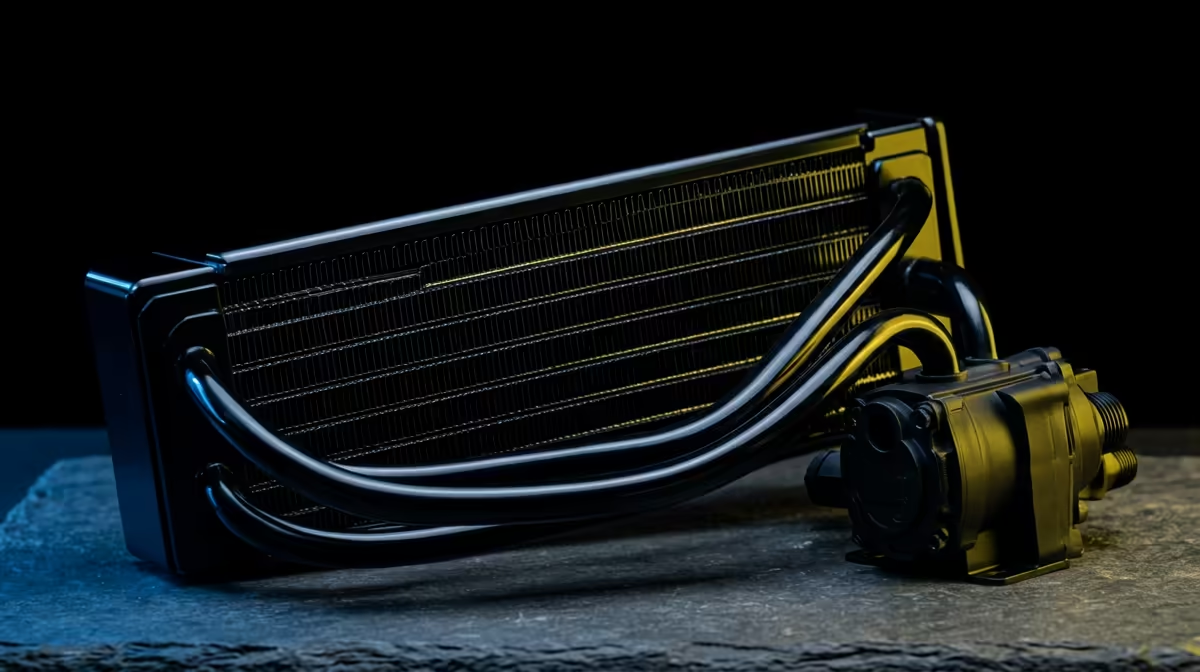
Air coolers dissipate heat through a metal heatpipe-and-fin stack mounted directly above the CPU. This works excellently for burst workloads, but under sustained all-core loads the fin stack absorbs heat until it reaches thermal equilibrium, at which point cooling capacity plateaus. A high-quality dual-tower cooler keeps a Ryzen 9 9950X around 88 to 92 degrees Celsius under a prolonged Cinebench R24 nT run. A 360mm AIO moves heat away from the CPU continuously via liquid, spreading it across a much larger surface area at the radiator; the same processor under the same load typically sits at 78 to 84 degrees Celsius, a meaningful gap for sustained rendering or compiling workloads.
The Case for Air Cooling in SA Builds 💨
Air coolers carry zero leak risk, require no maintenance beyond occasional dust cleaning, and never develop pump failures. In South African builds where the initial outlay matters, a Noctua NH-D15 or be quiet! Dark Rock Pro 4 in the R1,200 to R1,600 range delivers thermal performance close to a 240mm AIO at lower cost. For mid-range gaming rigs running a Core i5-14600K or Ryzen 5 7600X, where power limits stay under 90W during normal gaming, an air cooler is a completely rational choice that avoids the ongoing maintenance a liquid loop requires.
Noise, Size and Long-Term Reliability 🔧
A well-configured 360mm AIO running a quiet fan curve is typically quieter than a dual-tower air cooler at full load, because the radiator's larger surface area means the fans run at lower RPM to achieve the same cooling. However, air coolers have no pump to fail and no tubing to crack over years of use, making them the more reliable option when the build is expected to run for seven or more years without a hardware refresh. SA builders who overclock aggressively will find the AIO's thermal buffer more useful; those who run stock settings on efficient CPUs lose very little by choosing a quality air cooler.
Check RAM Clearance Before Buying an Air Cooler ⚡
Dual-tower air coolers are wide and can physically conflict with tall DDR5 heatspreaders, especially on micro-ATX boards with RAM slots close to the socket. Measure the gap between your socket centre and the nearest RAM slot before ordering; many NH-D15 and similar coolers require at least 35mm of RAM clearance on the CPU-facing side.
FAQ
Is a 360mm AIO always better than air cooling for gaming?
Not always. For gaming at stock CPU settings, a premium dual-tower air cooler matches a mid-range 360mm AIO within 3 to 5 degrees Celsius. The AIO's advantage becomes clear only under sustained all-core workloads or when pushing an unlocked processor beyond its power limits.
Which option is better for a compact mid-tower case?
It depends entirely on the case's radiator support. Many mid-tower cases support a 360mm front or top mount, making AIO installation straightforward. If your case only supports a 240mm radiator, a dual-tower air cooler with a 170mm height limit can be a better fit depending on the clearance between the socket and the left panel.
Do 360mm AIOs void CPU warranties from AMD or Intel?
No. Using a third-party AIO cooler does not void AMD or Intel CPU warranties, provided the cooler is mounted correctly and the CPU is not overclocked beyond the manufacturer's approved ranges.
Deciding between a 360mm AIO and an air cooler for your next build?
Browse both ranges at Evetech to compare options suited to your CPU and case configuration.