Quick Answer
For high-end gaming builds with a CPU TDP above 125W, 360mm radiator support matters more. For mid-range builds with CPUs under 105W TDP, generous air cooling clearance is equally effective and less expensive. The case feature you need depends on which CPU you are pairing and your total cooling budget.
Why TDP Drives the Cooling Decision 🌡️
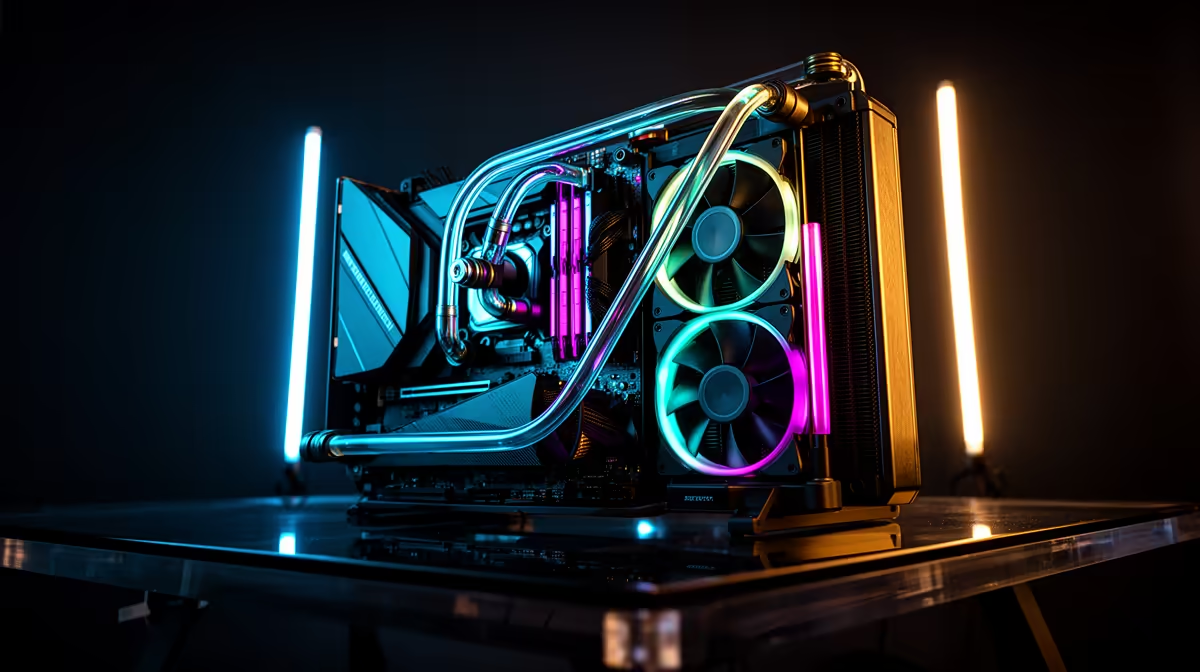
A 360mm AIO liquid cooler handles CPUs that push 150W to 253W TDP sustainably; a high-quality 120mm-tower air cooler like the DeepCool AK620 handles up to 260W TDP according to its spec sheet, but junction temperatures at that ceiling run 10°C to 15°C hotter than a 360mm AIO under the same load. For a Ryzen 7 9700X at 65W TDP, either option holds temps comfortably below 70°C package temperature during gaming. For a Core Ultra 9 285K at 253W, the 360mm AIO is the practical choice for sustained workloads. The case decision follows from this: if you plan on an AIO, 360mm support gives you the most capable option. If you want air cooling, prioritise a case with at least 165mm CPU cooler height clearance to fit a dual-tower air cooler.
Real-World Noise Levels in South African Homes 🔇
SA summers in Pretoria and Durban regularly produce ambient room temperatures above 28°C. In those conditions, air coolers spin their fans at higher RPMs to compensate for reduced thermal headroom, generating 35dBA to 42dBA of fan noise. A 360mm AIO with a properly configured pump curve and three 120mm fans can hold lower RPMs under the same ambient conditions, often staying at 28dBA to 32dBA during gaming sessions. For home gaming and streaming setups where quiet operation matters, 360mm AIO support in the case is worth the extra R1,500 to R2,500 that a quality AIO costs over a premium air cooler.
Case Features That Support Each Cooling Type 🗜️
360mm AIO support requires a radiator mount of at least 394mm along the front or top, plus an internal depth that allows a 30mm-thick radiator with fans to clear the GPU or RAM. Air cooling clearance means the case must accommodate tall dual-tower coolers; anything below 158mm will exclude most competitive air coolers. Some cases offer both: the Fractal Design Define R7, for example, supports 360mm radiators AND has 185mm CPU cooler height clearance, making it versatile for builders who might switch cooling strategies. These premium flexible cases sit in the R2,200 to R3,500 range locally.
Test Fan Curve Before Benchmarking ⚡
Set your AIO or air cooler fan curve in BIOS before running any performance benchmarks. The default turbo curve often runs fans at full speed unnecessarily. A custom step curve that ramps fans gradually above 70°C CPU temp will produce quieter daily use without sacrificing peak thermal performance.
FAQ
Can a 240mm AIO replace a 360mm if I choose an air-cooling-focused case?
For CPUs up to 125W TDP, a quality 240mm AIO performs comparably to a large air cooler and fits in cases with shallower front chambers. However, if your CPU regularly boosts above 150W, a 240mm radiator will struggle to dissipate heat fast enough and will run fans at high RPM continuously, negating the noise advantage.
Do cases with 360mm radiator support always have smaller air cooler clearance?
Not always, but often. To make space for a front-mounted 360mm radiator, the motherboard tray must sit further back, which can reduce the distance from the CPU socket to the top panel, limiting tower cooler height to 155mm to 158mm in some mATX designs. Check both figures in the spec sheet if you want flexibility.
Which is better value for a R20,000 gaming build in SA?
At R20,000, a mid-range build using a Ryzen 7 9700X will have the CPU budget to include a 240mm or 360mm AIO. Allocate around R1,800 to R2,500 for a 360mm AIO and choose a case that supports it. The improved thermals justify the cost at this build tier.
Not sure whether to go AIO or air cooling in your next build?
Evetech stocks a full range of cases, AIOs, and air coolers. Browse the cooling and cases sections to compare options that fit your CPU choice and budget.