Quick Answer
For CPUs with 65W to 125W TDP in gaming builds, a quality 240mm AIO is sufficient and costs R500 to R1,200 less than a 360mm equivalent. For 170W to 250W workstation and high-performance CPUs like the Ryzen 9 9950X or Core Ultra 9 285K, the 360mm radiator holds temperatures 8°C to 14°C lower under sustained load and is the correct choice.
Cooling Capacity: How Radiator Size Affects Thermals 🌡️
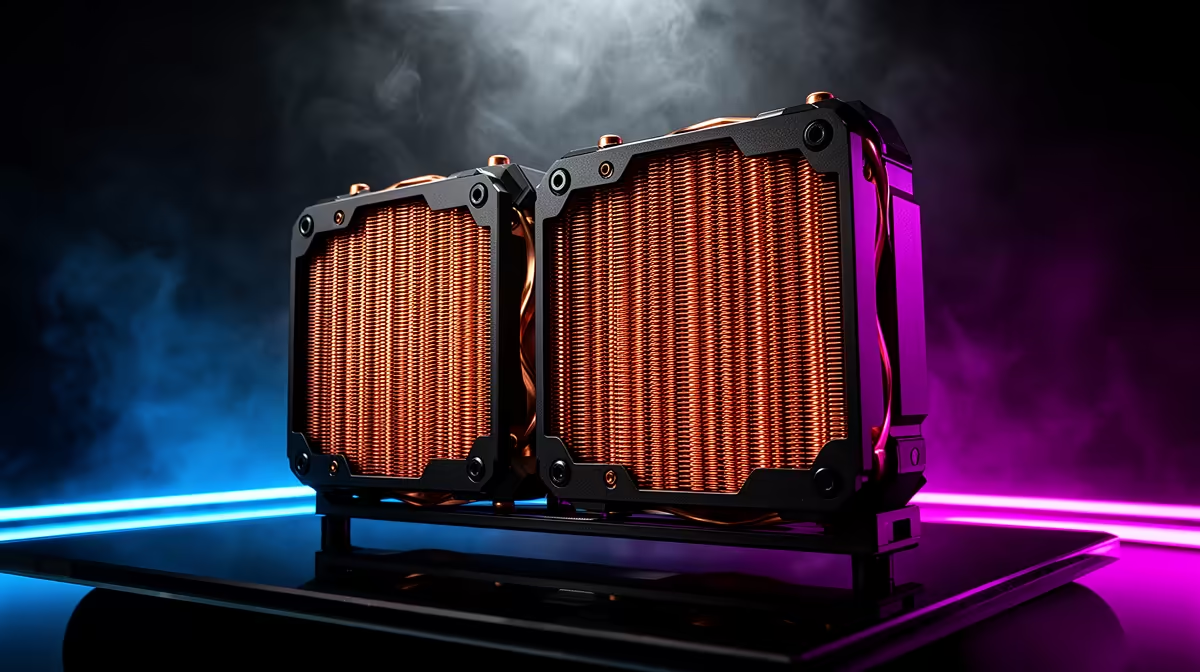
Radiator size determines how much surface area is available to transfer heat from the coolant to the case airflow. A 240mm radiator (two 120mm fans) has roughly 67% of the surface area of a 360mm unit (three 120mm fans). Under sustained all-core loads where heat builds continuously, this matters most. For a Ryzen 7 9700X at 65W to 88W typical gaming power, a 240mm AIO keeps package temperatures well within range, typically 65°C to 78°C at 25°C ambient. Push that same loop to handle a Ryzen 9 9950X at 170W sustained all-core, and the 240mm radiator struggles, with temperatures climbing to 90°C to 95°C while the 360mm unit holds the same workload at 78°C to 87°C.
Gaming Versus Creator Workload Demands 🎮
Gaming loads are intermittent: the CPU handles physics and AI for a few seconds, then drops back. This cyclic load pattern suits a 240mm AIO perfectly; the smaller radiator has recovery time between peaks. Creator workloads are sustained: video encoding, 3D rendering, and compilation push the CPU to 80% to 100% load for minutes or hours. Under these conditions, the 360mm radiator's extra thermal mass provides a meaningful buffer. A content creator using a Ryzen 9 9950X who also games will benefit from the 360mm AIO for both use cases, while a pure gamer on a Ryzen 7 9700X saves R700 to R1,200 and gets adequate cooling from a 240mm unit.
Case Compatibility and SA Market Pricing 💰
A 360mm radiator requires a case with a 360mm-compatible mount at the top or front panel, which most mid-tower and full-tower ATX cases support but compact cases may not. In South Africa, quality 240mm AIOs from reputable brands start at around R1,200 to R1,800. The 360mm equivalent from the same brand adds R600 to R1,200. Premium 360mm AIOs with LCD or AMOLED displays reach R3,500 to R5,500. The pricing gap is predictable enough that the decision can be based purely on CPU TDP and workload type rather than market conditions.
Match Radiator Size to CPU TDP, Not Core Count ⚡
A 16-core CPU in a gaming build that never exceeds 100W is well served by a 240mm AIO. A 6-core CPU running sustained 125W rendering workloads needs a 360mm. Use the CPU's realistic power draw under your actual workload, not the core count or theoretical maximum TDP, as the sizing input.
FAQ
Can a 240mm AIO cool a GPU in a small form-factor build?
AIO coolers only cool the CPU; they have no interaction with GPU thermals. The GPU is cooled by its own heatsink and fans. A 240mm AIO in an ITX build cools the CPU, while the GPU handles its own thermal load independently. The two cooling systems are separate.
Is a 360mm radiator always louder than a 240mm under the same CPU?
No, typically the opposite. At equivalent CPU thermal load, three fans on a 360mm radiator each spin slower than two fans on a 240mm unit working harder to compensate for the smaller surface area. The 360mm AIO is often quieter at the same CPU temperature.
Do 240mm AIOs fit in more cases than 360mm units?
Yes. 240mm AIOs are compatible with nearly all mid-tower, full-tower, and many compact ATX and mATX cases. 360mm units are not supported in some compact mid-towers or cases with VRM heatsinks that obstruct the top-front mounting area.
Not sure whether 240mm or 360mm is right for your CPU and workload?
Browse Evetech's full AIO cooler range across both radiator sizes, with options for AM5 and LGA1851 sockets stocked locally for fast dispatch.