Quick Answer
For a gaming PC used five hours daily, the payback period for the Platinum premium over Gold is approximately four to six years at South African electricity tariffs. If your build costs more than R30,000 and will run for at least four years, Platinum is worth the extra R800 to R1,500. For a budget build under R20,000, Gold is the smarter choice.
Running the Numbers at SA Electricity Tariffs 💰
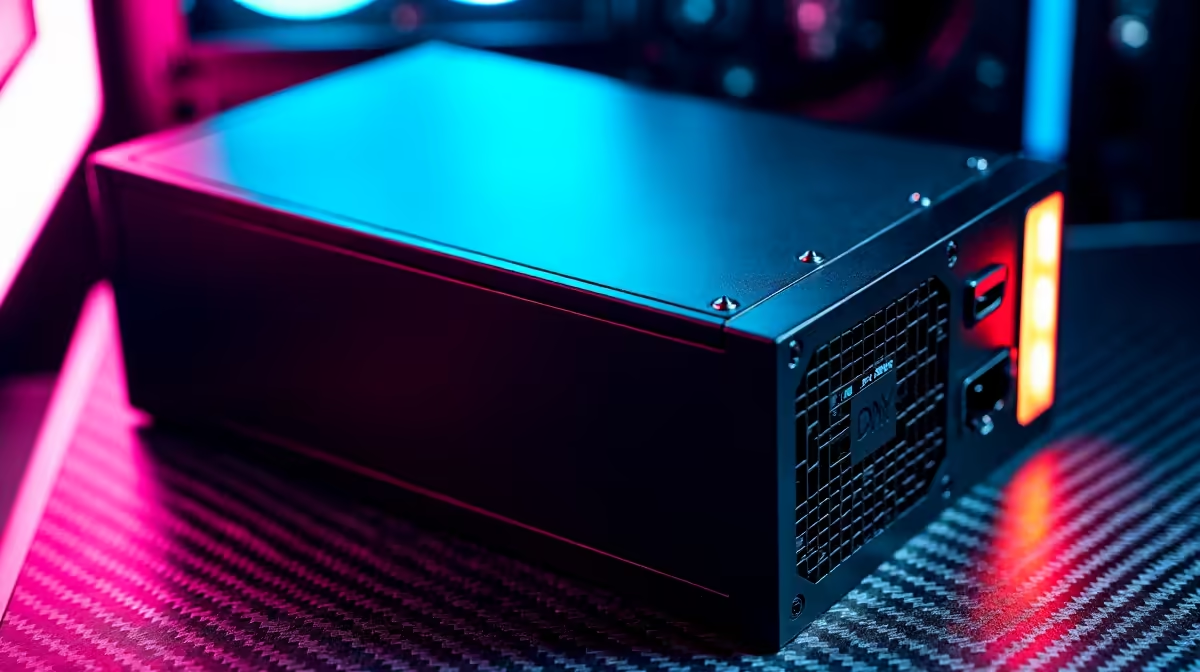
Take a real scenario: 850W PSU at 55% average gaming load (467W draw). Gold efficiency at 50% load is 90%, meaning 519W from the wall. Platinum at 92% means 507W from the wall, saving 12W. Over five hours of gaming daily for 365 days: 12W times 5 hours times 365 days equals 21.9 kWh saved per year. At R2.50 per kWh (mid-range Eskom residential tariff for Johannesburg), that is R54.75 per year in electricity saved. A Platinum PSU premium of R1,200 over an equivalent Gold unit has a payback period of roughly 22 years on electricity savings alone. However, the efficiency gap widens to 3 percentage points at 20% load, and PCs sitting at idle for hours push blended annual savings closer to R100 to R180 per year, reducing payback to six to twelve years.
The Non-Electricity Arguments for Platinum 🔧
The electricity calculation alone rarely justifies Platinum for a gaming PC. The stronger arguments are component quality and heat. Platinum certification forces manufacturers to use superior topologies (LLC resonant converters, synchronous rectification) and better capacitors (Japanese-branded 105-degree units). These choices reduce internal heat generation, which in South Africa's warm climate meaningfully extends capacitor life. A Platinum PSU may last eight to ten years before efficiency degradation becomes notable; a Gold unit from the same manufacturer may last six to eight years. The cost of a mid-build PSU replacement in South Africa, including unit cost and downtime, easily exceeds the upfront Platinum premium.
Matching the Decision to Your SA Build Budget 💡
For a build under R18,000 with a mid-range GPU, a 650W to 750W Gold unit at R2,200 to R3,200 is the correct call. For a build at R25,000 to R40,000 with an RTX 5070 Ti or RTX 5080, the R800 to R1,200 step to Platinum is a small percentage of build cost and buys better component quality protecting a high-value GPU. For a flagship build above R45,000, Platinum at 850W to 1000W is the standard choice.
Measure Your Actual Load Before Comparing Efficiency Tiers ⚡
Most gaming PCs draw 40 to 65% of PSU rated wattage during typical sessions. Run a 30-minute GPU stress test and note the total system wattage from a smart plug or hardware monitor. Use that real figure to calculate your actual efficiency operating point before deciding between Gold and Platinum.
FAQ
Is the Gold-to-Platinum upgrade worth it for a student build in South Africa?
No. For a budget student build, put the R1,000 premium toward a better GPU or more RAM where it directly improves the computing experience. A quality 650W Gold unit from a reputable brand is completely sufficient for student gaming or academic use.
Do Gold and Platinum PSUs carry the same warranty length from the same manufacturer?
Not always. Some manufacturers tier their warranty by product line: a Gold unit in the mid-range line may carry a 5-year warranty while the Platinum premium line carries 10 years. Check the specific product warranty at Evetech at the time of purchase.
Does a Platinum PSU run noticeably cooler in a closed case?
At typical gaming loads, a Platinum PSU generates roughly 15 to 25W less heat than a Gold equivalent. This does not meaningfully impact overall case temperature (usually under 0.5 degrees Celsius difference), but it does reduce the PSU internal temperature and fan speed, contributing to quieter operation and extended component life.
Comparing Gold and Platinum for your next build?
Evetech stocks both efficiency tiers from verified brands. Browse the power supply section at Evetech and filter by wattage to compare current pricing side by side.