Broadcast, simulation and professional visualization can all distribute imagery across several graphics processors, but their definitions of success differ. A multi-GPU synchronization design should preserve those differences: common hardware capacity does not turn three workflows into one generic visual system.
Quick Answer
RTX PRO Sync coordinates as many as eight NVIDIA professional GPUs for broadcast, simulation and visualisation systems whose frames must remain aligned across many outputs.
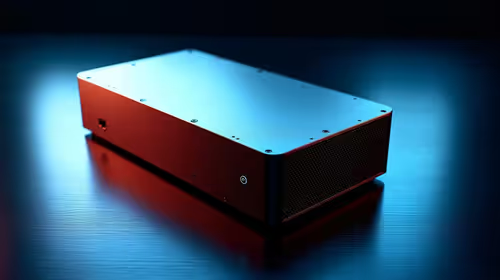
PNY RTX Pro Sync gives professional multi-GPU displays Genlock, Frame Lock and NVIDIA Mosaic. For R19,599, the card covers an eight-GPU design and a synchronized field of 32 screens. Each workload must still define and test its own content, timing and responsiveness requirements.
📡 Translate broadcast needs into timing tests
A broadcast environment should identify its timing reference and the equipment expected to follow it. Genlock serves that alignment role. Frame Lock becomes relevant where graphics resources must coordinate frame presentation across the visual path.
Do not accept "broadcast ready" as a test. Choose the transitions, motion and operating states that could reveal disagreement, then observe them through the complete system. If delay matters, set a measurable end-to-end limit for the project rather than deriving one from the presence of synchronization functions.
Keep on-air consequences visible
Rank failures by what the viewer would notice. A brief mismatch at a prominent wall boundary may matter more than an issue in a rarely used layout. This priority list helps the commissioning team spend time on the most consequential paths.
🧪 Map simulation outputs to processors
Simulation workloads should be divided by application, view and output group. Assign each region to a proposed GPU and mark where the scene crosses into another processor's responsibility. These boundaries become the focus of frame-coordination tests.
Eight NVIDIA RTX Pro GPUs form the outer processor count for PNY RTX Pro Sync. Compare options in Evetech's workstation graphics card range after the software load and outputs are allocated. This count is an architectural limit, not proof of simulation performance.
Validate representative scenarios
Use scenes that resemble actual operating complexity and move attention across the complete display environment. Record which GPU owns each output and which synchronization roles are active. A passing result should be reproducible after a restart, maintenance event or later expansion.
🖼️ Design visualization around the audience
Professional visualization may aim for one broad canvas, several coordinated data views or a mixture of both. NVIDIA Mosaic provides the arranged display capability. The card's overall display boundary is 32 synchronised screens, but the correct quantity comes from sight lines, information density and content use.
Review Evetech's PC monitors against the physical drawing and intended observer positions. Synchronization cannot correct a canvas that is unreadable from the room or badly divided by panel edges.
Keep physical and digital layers distinct
Mosaic can arrange the visual surface; it cannot remove a bezel or choose a mount. Genlock and Frame Lock coordinate timing-related behaviour; they do not select content. Give each project discipline a clear owner so problems are directed to the right layer.
🧾 Build a common commissioning pack
Although the workflows differ, they can share a document structure. Include the timing-reference diagram, GPU-to-output map, panel layout, selected synchronization functions and observable pass conditions. Attach the representative test content and the accepted result.
The PNY synchronization card contributes Genlock, Frame Lock and Mosaic for R19,599. Keep that component price separate from processors, screens and integration work so changes can be assessed cleanly.
Compare relevant graphics card accessories only when the common commissioning architecture has been approved. A supporting part should be selected because the pack gives it a role, not because it appears in a generic multi-GPU list.
Build a cross-use decision matrix
Create columns for timing reference, cross-GPU frame coordination, arranged canvas, application workload and audience consequence. Fill one row for broadcast, one for simulation and one for visualization. The matrix will show shared functions without erasing the reasons behind them.
For example, two workflows may both require Frame Lock while observing different content and failure boundaries. Keep their acceptance material separate even if the underlying card is the same. This avoids treating a successful broadcast demonstration as proof of a simulation result.
Define ownership at handover
Name the team responsible for the timing reference, the person who maintains GPU allocation and the owner of each canvas mode. Give them a short recovery scenario based on their real workflow. The purpose is to show that the documentation can be used after the commissioning specialists leave.
An operator should be able to identify whether a symptom follows an application view, an output group or a broader timing event. That classification produces a better escalation request and reduces the urge to change every layer at once.
Treat expansion as a workload decision
Adding a GPU or display group should begin with a new application, output or viewing requirement. Update the appropriate row in the matrix, redraw affected boundaries and repeat the use-specific test. Remaining capacity below eight GPUs and 32 screens is useful only when a real phase needs it.
Avoid expanding all three environments by the same pattern simply because they share hardware. A broadcast wall may add a timed source, a simulator may add another visual region, and a visualization space may change its audience canvas. Each addition changes different evidence.
Compare proposals by missing outcomes
When reviewing alternatives, list the required outcomes that each design cannot demonstrate. A lower price should not outrank a failed timing test, while a larger GPU allowance has little value if the planned workload never uses it.
Keep the PNY card's R19,599 line visible beside the functions it covers. This makes the acquisition decision legible to technical and budget reviewers without presenting capacity as a generic performance score.
Two synchronisation cards may be used in the individual system, while Mosaic supports 32 simultaneous displays or projectors. The supplied cable inventory provides four 12-inch connections and two measuring 24 inches, giving the installer known internal linking options. That hardware can deliver interactive 3D graphics or high-fidelity video across a large array, with the application and workload determining the actual performance and latency.
Broadcast and simulation teams should also repeat the test after application, driver or output-routing changes.

Frequently Asked Questions
What does multi-GPU synchronization coordinate?
It keeps timing and frame behaviour intentional when one professional visual system is distributed across participating graphics processors.
Do broadcast and simulation use identical tests?
No. They may use the same card functions, but each workflow needs representative content and its own acceptance outcomes.
What are the capacity boundaries?
The PNY design's outer counts are eight RTX Pro GPUs and 32 synchronised displays.
Are application performance figures included?
No workload-specific benchmark follows from the synchronization features. Test the actual application and complete display path.
How much is the card?
PNY RTX Pro Sync is R19,599, excluding the rest of the professional visual system.
Can the same card serve all three workload types?
Its Genlock, Frame Lock, Mosaic and capacity roles can be relevant to broadcast, simulation and visualization. That common fit does not merge their evidence. Each project must allocate its own applications, define the consequence of failure and run representative content through the completed system before accepting the design. Preserve separate operating baselines if the same installation switches among these workloads, since their critical boundaries and observers may differ. Give every baseline a named owner and recovery state.
Label the workload on each saved result.
Ready to design synchronization around the workload?
Compare Evetech's professional graphics, monitors and support categories after broadcast, simulation or visualization acceptance criteria are written.