Quick Answer
A fully modular PSU lets you attach only the cables your build needs, eliminating unused bundles that block airflow inside the case. Removing one or two unused cable sets in a mid-tower can improve GPU exhaust airflow by 5 to 15 percent, translating to 3 to 6 degrees Celsius lower GPU load temperatures in a well-optimised build.
What Full Modularity Means for Cable Management 🔧
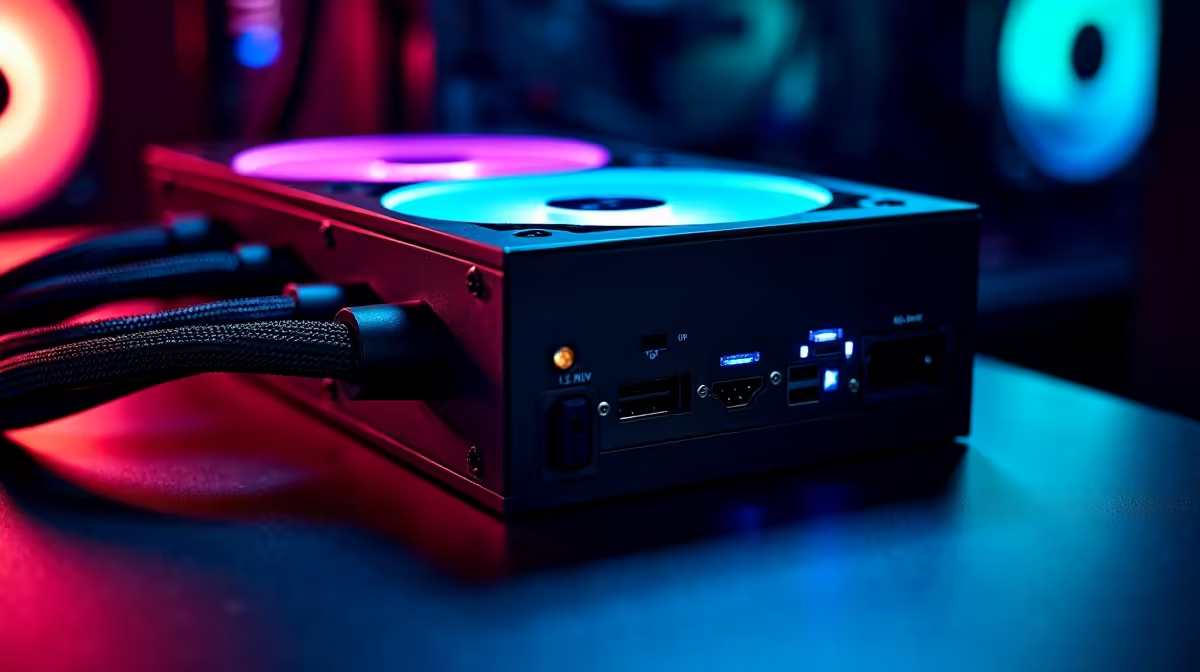
A non-modular PSU has all cables permanently attached. A semi-modular unit hardwires the 24-pin ATX and one EPS CPU cable, with all others detachable. A fully modular unit makes every cable removable, including the 24-pin ATX. For a typical gaming PC, the active cable set is one 24-pin ATX, one to two EPS CPU cables, one 12V-2x6 GPU cable, and two to four SATA cables. A non-modular 1000W PSU ships with ten to fourteen cables, of which four to eight are unused and must be folded behind the motherboard tray. Fully modular design eliminates this: fit only what you need and leave the rest in the accessory bag. The result is a cleaner cable path from PSU to components, with the rear tray space free for better airflow circulation. Locally, fully modular 1000W Gold PSUs are available from around R4,200 to R5,800 at Evetech.
How Cleaner Cabling Affects Airflow 🖥️
Airflow inside a PC case follows the path of least resistance. A bundle of unused cables folded against the back of the PSU shroud raises air resistance in the lower chamber, reducing the volume of air the PSU fan can draw through its intake. In cases without a shroud, unused cable bundles sit directly in the GPU exhaust path between the card and the rear exhaust fan. Removing this obstruction allows GPU exhaust to reach the rear fan more directly. In practical mid-tower builds, the GPU temperature delta between clean modular cable management and bundled non-modular cables is 3 to 8 degrees Celsius under sustained gaming load. In SA summer conditions where baseline GPU temperatures are already elevated, this headroom is meaningful rather than marginal.
Route the EPS Cable Before Installing the Motherboard ⚡
The EPS CPU cable is the most difficult to route in a fully built system because it travels from the PSU at the bottom to the CPU socket near the top. Before installing the motherboard, feed the EPS cable through the routing grommet behind the board and up behind the tray first, then install the board over it. Attempting to route the cable after motherboard installation often requires partial disassembly.
FAQ
Can I use third-party cable sets with a fully modular PSU?
Only cables designed specifically for that PSU model. Modular connector pinouts vary between manufacturers and sometimes between product lines from the same brand. Using a cable from a different brand's PSU can remap power pins to ground pins, causing immediate hardware damage. Always use supplied cables or confirmed-compatible replacements from the same brand.
Is there a downside to fully modular compared to hardwired units?
Modular connectors add a small amount of electrical resistance at each connection point. In practice, for consumer-grade PSUs, this resistance is negligible at rated current levels. The more practical concern is ensuring connectors are fully seated: a partially inserted cable is a failure point that hardwired designs avoid.
How should I store unused modular cables for future builds?
Store in a labelled zip-lock bag alongside the PSU manual. When upgrading the case or changing storage configurations, having the correct cable set immediately available saves time. Some PSU packaging includes a dedicated accessories bag for this purpose.
Clean cables, cooler build?
Evetech stocks fully modular power supplies from 650W to 1600W in Gold and Platinum efficiency tiers. Browse the power supply section to find the right modular unit for your case and GPU combination.