Quick Answer
The most impactful ergonomic features for extended gaming sessions are height adjustment of at least 100 mm of travel, tilt adjustment, swivel, and a monitor stand that allows precise positioning. Flicker-free backlights and low blue light modes compound the benefit for sessions lasting four hours or more.
Monitor Stand Adjustment Range Explained 🔧
Stand adjustability is the most neglected ergonomic feature in budget gaming monitor purchases. A monitor whose screen centre sits at or slightly below eye level reduces neck flexion, the most common source of gaming-related neck and shoulder strain. Most entry-level gaming monitors offer only tilt adjustment (minus 5 to positive 15 degrees), insufficient if your desk height differs from the monitor's default stand height. Mid-range and premium monitors add height adjustment of 100 to 130 mm and swivel of 15 to 30 degrees. This allows you to dial in a precise position regardless of chair height.
Flicker-Free and Low Blue Light: Real Benefits 💡
PWM dimming flickers the backlight at 60 Hz to 3,000 Hz to regulate brightness. At lower PWM frequencies, some users experience headaches and eye fatigue during extended sessions. Flicker-free displays use DC dimming instead, eliminating backlight flicker entirely. Low blue light modes reduce the blue wavelength component of the display's output, linked to suppressed melatonin production and increased eye fatigue. For SA gamers who game after dark, enabling a hardware-level low blue light mode (not just Windows Night Light) can noticeably reduce perceived eye strain at the end of a four-hour session.
Chair and Desk Pairing for a Complete Setup 🪑
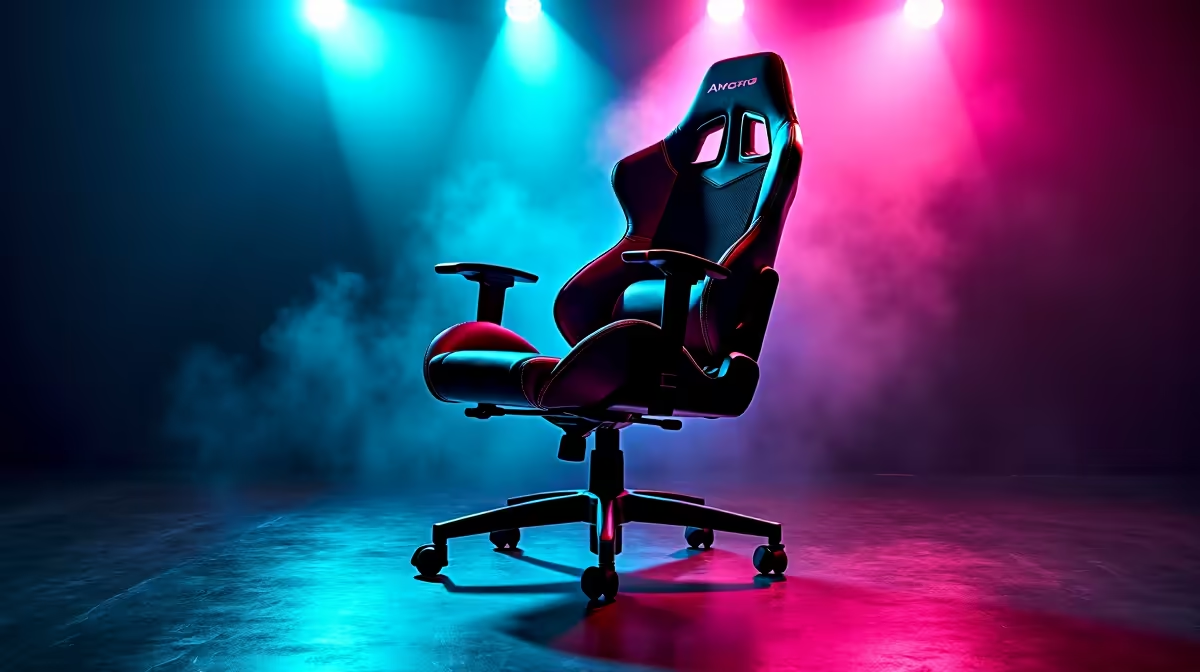
Monitor ergonomics are inseparable from chair and desk height. The optimal ergonomic triangle: feet flat on the floor, thighs parallel to the desk surface, screen top edge at or slightly below eye level, and keyboard at elbow height. SA gaming chairs typically raise seat height to 45 to 55 cm, placing average users' eyes at 110 to 120 cm above floor level. A gaming desk at 74 to 76 cm height combined with a monitor stand that raises the screen centre to 115 to 120 cm covers this range comfortably. If the stand does not reach this height, a monitor arm costing R600 to R1,200 locally provides infinite height and depth adjustment.
Check Viewing Distance With the Arm-Reach Test ⚡
Sit in your gaming chair in normal posture and extend your arm forward. Your fingertips should nearly touch the screen centre at comfortable arm length. If the screen is farther away, you are straining to read fine detail. Bring the monitor closer using a VESA arm. This check takes ten seconds.
FAQ
How important is monitor height compared to chair height for ergonomics?
Both matter equally. Ergonomic benefit requires aligning the monitor, chair, and desk as a system. Adjusting only one element while leaving others misaligned negates much of the benefit. Start by setting chair height so feet rest flat, then align the monitor to your resulting eye level.
Do gaming monitors have better ergonomic features than office monitors?
Not necessarily. Many office monitors prioritise ergonomic adjustability over gaming specifications, offering four-way stands as standard. Gaming monitors at the entry level often prioritise refresh rate while the stand is an afterthought. Check the specification sheet for tilt-swivel-height range before purchasing.
What is the recommended distance from a 34-inch ultrawide for gaming?
For a 34-inch ultrawide, the recommended viewing distance is 80 to 100 cm from eye to screen. Closer than 70 cm requires excessive lateral eye movement. Further than 110 cm makes fine detail at WQHD harder to resolve, negating the resolution advantage.
Building a setup for marathon gaming sessions?
Evetech stocks gaming monitors with full ergonomic stands alongside gaming chairs and accessories for extended comfort. Browse the PC hardware range to assemble a setup built for long sessions.