Quick Answer
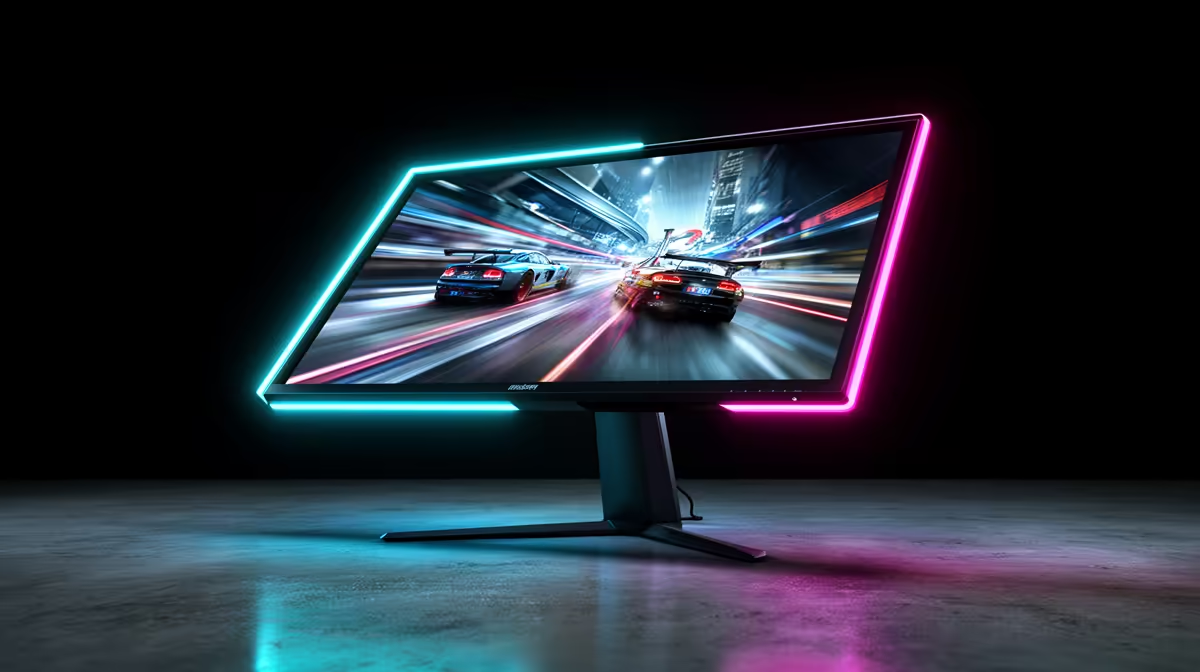
A 0.3ms Fast IPS response time refers to the GtG (grey-to-grey) pixel transition speed measured at optimal overdrive settings. At this speed, trailing or ghosting behind fast-moving objects is essentially invisible to the human eye, placing Fast IPS panels in the same practical motion-clarity tier as TN panels while retaining far superior colour accuracy and viewing angles.
How Fast IPS Achieves 0.3ms Without TN Compromises 🔧
Traditional IPS panels had GtG response times of 4ms to 8ms because the liquid crystal molecules rotate more slowly than those in TN panels. Fast IPS technology applies a stronger electrical field and uses specially formulated liquid crystal compounds to accelerate that rotation. The result is a sub-millisecond GtG figure that was previously impossible for IPS technology. Monitors like the LG 27GP950-B (Nano IPS) and the ASUS ROG Swift Pro PG248QP exploit this approach, the latter hitting a verified 0.3ms GtG at 540Hz refresh rate while keeping the wide colour gamut and 178-degree viewing angles IPS is known for.
Motion Clarity: Response Time vs Refresh Rate vs MPRT 🎮
Response time and refresh rate are related but distinct. A 0.3ms GtG response time tells you how fast each pixel changes colour. MPRT (moving picture response time) measures the perceived blur during a full frame cycle and is often 1ms or lower at 240Hz with backlight strobing enabled. At 240Hz, each frame is displayed for approximately 4.17ms, so even a 1ms GtG panel leaves most of the frame period as static hold time, which is where motion blur actually originates. ELMB Sync-style strobing reduces this by only illuminating the backlight during the sharpest part of the frame, cutting perceived MPRT to around 0.5ms on flagship panels.
Where 0.3ms Fast IPS Makes a Real Difference 🏆
In competitive FPS titles such as Valorant or CS2, fast target acquisition at framerates above 200 fps becomes meaningfully cleaner on a 0.3ms Fast IPS panel compared to a 5ms IPS screen. The difference is smaller versus other sub-1ms displays. Where Fast IPS genuinely outperforms OLED for some use cases is brightness: Fast IPS panels regularly sustain 400 to 600 nits across the full screen, which matters in brightly lit South African rooms or LAN venues where overhead lighting washes out darker OLED panels. Locally, 240Hz Fast IPS monitors are priced between approximately R5,500 and R11,000.
Overdrive Sweet Spot ⚡
Setting overdrive too high on a Fast IPS monitor causes inverse ghosting, where a bright corona appears ahead of moving objects. Set overdrive to Normal or Medium in the OSD and only push it to Extreme if you are running the monitor at its rated maximum refresh rate.
FAQ
Is 0.3ms GtG the same as 0.3ms input lag?
No. GtG measures pixel colour transition speed, while input lag measures the delay from a mouse click or keypress to the frame appearing on screen. Input lag on most 240Hz monitors sits between 1ms and 4ms regardless of the panel GtG figure. Both matter for competitive gaming, but they are independent specifications.
Can the human eye perceive the difference between 0.3ms and 1ms GtG?
Under controlled test conditions at 240Hz or above, trained players can detect a marginal improvement, but in typical play the difference between 0.3ms and 1ms GtG is negligible. The refresh rate and consistent frame delivery from the GPU have a much larger practical effect on perceived smoothness.
Do 0.3ms Fast IPS monitors cost significantly more in SA?
Monitors rated at 0.3ms GtG are typically flagship 240Hz or higher panels and carry a corresponding price, usually between R8,000 and R14,000 locally. Budget IPS gaming monitors at 1ms GtG are available from around R3,500 and are a better starting point if your GPU cannot sustain framerates above 165fps.
Want the sharpest motion clarity on an IPS panel?
Evetech stocks Fast IPS and high-refresh gaming monitors across a range of price points. Visit the monitors section at Evetech to compare specs and find the right panel for your setup.