Quick Answer
Copper water blocks and aluminium radiators serve complementary roles in a CPU cooling loop. The copper block absorbs heat from the CPU at the source with high thermal conductivity (around 385 W/m·K), while the aluminium radiator dissipates that heat into the air efficiently across a large surface area. Understanding each component's role helps you evaluate AIO and custom loop coolers more accurately.
Copper Water Blocks: Heat Absorption at the Source 🔬
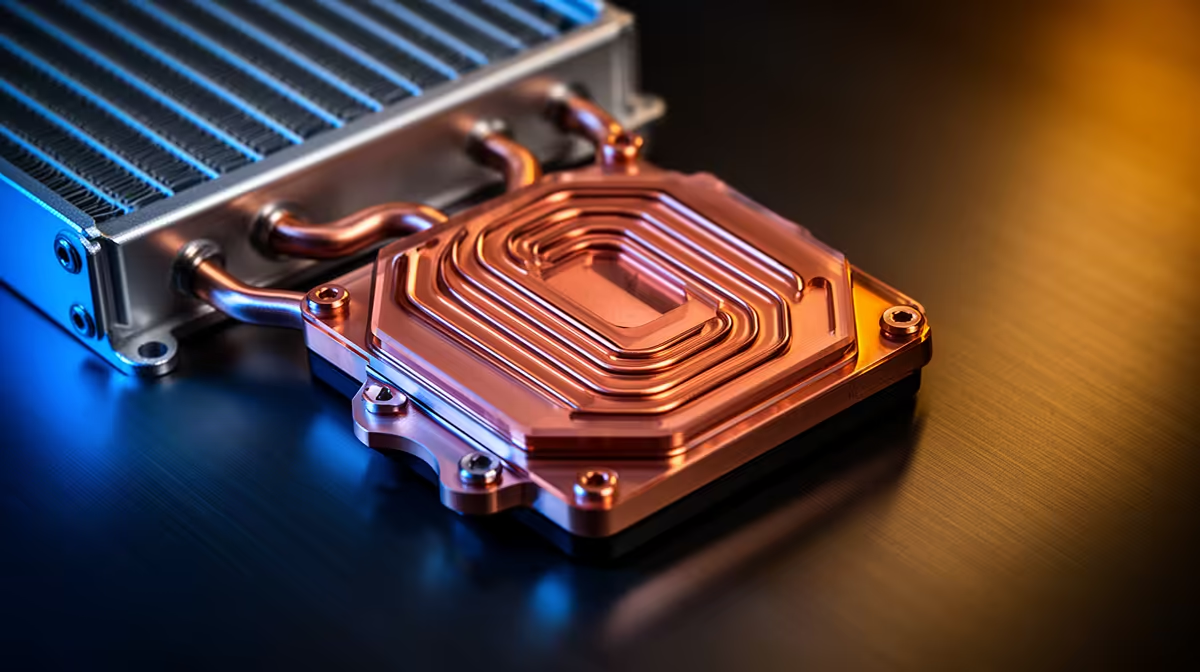
A water block (or cold plate in AIO terminology) is the component that makes physical contact with the CPU's integrated heat spreader (IHS). The block's base is made from copper because copper has the highest thermal conductivity of any practical metal, moving heat from the hot IHS surface into the circulating coolant faster than any alternative. Premium water blocks use a micro-fin or jet-plate design internally, where the copper base is machined into hundreds of thin fins or nozzles that maximise coolant contact surface area. This design is particularly important for modern high-density CPU dies: a Ryzen 9 9950X on AM5 concentrates over 170W of heat across a relatively small die area, and the micro-fin geometry ensures the coolant sweeps this heat away before it accumulates into a thermal spike.
Aluminium Radiators: Heat Dissipation Across Surface Area 🌡️
The radiator's role is to transfer heat from the warm coolant to the surrounding air.
The Coolant Loop Connecting Both Components 🔧
The pump and coolant are the connective tissue between the copper block and the aluminium radiator. Coolant absorbs heat at the cold plate, travels through flexible tubing to the radiator, releases heat to the air through the radiator fins, and returns cooled to the cold plate. The rate at which this cycle completes (determined by pump flow rate) and the efficiency of heat transfer at both ends (determined by cold plate geometry and radiator surface area) are the two primary performance variables. In a sealed AIO, these are fixed by the manufacturer's design. In a custom loop, each component can be chosen and optimised independently for specific CPU and GPU heat loads.
Radiator Fin Dust Management ⚡
In South African homes with sandy or dusty environments (particularly in Gauteng and the Northern Cape), radiator fins accumulate dust much faster than in coastal cities. Inspect your radiator fins every six months and clean them with compressed air blown perpendicular to the fin direction. Clogged fins can reduce thermal performance by up to 15%, which is equivalent to losing one degree of ambient temperature buffer on a hot summer day.
FAQ
Does the type of coolant affect how well copper and aluminium work together?
Yes. The coolant must contain corrosion inhibitors to prevent galvanic corrosion at the copper-aluminium junction. Factory-sealed AIOs use pre-mixed inhibited coolant. Never refill with plain distilled water, as it lacks the inhibitors needed to prevent slow corrosion of both the copper block and aluminium radiator joints.
Can I upgrade just the water block in an AIO?
Not on a standard sealed AIO. The cold plate, pump, and tubing are a sealed unit and are not designed for component-level user replacement. Custom loops allow independent water block selection; sealed AIOs do not.
How does copper cold plate size affect real-world temperatures?
A cold plate that fully covers the CPU's IHS allows heat to spread evenly into the coolant. A small cold plate that only contacts the central portion of a large IHS creates a thermal gradient, with the IHS edges running hotter than the centre. For large-die chips like the Ryzen 9 9950X, a wide-coverage cold plate can reduce peak hotspot temperatures by 5 to 10 degrees Celsius versus a compact legacy design.
Want to understand exactly what you're buying in an AIO?
Evetech lists cold plate design details and radiator specifications for every liquid cooler in stock, so you can compare thermal architecture before purchasing.