Quick Answer
Lambda A (Lambda A-rated) PSUs measure below 25 dB(A) at typical load and qualify as near-silent by room acoustics standards. Active-cooled PSUs without Lambda A certification run 30 to 45 dB(A) under load. Choose Lambda A for home office and work-from-home setups, active-cooled for maximum thermal headroom in high-ambient SA environments where silence is less critical.
What Lambda A Certification Actually Measures 🎙️
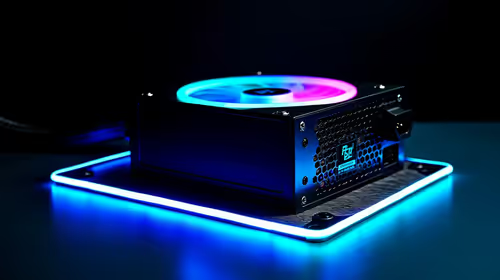
The Cybenetics Lambda noise rating system, widely adopted by premium PSU brands, rates acoustic output at 50 percent load in a controlled anechoic environment. Lambda A indicates below 25 dB(A), Lambda AA below 20 dB(A), and Lambda S is passive (zero fan noise). A PSU rated Lambda A at 50 percent load may still spin its fan during a full-load gaming session, so check whether the unit specifies the noise rating at 100 percent load or only at 50 percent. The most practical Lambda A units for South African gaming use cases combine a semi-passive fan mode (fan off at light loads) with a low-speed fan curve at gaming loads, achieving under 30 dB(A) even at 700W output.
Active Cooling: When More Airflow Beats Silence 🌡️
Standard active-cooled PSUs use a 120mm or 135mm fan that spins proportionally to internal temperature and load. At full load they typically measure 35 to 48 dB(A), which is audible over ambient room noise. For builds running an RTX 5090 or a dual-GPU render workstation in a dedicated gaming room with no acoustic treatment, the extra fan airflow provides meaningful thermal headroom, keeping capacitors and the switching stage cooler during long sessions. South Africa's warm Highveld summers make active cooling more justifiable in compact cases where PSU temperatures can reach 45 to 50 degrees Celsius under sustained load.
Choosing Between the Two for Your SA Setup 🔧
For a home office or work-from-home desk where video calls, streaming, and gaming share the same space, Lambda A or better is the choice to make. PSUs with Lambda A ratings from established brands typically cost R3,200 to R5,500 at local retail in the 750W to 1000W range. For a dedicated gaming room, lan-party build, or system under a desk in a noisy lounge, standard active cooling at a lower price point is perfectly acceptable. A practical middle ground is a hybrid fan mode PSU with a good efficiency rating: fan off below 40 percent load, quiet fan curve above it, without the formal Lambda A certification but close in practice.
Noise Matters More Than You Think on Video Calls ⚡
If your PC shares desk space with your microphone for work meetings, a PSU running 40 dB(A) under light load is clearly audible to call participants. Lambda A or semi-passive PSUs that idle silently eliminate this problem entirely without requiring acoustic panels or mic noise gates.
FAQ
Is a fanless (passive) PSU practical for a gaming PC in South Africa's climate?
Passive PSUs, rated Lambda S, are designed for light workloads and low ambient temperatures. Running a passive PSU in a high-wattage gaming build in a warm SA room risks overheating the unit. Passive designs are best reserved for HTPCs or low-power productivity builds under 300W.
Does a quieter PSU affect gaming performance?
Not directly. A PSU's noise is a byproduct of its fan speed, which is thermal management for the unit itself. A quieter PSU that runs cooler under load may contribute marginally to lower chassis temperatures, which can benefit sustained GPU boost clocks, but the effect is small compared to case fan configuration.
How do I measure the actual noise level of my PSU in my setup?
Use a smartphone decibel meter app and measure from roughly 50cm in front of the case with all other fans at idle. Then switch to full gaming load and remeasure. The difference tells you how much the PSU fan contributes to total system noise, helping you decide if an upgrade is worthwhile.
Want a quieter PC without sacrificing power?
Evetech stocks semi-passive and Lambda A rated PSUs suitable for home office and gaming builds across multiple wattage classes.