Quick Answer
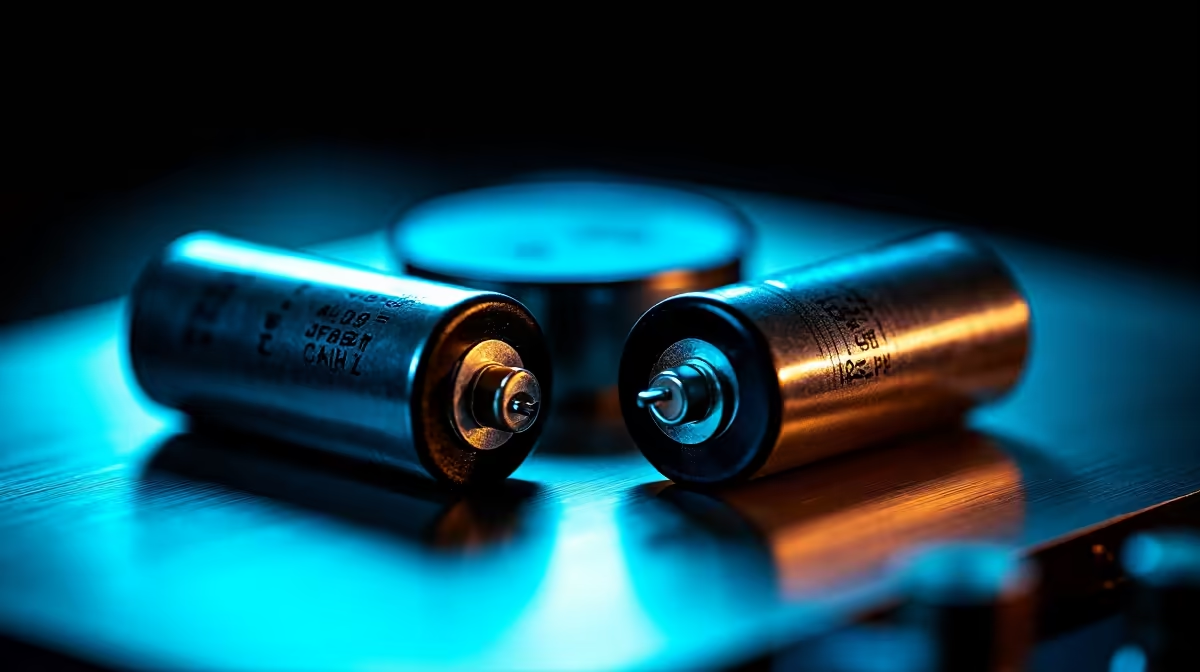
Military-grade capacitors rated at 105 degrees Celsius last two to five times longer than standard 85-degree parts under sustained load, and solid-state chokes with high saturation current eliminate magnetic whine while maintaining clean voltage under current spikes. These components directly extend the usable life of motherboards, PSUs, and GPU power delivery circuits.
What the Specifications Actually Mean 🔧
A standard electrolytic capacitor is rated for 1,000 to 2,000 hours at 85 degrees Celsius. A 105-degree military-spec equivalent is rated at 5,000 to 10,000 hours at that same temperature. Because capacitor lifespan halves for every 10-degree rise above its rating, the 105-degree unit begins with a massive baseline advantage. Chokes rated to military standards use low-permeability ferrite cores with higher saturation current: they handle transient current spikes without entering saturation, which would distort voltage output. On a motherboard VRM powering an overclocked Ryzen 9 9950X or Core Ultra 9 285K drawing sustained 200W or more, unsaturated chokes mean cleaner power delivery and more stable boost clocks. Premium motherboards with confirmed military-grade VRM components sit in the R3,500 to R8,000 range locally and are available at Evetech.
Where These Components Appear and Why It Matters 🖥️
Military-grade capacitors appear in three main locations: motherboard VRM sections, PSU primary-side bulk capacitors, and GPU power delivery circuits. The PSU location matters most: a failing primary bulk capacitor can emit voltage spikes that damage the motherboard, GPU, and storage simultaneously. A motherboard capacitor failure affects CPU stability but leaves other components unharmed. For South African builders where summer ambient temperatures in unair-conditioned rooms routinely reach 33 to 36 degrees Celsius, the thermal advantage of 105-degree caps is directly applicable: standard caps operating at 65 degrees with only 20 degrees of headroom age faster than military-grade caps with 40 degrees of headroom at the same internal temperature. A premium board or PSU with these components should deliver seven to ten years of reliable service under enthusiast workloads.
Verify the Temperature Rating, Not Just the Label ⚡
Some boards advertise military-grade components without specifying the actual temperature or hour rating. Look for explicit 105C or 10K-hour figures in the product specification table, not just in the headline feature list. Budget boards sometimes use 105-degree caps only on low-current rails while fitting standard parts on the main VRM where it matters most.
FAQ
Do military-grade components improve benchmark scores?
No. Their benefit is lifespan and stability under thermal stress, not raw performance. The difference appears over years of operation, especially in warm environments or systems running 24 hours a day for rendering or server tasks.
Are solid polymer capacitors better than military-grade electrolytics?
For low-voltage, high-frequency VRM applications, solid polymer caps have better frequency response. Military-grade electrolytics are preferred on PSU primary stages where high-voltage handling matters more than frequency response.
Should I prioritise military-grade caps on the motherboard or the PSU?
Prioritise the PSU. A failing PSU capacitor can damage everything downstream simultaneously. A motherboard capacitor failure is typically isolated to CPU instability, a narrower and less catastrophic outcome.
Building for the long haul?
Evetech stocks motherboards and PSUs from brands that use 105-degree Japanese capacitors and military-spec chokes across mid-range and flagship lines. Check the components section for options suited to your platform.