Quick Answer
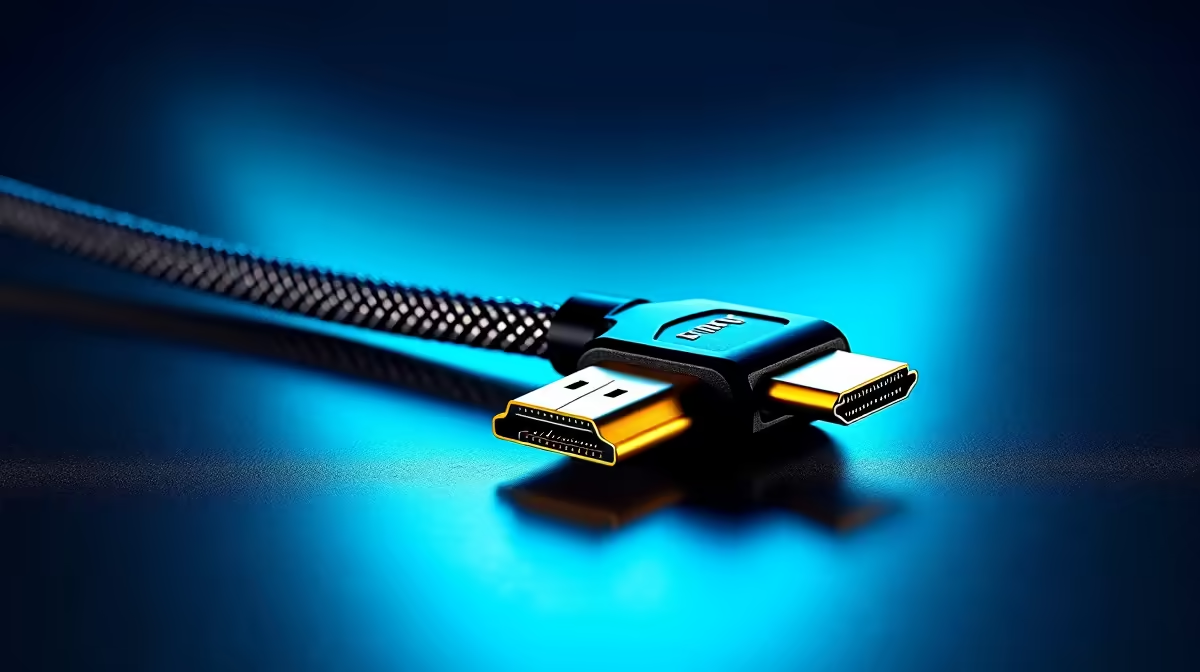
Signal degradation in passive copper video cables becomes measurable above 1.5m and noticeable above 3m for 4K 60Hz signals. At 1.5m to 2m with a certified DisplayPort 1.4 or HDMI 2.1 cable using AWG 24 to 28 conductors, signal integrity is maintained. The solution for longer runs is an active cable or repeater, not a premium passive cable.
Why Signal Degrades Over Distance 📡
Copper conductors have inherent resistance and capacitance per unit length. At 4K 60Hz over DisplayPort 1.4, the signal runs at 8.1 Gbps per lane across four lanes. Each extra 0.5m of cable adds resistance that slightly attenuates the signal and increases the rise time of each digital transition. At 1.5m this degradation is within specification for any certified AWG 26 or AWG 24 cable. At 3m it approaches the edge of the passive cable specification for DP 1.4. At 5m it exceeds what passive copper can reliably sustain at 4K 60Hz. HDMI 2.1 at 48 Gbps degrades faster with distance than DP 1.4 at 32.4 Gbps due to the higher frequency content, meaning a 3m HDMI 2.1 cable is more likely to fail than a 3m DP 1.4 cable.
Practical Solutions for 2m to 5m Runs 🔧
For 1.5m to 2m: a certified passive DP 1.4 cable at AWG 26 or better resolves any degradation concern. These are available at Evetech for R140 to R280. For 2m to 3m: step up to AWG 24 construction; most premium cables in the R200 to R350 range use this gauge. For 3m to 5m: use an active cable. Active DisplayPort cables contain a signal-boosting chip at one end (the source end, which must be connected correctly) that pre-emphasises the signal to compensate for the cable attenuation. They cost R250 to R450 at 3m to 5m. Beyond 5m: active optical fibre DisplayPort cables carry 4K at full bandwidth up to 30m or more and are used in conference rooms and home cinema installations.
South African Home and Office Routing Realities 🏠
In a typical South African sectional title apartment or townhouse, running a cable from a PC tower under a desk to a wall-mounted monitor can easily exceed 2m once routing over skirting boards or through cable channels is factored in. Buy cables 30 to 40 percent longer than the straight-line distance to account for routing. A 2m cable often only reaches if installed perfectly straight; a 3m cable handles real-world routing. For a wall-mounted 4K TV receiving signal from a PC or media player below, 3m is often the minimum needed, putting you in the active cable territory for HDMI 2.1.
Measure the Route, Not the Distance ⚡
Before buying a cable, run a piece of string along the actual cable path including bends around furniture and over cable trays. Measure the string rather than the straight-line distance. Most installs require 30 to 50 percent more cable than the direct desk-to-monitor distance suggests.
FAQ
Does cable thickness indicate better signal quality at long lengths?
Generally yes for passive cables. Thicker cables use lower AWG numbers (AWG 22 to 24) which have lower resistance per metre, supporting longer runs. A noticeably heavy and stiff cable at 2m is likely AWG 24 and well-suited to 4K runs.
Can I use a cable rated for 2m at 3m without problems?
For 4K 60Hz at DisplayPort 1.4, a cable rated to 2m may or may not function reliably at 3m depending on its construction. The risk is intermittent signal loss rather than total failure. Using a cable rated to 3m or longer eliminates the risk entirely.
Does a signal repeater degrade image quality?
A quality active cable or active repeater does not degrade image quality. It regenerates the digital signal so the display receives a clean full-bandwidth feed identical to what a short passive cable would provide.
Dealing with a long cable run in your home or office?
Evetech stocks passive and active DisplayPort cables in lengths from 1m to 5m. Browse the cable accessories section to find the right option for your installation distance.