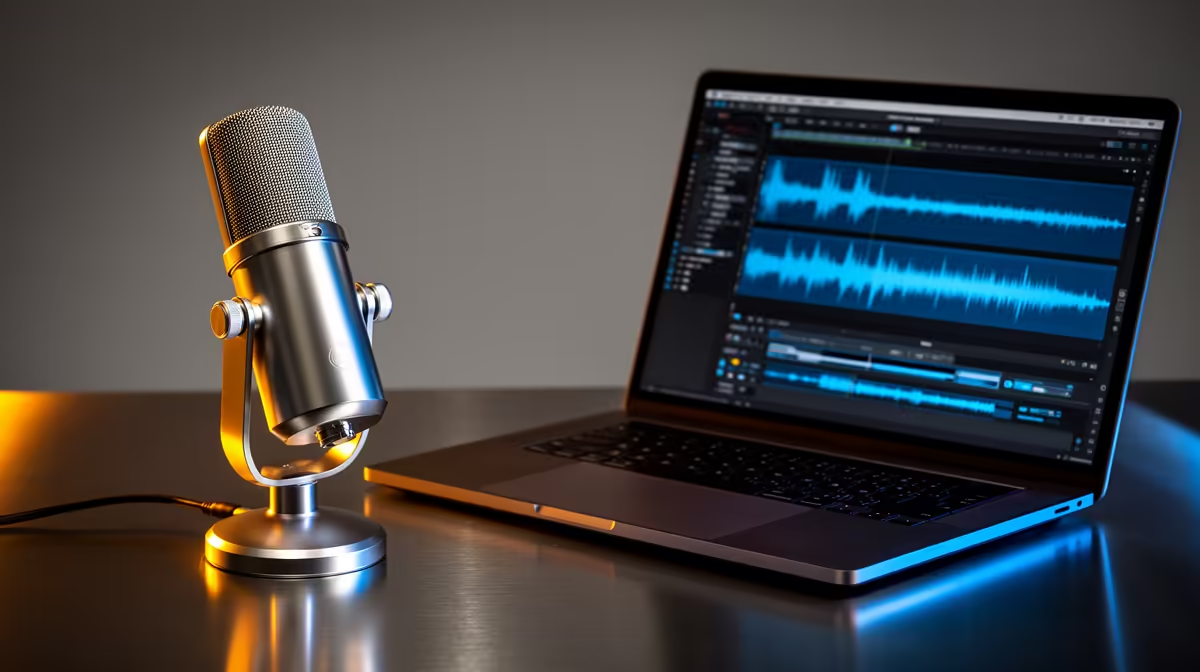
Camera manufacturers have invested heavily in AI audio processing, and for casual use the pitch is reasonable: one device, no extra cables, clean-enough sound. But "clean enough" and "genuinely good" are not the same claim. The real question for a serious SA streamer is whether AI noise-canceling camera audio actually closes the gap with a dedicated microphone, or whether it simply hides the original problem behind processing.
Quick Answer
A dedicated microphone is the better choice for PC streaming. Camera AI audio suits tidy desks and casual content where simplicity matters more than quality. A dedicated mic positioned 15 to 20cm from the mouth captures more warmth, detail, and presence than any camera sitting a metre away can replicate, even after processing.
🎙️ The Physics Problem Camera Audio Cannot Solve
Distance is the core constraint that no algorithm fully overcomes. A webcam or streaming camera typically sits on top of a monitor, roughly 60 to 90cm from a seated streamer's mouth. A dedicated microphone on a desk stand or mounting arm sits 15 to 20cm away.
Sound pressure falls with distance. At 20cm from the mouth, a microphone receives a far more powerful, direct signal from the voice than at 80cm. That strength difference means the close mic's signal-to-noise ratio is inherently better before any processing is applied. Camera AI audio has to work harder with a weaker input signal, which limits how much warmth and detail it can recover.
The capsule size and quality also differ considerably. Purpose-built microphones use capsules engineered specifically for vocal pickup, often with larger diaphragms that respond to the subtle dynamics of human speech more accurately than the miniaturised microphone array fitted inside a camera body.
Polar Pattern Versus Beam Steering
A dedicated dynamic or cardioid microphone attenuates off-axis sound through its physical construction. The capsule geometry and body shape reject sound arriving from the sides and rear without processing overhead. Camera AI audio uses beam steering: it analyses the signal from multiple built-in capsules and applies digital filtering to emphasise the voice direction. Beam steering is clever, but it introduces processing artefacts that physical rejection does not.
⚡ Where Camera AI Audio Is Genuinely Good Enough
Camera AI audio earns its place in specific situations. A casual Just Chatting stream with a clean, quiet room behind the creator is one of them. When the source audio is already decent, the AI cleans up fan hum and ambient noise to a genuinely usable standard, and the absence of extra hardware is a real practical benefit.
Desk tidiness is another legitimate consideration. A USB microphone, boom arm, and cable routing add visible complexity to a setup. For a creator whose camera frame shows the whole desk and who prefers a minimal aesthetic, keeping audio inside the camera is a reasonable trade.
The format also matters. For short-form clips where audio is often compressed further downstream, the quality difference between camera audio and a dedicated mic narrows. A YouTube Short or TikTok clip processed through platform compression reduces the gap between sources considerably compared with a long-form stream heard at full quality.
🔌 Running Both Together: Why It Creates Problems
The temptation to use both the camera's built-in audio and a dedicated microphone simultaneously is understandable, but the practical result is usually worse than either source alone. The two capsules are physically separated by at least 60 to 80cm, which means the voice arrives at each one at a fractionally different time.
That timing gap creates a comb filtering effect when the signals mix: certain frequencies cancel and others reinforce in a pattern that gives the combined audio a hollow, slightly phasey quality. Select one source and route it exclusively to the stream rather than blending the two. If the dedicated microphone is available, use it as the sole audio source and treat the camera's built-in audio as a backup.
Pro Tip ⚡
Run the camera audio through the same AI suppression software even when using a dedicated microphone as the main source. Camera audio routed to a backup recording track then serves as a recovery option if the main microphone has issues mid-stream.
🧠 What a Dedicated Mic Adds That Processing Cannot Fake
Broadcast warmth, sometimes called presence or nearfield character, comes from the combination of a large capsule close to the mouth and the natural proximity effect that builds low-frequency richness as the source gets closer to a directional capsule. That quality is a function of physics and position, not post-processing.
A dynamic microphone with tight cardioid characteristics also rejects room noise in a way that camera AI audio cannot match in a genuinely noisy environment. A Joburg bedroom near a busy road, or a Cape Town flat where wind noise is a regular factor, exposes the limitation of beam steering more quickly than a quiet, treated studio would. The dynamic mic's physical attenuation of off-axis noise means the AI suppression has far less work to do and makes fewer compromises in the process.
For streamers at any level above casual, spending R1,500 to R3,000 on a dedicated microphone transforms how the stream sounds to every viewer, and audio quality consistently correlates with viewer retention across streaming categories.
Frequently Asked Questions
What makes a dedicated microphone sound warmer than camera audio at equivalent settings?
The combination of capsule size, source proximity, and the proximity effect. A large-diaphragm capsule 15cm from the mouth captures a richer low-midrange signal with a physical depth that a camera array 80cm away at smaller capsule size cannot reproduce. AI processing can attenuate unwanted noise but cannot add warmth that was never captured in the first place.
Is camera AI audio adequate for podcasting as well as streaming?
For a podcast that will be compressed for distribution and listened to on phone speakers or earbuds, camera AI audio at its best is borderline adequate. For content where the audio experience is central to what the listener is there for, a dedicated microphone is the correct tool. Podcast listeners are an attentive audience, and audio quality is more noticeable in that format than in a gaming stream where the gameplay audio competes for attention.
Why does mixing both sources produce worse audio than using one?
The two capsules pick up the voice at slightly different times due to their physical separation. That offset, even at a fraction of a millisecond, causes phase relationships between frequencies to shift when the signals are combined. Certain frequencies cancel out and others add together in an irregular pattern, creating the hollow comb-filter quality that listeners recognise as an echo without quite being able to name it.
Which environment favours camera audio most?
A quiet, acoustically treated space where background noise is minimal and the desk is tidy. Under those conditions, the camera AI audio handles what little noise is present effectively, and the positioning limitation matters less because there is no ambient noise penalty for a slightly weaker input signal. Outside that specific environment, a dedicated microphone's physical advantage becomes more pronounced.
What is a realistic Rand range for a dedicated microphone that outperforms camera audio?
Entry USB options priced at R1,200 to R1,800 already outperform camera AI audio in almost every streaming scenario. Moving up to R2,000 to R3,000 adds noticeably better capsule quality, lower self-noise, and more nuanced polar pattern behaviour. The biggest gain happens between camera audio and an entry dedicated mic, not between mid-range and premium.
Ready to upgrade from camera audio to a microphone that your viewers will notice?
Browse the dedicated USB and XLR microphones available for South African streamers, and hear the difference from the very first stream.