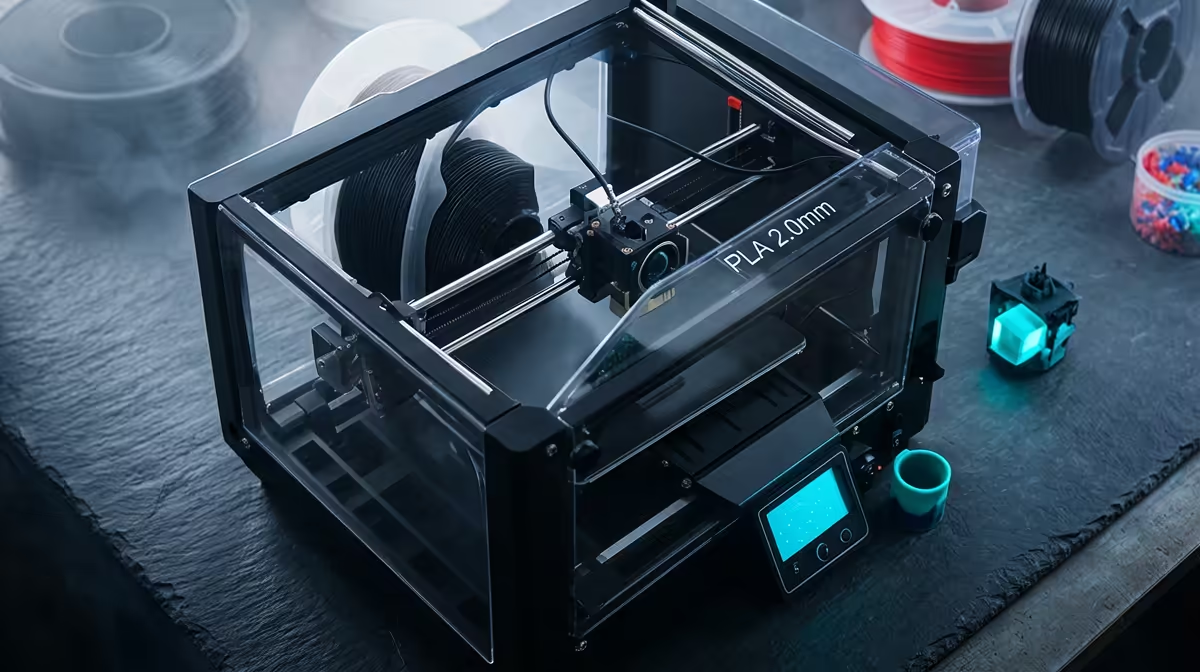
Turning a hobby printer into a paying service starts with one decision that shapes everything after it: which machine you fulfil orders on. The best 3D printer to start a print business in South Africa for most newcomers is the Bambu Lab P1S at roughly R12,495, an enclosed CoreXY machine that prints reliably enough to take customer money without babysitting every job. The maths is simple. At about R100 per billable SA print hour, the machine pays for itself in roughly 125 hours of paid work.
Quick Answer
The Bambu Lab P1S at R12,495 is the recommended first machine for a SA print business. Its enclosed chamber, fast CoreXY motion, and automatic flow calibration give you the repeatability that order fulfilment demands. Expect to clear the machine cost in about 125 billable hours at a R100 per hour rate.
Why an enclosed CoreXY beats an open bed-slinger for paid work
A hobby printer and a business printer are judged on different things. At home a failed print costs you a coffee's worth of filament and a shrug. On a paid order it costs a refund, a missed deadline, and a customer who never comes back. That gap is why the first business decision is reliability over raw speed numbers on a box.
The P1S is enclosed, which matters the moment you move past PLA. ABS and ASA, the materials customers ask for when they want parts that survive a hot car or outdoor use, warp and crack on open printers because draughts cool the print unevenly. A sealed chamber holds heat around the part and keeps layers bonding. The CoreXY motion system, where the toolhead moves on a fixed-mass gantry rather than dragging the whole bed back and forth, also holds quality at higher speeds, so you turn jobs around faster without ringing artefacts showing up on the surface.
The current crop of capable machines sits in a clear band at Evetech, and the 3D printers range is the quickest way to compare enclosed against open-frame options side by side before you commit.
Running the ROI honestly
Print businesses fail on bad maths more often than bad machines. Here is a grounded way to think about it.
Your true cost per print
Filament is the obvious cost, but it is rarely the biggest one. A 1kg spool of decent PLA runs in a sensible band locally and yields a lot of small parts, so material on a typical desk-sized item is often under R30. The costs people forget are electricity, failed prints, post-processing time, and machine wear. Build a buffer for a failure rate of around 5 to 10 percent on complex jobs, because at least some prints will fail and you still pay for the filament and the hours.
Pricing the hour, not the gram
Customers do not care how many grams a part weighs, so do not price that way alone. A common SA approach is a base machine-time rate of roughly R80 to R120 per print hour, plus material, plus a setup fee for design work or model preparation. At a R100 average hour, a machine that prints reliably 12 hours a day five days a week is billing real money long before the month is out.
When the P1S pays for itself
At R12,495 and a R100 billable hour, the break-even point lands near 125 hours of paid printing. A part that takes four hours to print is one R400 line item. Stack enough of those and the machine clears its own cost inside the first month or two of steady demand, after which the printer is profit minus consumables.
What you actually print for money in SA
The orders that pay are rarely the dragons and trinkets that fill social feeds. The bread and butter is functional and local: replacement knobs and brackets for appliances that are out of warranty, custom jigs for small manufacturers, branded promotional items for events, prototype housings for makers and startups, and bespoke parts the big suppliers do not stock. Cosplay and tabletop gaming props bring volume around conventions and holidays, but the repeat business comes from people who need a specific part and cannot find it anywhere else.
That local-demand angle is the moat. A print business in Cape Town or Joburg wins on turnaround and on solving problems for nearby customers who would otherwise wait weeks for an import.
Scaling from one printer to a small farm
A single P1S proves the model. When you are consistently turning away work or quoting long lead times, that is the signal to add a second identical machine rather than a different one. Identical printers mean one profile, one set of consumables, and predictable results across both, which is exactly what fulfilment needs. Two or three P1S units running the same job in parallel is a print farm in everything but name, and it costs far less than one large industrial machine while staying easy to maintain.
You will also lean on tooling and spares the moment you go multi-machine: spare nozzles, build plates, and a sensible supply of filament so you never stall a paid job waiting on stock. The accessories best sellers is a useful place to keep an eye on the bits that wear out and the add-ons that keep a small farm humming.
Frequently Asked Questions
Is the Bambu Lab P1S good enough to take paying customers from day one?
Yes. Its enclosed chamber and automatic calibration produce repeatable results without constant tuning, which is the core requirement for fulfilment. You can quote a customer a finish and trust the machine to deliver it consistently.
How long until a 3D print business covers the cost of the printer?
At roughly R100 per billable print hour, the R12,495 P1S clears its cost in about 125 hours of paid work. With steady demand that is a matter of weeks, not months, after which the machine runs at a healthy margin.
Should I start with one printer or several?
Start with one and prove the demand before buying more. When you are consistently quoting long lead times, add a second identical machine so you keep a single profile and predictable output across both.
What sells best for a SA print service?
Functional local parts: appliance spares, custom jigs and brackets, branded event items, and prototype housings. These bring repeat business, while props and figurines drive seasonal volume around conventions.
Do I need ABS or ASA, or is PLA enough?
PLA covers most decorative and indoor work and is the easiest to print. You need an enclosed machine for ABS and ASA when customers want parts that tolerate heat, sun, or outdoor use, which is exactly why an enclosed printer is the safer business choice.
Ready to turn print hours into income? Compare enclosed business-grade machines in the 3D printers range at Evetech and line up the spares and add-ons that keep a small print farm running.