


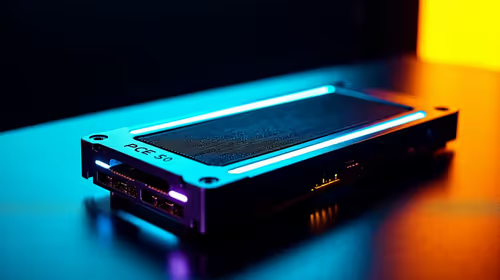
PCIe 5.0 vs PCIe 4.0 for Couch Co-Op Gaming in SA
PCIe 5.0 and PCIe 4.0 differ most in lane support, compatibility, and upgrade value for couch co-op gaming. SA buyers should match the choice to their actual hardware and games.
Read moreGen 5 NVMe vs Gen 4 NVMe for streaming on Twitch and YouTube Difference explained is mostly about compatibility, budget, upgrade path, and setup fit. SA buyers should check device support and real needs before expecting a clear win from either.

When a build is aimed at live encoding while you play and chat, the gap between Gen 5 NVMe and Gen 4 NVMe shows up in specific places rather than across the board.
Gen 5 NVMe wins on paper since Gen 5 peaks above 12,000 MB/s sequential, but for streaming on Twitch and YouTube the felt difference is modest. Most SA buyers in the R1,600 to R5,500 range get better value from Gen 4 NVMe plus more GPU or panel budget.
Strong Gen 4 drives sit around 7,000 MB/s and cost far less, which keeps it firmly in the value seat. If your current parts are healthy, the money saved by choosing Gen 4 NVMe is better aimed at the component that limits you most right now.
Before you commit, confirm your board, cooling and case actually support the storage generation you want. SA ambient temps run warm, so airflow and proper mounting matter; a throttled part is no faster than the cheaper one it replaced.
For a streaming on Twitch and YouTube machine in the R1,600 to R5,500 bracket, the order that moves the needle is usually GPU, then display, then memory, then this storage generation choice. Spend top-down and you rarely regret it.
Only if your platform is new and the price gap is small. For pure streaming on Twitch and YouTube, Gen 4 NVMe delivers nearly the same feel, and strong Gen 4 drives sit around 7,000 MB/s and cost far less.
Not in any way you would notice during normal play. Strong Gen 4 drives sit around 7,000 MB/s and cost far less, so the bottleneck is far more likely to be your GPU or panel.
It can draw a little more, so check your board and airflow first. In a well-ventilated SA build it is manageable, but a cramped case can claw back the advantage.
Decide your streaming on Twitch and YouTube priorities first, then let the Gen 5 NVMe versus Gen 4 NVMe choice fall out of that, not the other way round.
PCIe 5.0 and PCIe 4.0 differ most in lane support, compatibility, and upgrade value for couch co-op gaming. SA buyers should match the choice to their actual hardware and games.
Read more
Wi-Fi 7 and Wi-Fi 6E matter for 4K video editing when you move large footage across a local network. This real-world difference between Wi-Fi 7 and Wi-Fi 6E guide looks at NAS access, router distance, adapters, and SA creator setups.
Read more
Wi-Fi 6E vs Wi-Fi 6 depends on Competitive esports needs, platform limits, and budget fit. Compare compatibility, latency, upgrade path, and real setup constraints before choosing for an SA build.
Read more
80+ Gold and 80+ Platinum explained for PC builders starts with PSU efficiency, not gaming speed. SA builders should weigh wattage, thermal load, warranty, cable quality, and how long the system will be kept.
Read more
80+ Gold and 80+ Platinum affect heat and power waste more than AAA single-player gaming FPS. The real-world difference is PSU quality, wattage headroom, fan behaviour, and SA electricity cost during long cinematic sessions on powerful GPUs.
Read more
LGA 1851 vs LGA 1700 affects MMO and live-service games through CPU consistency, memory, and platform headroom. For SA players, the real-world difference depends on crowded hubs, background apps, motherboard cost, and upgrade timing.
Read more
The great PC refresh of 2026 is driven by Windows 11 requirements: millions of machines lack TPM 2.0 or a supported CPU, forcing replacement over a simple upgrade. SA home and office users on 2017-era PCs are in this global wave with Windows 10 now unpatched.

Searching for a universal smartphone mount in South Africa? 📱 Discover the essential features to ensure your device stays secure, stable, and perfectly positioned during your daily commute. 🚗
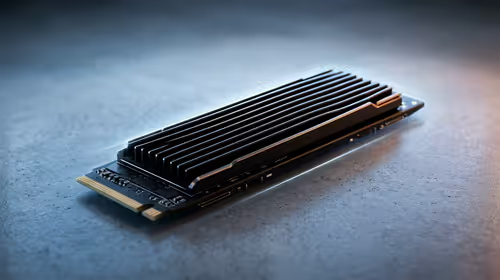
Pre-Black Friday NVMe SSD buying advice for SA should be shortlisted around the job it must do. South African buyers should compare capacity, speed, thermals, and motherboard support, warranty path, and upgrade room before treating any pick as best.

Wi-Fi 7 vs Wi-Fi 6e for cinematic story games comes down to router support, latency goals, device compatibility, and coverage. SA buyers should match the choice to the real network setup.

Wireless gaming headsets are available at Evetech from R499 including VAT, with 75 models in stock. The range runs to R999 for console-specific PDP Phantom Air models.

FPS drops blamed on a wireless mouse often point to input, driver, USB, network, or system-load checks. Use a quick SA-friendly troubleshooting flow to isolate software, firmware, thermals, storage, and game settings before replacing hardware.

How to fix fps drops on steam deck starts with power profile, shader cache, storage health, and per-game settings. For South Africa, check charger quality, heat, and download stability before assuming the handheld needs repair. Retest after updates.
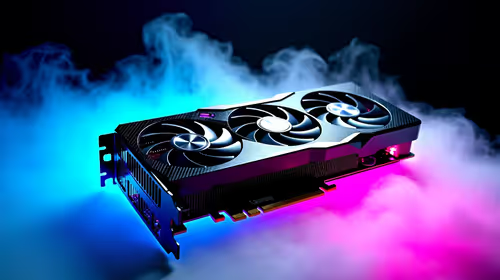
How to fix low FPS after an RTX 5080 build upgrade starts with driver cleanup, display settings, thermals, and power mode. For SA gamers, verify GPU usage, PCIe speed, RAM profile, and CPU limits before changing parts.
Wireless gaming headsets are available at Evetech from R499 including VAT, with 75 models in stock. The range runs to R999 for console-specific PDP Phantom Air models.
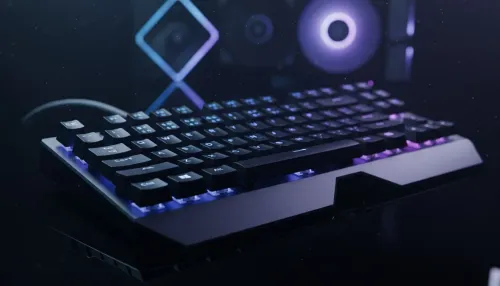
Gaming keyboards are available at Evetech from R399 including VAT, with 41 models in stock. The best keyboards run from R3,999 analog and Hall-effect boards up to R6,699 flagships.

Gaming headsets are available at Evetech from R329 including VAT, with 120 models in stock. The best headsets open at R6,499 and run to R15,499 for the Arctis Nova Elite.
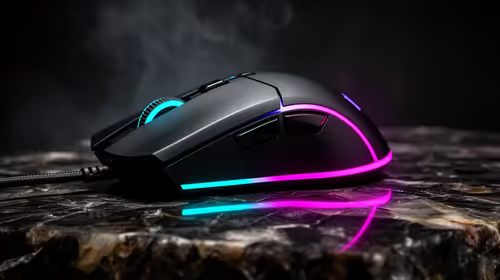
Gaming mice are available at Evetech from R199 including VAT, with 105 models in stock. The best mice start at R3,699 for the Razer DeathAdder V3 Pro and run to R4,199.