Quick Answer
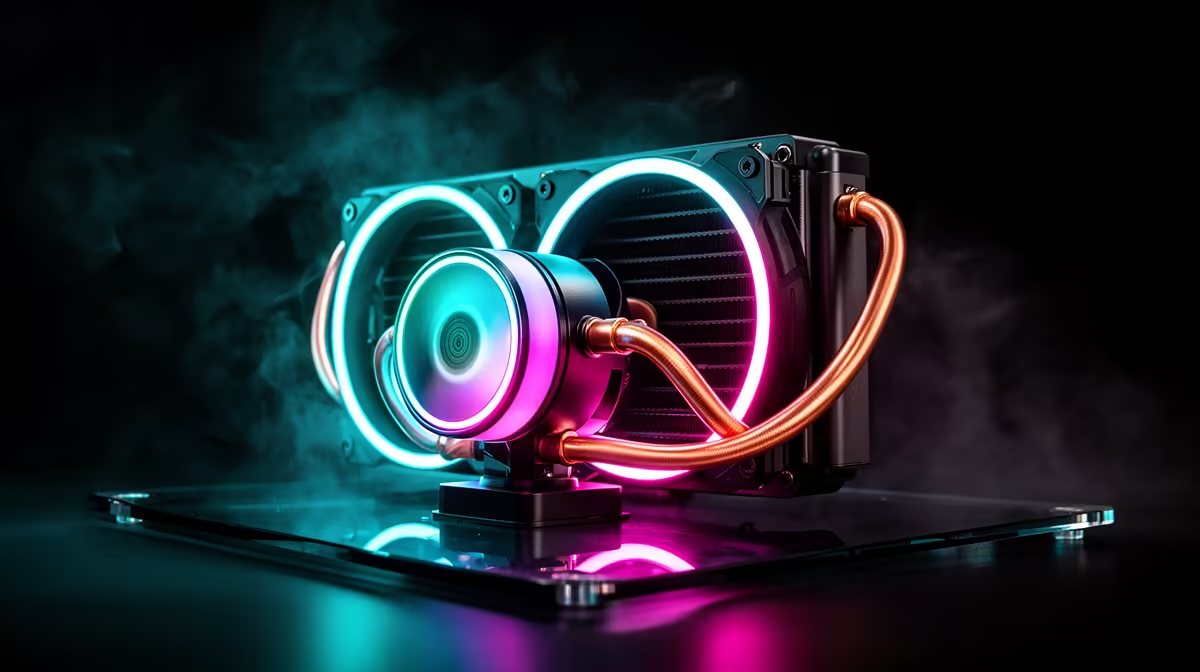
For a rand-conscious high-performance gaming build, the best-value AIO cooler spec combination is a 240mm or 360mm radiator with an Asetek Gen 7 or Gen 8 pump, copper cold plate with micro-fin channels, and daisy-chain ARGB fans. You do not need an LCD display to cool a CPU effectively. Prioritise pump quality and radiator size; cut the display to save R500 to R1,200 if budget is tight.
Pump Quality Matters More Than Radiator Size 🔧
The pump is the heart of any AIO. It circulates coolant from the hot CPU cold plate to the radiator where heat dissipates. Asetek is the dominant pump OEM, supplying platforms to ASUS ROG, Corsair, NZXT, and MSI among others.
For a Ryzen 7 9800X3D running at its 120W gaming TDP, a Gen 7 pump on a 240mm radiator performs adequately. For a Ryzen 9 9900X or Core i7-14700KF where TDP spikes hit 175W, a Gen 8 pump on a 360mm unit provides noticeable stability in sustained workloads. The upgrade cost from Gen 7 to Gen 8 is typically R700 to R1,200 at SA retail, which is worth it for CPUs above 150W TDP.
Fan Specifications for High Static Pressure 🌀
Gaming PCs run AIO fans at varying speeds based on temperature curves, not continuously at maximum. The important fan specification for radiator use is static pressure, not maximum CFM (airflow volume). Static pressure fans overcome the resistance of the radiator fin stack to move air through it effectively.
Look for fans rated at 2.0 to 3.0mm H2O static pressure.
Cold Plate and Thermal Interface 💰
Copper cold plates with micro-fin channel etching, available in AIOs from around R2,200 upward, transfer heat 10 to 15 percent more efficiently than flat copper base plates found in the cheapest AIO options. For a rand-conscious build, this is the specification to prioritise over aesthetic features like LCD displays or premium sleeved tubing.
Most AIOs above R2,000 at Evetech ship with pre-applied thermal compound rated for 3W/mK or better. If a budget AIO in the R1,200 to R1,800 range includes a low-grade pad instead of paste, replacing it with a quality compound like Thermal Grizzly Kryonaut (around R180 to R220 locally) immediately improves installation results by 3 to 7 degrees Celsius at CPU junction.
Skip the Display, Not the Pump ⚡
When trimming AIO budget, remove the LCD display feature before downgrading the pump platform. A no-display AIO with an Asetek Gen 8 pump cools the same as a display-equipped unit and costs R600 to R1,200 less at SA retail. The pump platform directly affects thermal performance and longevity; the display does not.
FAQ
What is the minimum AIO size for a Ryzen 7 9800X3D gaming build?
A 240mm AIO with a quality pump is the practical minimum. The 9800X3D has a 120W TDP in gaming and does not push extreme heat under typical game loads. A 360mm unit gives more headroom for sustained workloads and runs quieter at lower fan speeds, but is not mandatory for a primarily gaming-focused build.
Do cheaper AIO coolers last as long as premium ones?
Generally no. Budget AIOs in the R800 to R1,500 range often use sleeve-bearing fans and lower-rated pump impeller materials. Expect three to four years of reliable service. Premium AIOs at R3,000 and above with Asetek pumps and quality fan bearings routinely last five to seven years. Over two CPU generations, the premium unit is often the better total value for SA buyers.
Should I choose ARGB or no-ARGB to save money?
ARGB fans cost R100 to R250 more than non-ARGB equivalents per fan. On a three-fan 360mm AIO, that is a R300 to R750 premium for lighting. If you have a windowed case and want aesthetic integration with your motherboard's lighting, ARGB is worth it. In a non-windowed case, skip ARGB and redirect that budget to a better pump tier.
Cooling a high-performance build without overspending?
Browse AIO coolers at Evetech across the R1,800 to R5,500 range to find the best pump-and-radiator combination for your CPU and budget.