The sticker price on a tiny emulation handheld looks almost too good until the shipping line lands, and that is the part most buying guides skip. A budget retro handheld under R1,000 is genuinely achievable, but only if you treat the freight, import fees, and exchange rate as part of the real cost rather than a surprise at checkout. Devices like the Miyoo Mini Plus start below 60 US dollars, which is right on the edge of that R1,000 line once everything is added.
Quick Answer
Yes, you can land a capable retro handheld for around R1,000, with the Miyoo Mini Plus the standout pick at roughly 60 US dollars before shipping. Add freight and the exchange rate and it sits near or just over the R1,000 mark, so the honest budget is "about R1,000 delivered," not the bare device price.
The Real Cost Of Importing A Cheap Handheld
The catch with these devices is that the headline price is the device alone. A handheld advertised at 55 to 60 US dollars is not the price you pay to have one in your hands in Cape Town or Johannesburg. Freight on a small parcel, the rand-to-dollar rate on the day, and any import handling all stack on top.
That is why "under R1,000" is best read as a delivered target. A 60 dollar device can convert to well under R1,000 on the rand alone, then climb back toward or past it once shipping is included. Knowing this up front stops the classic mistake of celebrating a cheap cart total and then being caught by the delivered figure.
Miyoo Mini Plus: The Value Benchmark
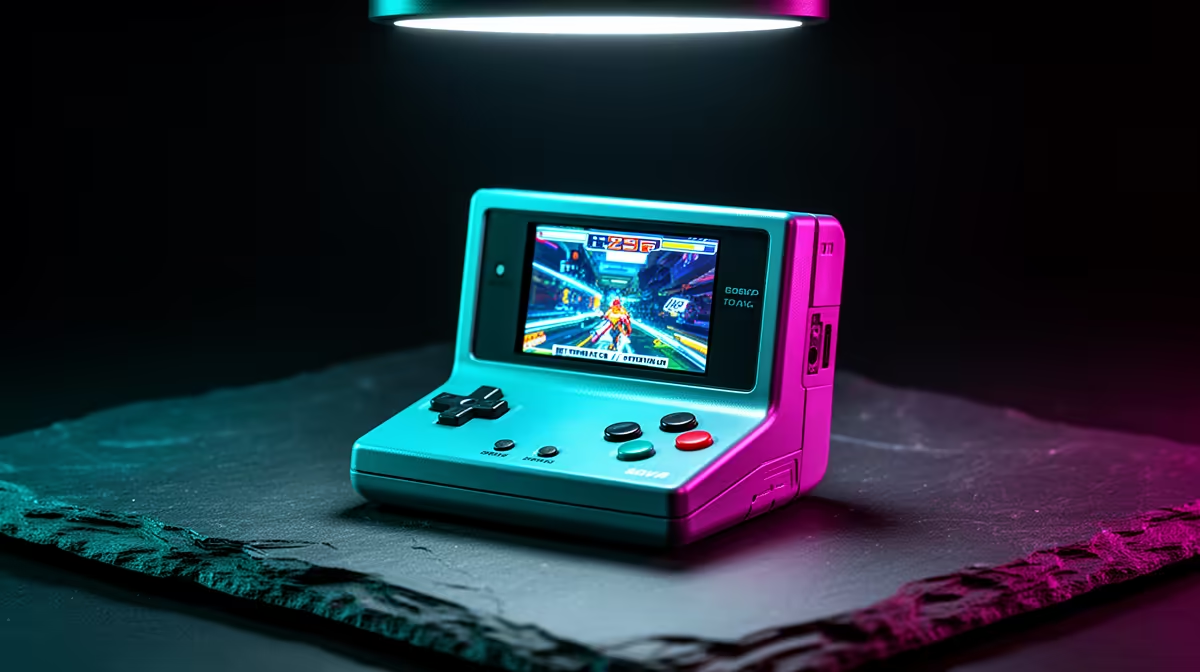
The Miyoo Mini Plus is widely treated as the king of the budget tier, and at around 60 US dollars it is the device the others are measured against. It runs the community OnionOS, has a crisp 3.5 inch IPS screen, and is genuinely pocketable, the kind of thing that disappears into a jeans pocket. It handles everything from NES up through PlayStation 1, and the Game Boy, SNES, and Sega Genesis libraries feel completely native on it. Community support is its real edge: years of firmware refinement mean it just works.
The hardware inside is a dual Arm Cortex-A7 running at 1.2GHz paired with 128MB of DDR3 RAM, which sounds modest but is calibrated for the systems it targets. OnionOS runs over a hundred emulators, covers Nintendo DS through Drastic, and supports instant save-state switching with a button press, a feature the stock firmware does not offer. The device is 108mm tall and 162 grams, which is smaller and lighter than a Game Boy Pocket. Battery life is honest at four to five hours on a 3,000mAh cell; not marathon territory, but enough for a commute or a long evening.
Anbernic RG35XX H: The Comfortable Alternative
Sitting around 55 to 70 US dollars, the Anbernic RG35XX H takes a horizontal shape that feels like a miniature Game Boy Advance SP opened flat. Build quality is strong for the money, the IPS display is sharp, and the D-pad is solid. If you find vertical handhelds cramped, this is the more comfortable hold for longer sessions.
The RG35XX H shares the H700 quad-core Cortex-A53 chip with the broader Anbernic range, which means it matches the Miyoo on retro 8-bit and 16-bit performance and extends cleanly into PS1. Its 4-inch 640x480 IPS panel is larger than the Miyoo Mini Plus, which helps with reading small text in RPGs and improves visibility in bright SA daylight. The trade-off is that it is bulkier in a pocket.
Powkiddy RGB30: The Square-Screen Specialist
The Powkiddy RGB30 usually runs a little higher, around 70 to 90 US dollars, which can push it past the R1,000 line once shipped. Its trick is a 4 inch square 1 to 1 screen. That aspect ratio is brilliant for Game Boy and Game Boy Color titles, which run at near pixel-perfect integer scaling with room to spare. It is a niche pick, but for those specific libraries it is the most satisfying screen in the budget class.
Which One Fits Your R1,000?
If pocketability and proven software matter most, the Miyoo Mini Plus is the safe buy. If you want a roomier, landscape grip, the RG35XX H earns its place. The RGB30 is for collectors fixated on Game Boy-era games who do not mind nudging slightly over budget. All three are import devices, so factor delivery into the decision rather than the device price alone.
If you would rather skip the import wait and freight calculation entirely, the locally stocked handheld gaming consoles range at Evetech lets you buy in rand with local support, and the PC best sellers at Evetech shows you which portable and small-form picks South African buyers are choosing right now.
Frequently Asked Questions
Can I really get a retro handheld for under R1,000?
Yes, but treat R1,000 as a delivered target. The Miyoo Mini Plus at around 60 US dollars is the realistic pick, landing near or just over R1,000 once shipping and the exchange rate are added rather than the device price alone.
Which budget retro handheld is best for beginners?
The Miyoo Mini Plus. Its OnionOS firmware is mature and well documented, the screen is sharp, and the huge community means setup help is easy to find. It plays NES through PS1 comfortably.
What systems can these handhelds emulate?
The whole budget tier comfortably runs NES, SNES, Game Boy, Game Boy Color, Game Boy Advance, and Sega Genesis, with PlayStation 1 playable on the stronger picks like the Miyoo Mini Plus.
Why is the Powkiddy RGB30 screen different?
It uses a 4 inch square 1 to 1 aspect ratio panel. That shape suits Game Boy and Game Boy Color games perfectly, letting them run at near pixel-perfect integer scaling with generous border space instead of being stretched.
Is it cheaper to import or buy locally?
Imports can look cheaper on the device price, but freight, the exchange rate, and any handling close the gap and add a wait. Buying locally in rand removes the surprise costs and gives you support if something goes wrong.
How long does the Miyoo Mini Plus battery last?
The 3,000mAh cell delivers roughly four to five hours of gameplay, with lighter 8-bit and 16-bit systems extending that slightly and PS1 at the lower end. A power bank easily keeps sessions going if you need more.