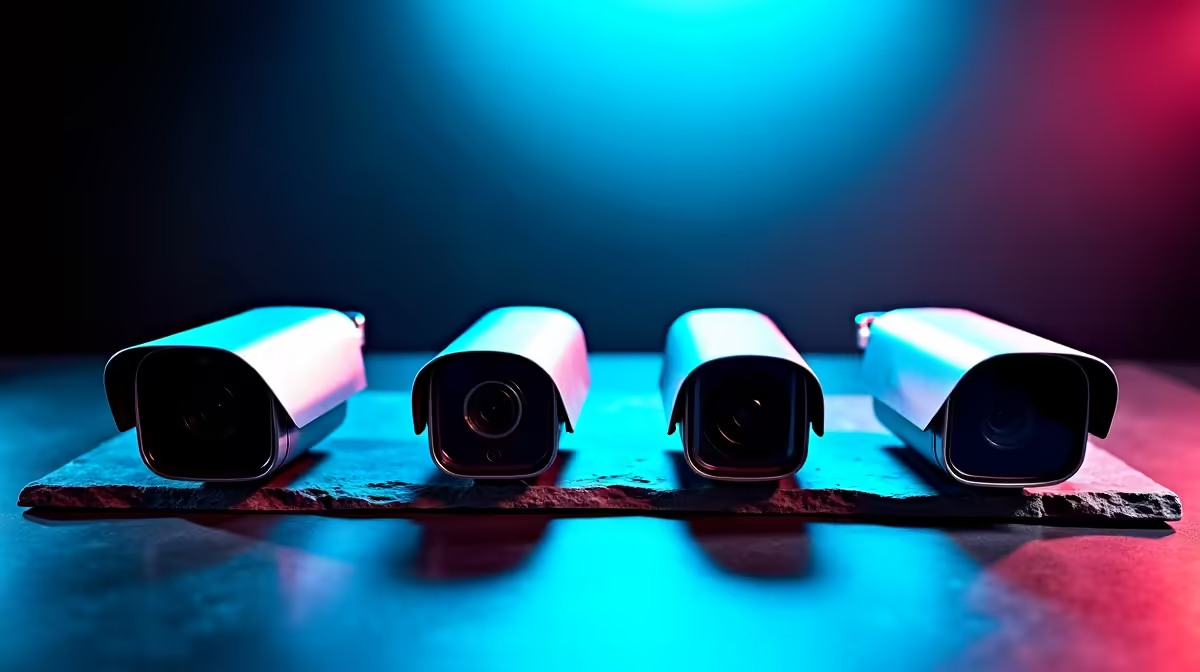
Frigate runs its AI detection on your own hardware, with no cloud and no subscription, but it is fussy about cameras. Pick the wrong one and detection stutters or the stream drops daily. The right Frigate camera does two things well: it exposes a stable RTSP stream, and it serves a second low-resolution sub-stream so Frigate can run detection cheaply while recording the full-resolution feed. Get those two right and a local AI NVR build just works.
Quick Answer
A camera for Frigate must expose an RTSP stream and support dual-stream output, so Frigate runs detection on a low-resolution sub-stream while recording the high-resolution main stream. Look for ONVIF Profile S support, a published RTSP URL, and H.265 or H.264 encoding. Brands like Dahua, Hikvision, and Amcrest are the safe picks; avoid closed ecosystems like Ring, Nest, Arlo, and Blink that block RTSP. A typical setup pairs a roughly 2K main stream with a 640x480 sub-stream.
Why dual-stream is the whole game
This is the concept that makes or breaks a Frigate build, so it is worth understanding clearly. Frigate's object detection model works on small image dimensions, around 320x320 pixels, because that is what the AI model actually ingests. Feeding it a full 4K frame wastes huge amounts of processing power resizing the image down, and the extra detail is simply discarded in the resize, so it buys you nothing.
The elegant solution is two streams from one camera. The high-resolution main stream gets recorded so your footage is sharp when you review it. A separate low-resolution sub-stream feeds the detection engine, which is all the AI needs and keeps processing load low enough that a modest machine can watch several cameras at once. A camera that cannot output a sub-stream forces Frigate to chew through full-resolution frames, which is the fast route to a struggling system.
The non-negotiable camera requirements
Frigate is open and standards-based, so it needs cameras that play by open standards.
A real RTSP stream
Frigate consumes RTSP, the standard streaming protocol, so the camera must expose an RTSP URL you can point Frigate at. Crucially, the manufacturer should publish that RTSP URL in its documentation. Cameras that hide their stream behind a proprietary app and never document an RTSP path are a constant fight and often impossible.
ONVIF Profile S
ONVIF Profile S is the interoperability standard that lets cameras and software from different makers talk to each other. A camera that supports it integrates cleanly. Closed ecosystems that skip ONVIF, the subscription-driven consumer brands, are the ones to avoid for a Frigate build.
Efficient encoding
H.265 on the main stream keeps recording file sizes manageable, while H.264 is widely used on the sub-stream for broad compatibility. A common, well-regarded configuration runs a roughly 2688x1520 main stream at around 15fps with a low-resolution 640x480 sub-stream at about 5fps for detection.
Brands that work and brands to avoid
Experience across the community points clearly in one direction. Dahua, Hikvision, and Amcrest are the recommended brands, in roughly that order, because they expose proper RTSP streams, support ONVIF, and hold a stable connection for long stretches. Reolink models are also widely used and pair on-camera AI with good firmware polish, making them a popular value choice.
The brands to steer clear of are the closed consumer ecosystems, Ring, Nest, Arlo, and Blink, which do not support ONVIF Profile S, lock features behind subscriptions, or refuse to publish RTSP URLs. They are built to keep you inside their own app and cloud, which is the opposite of what a local Frigate build is for. The smart home and appliances range at Evetech is a sensible place to check which cameras expose the open stream Frigate needs, and storage and accessories for the build show up among the most popular accessories.
Sizing the machine behind the cameras
The cameras are only half the build; Frigate needs something to run the detection on. The load scales with how many cameras and how busy they are, and a hardware accelerator, whether a Google Coral, an integrated GPU, or a discrete card, takes the detection workload off the main processor and lets one machine comfortably watch several streams. The dual-stream approach keeps that load reasonable in the first place, which is exactly why it matters so much. A small, efficient mini PC or a modest desktop is plenty for a typical home build, and pairing the right cameras with the right host is what turns Frigate from a frustrating experiment into a dependable, private NVR.
Power over Ethernet versus wifi
For a Frigate build, wired cameras using power over Ethernet are generally the stronger choice over wifi models, and it is worth understanding why. A single Ethernet cable carries both power and data, so there is no battery to recharge and no wifi congestion to cause the dropped streams that plague busy wireless networks. Frigate depends on a rock-steady connection to run continuous detection, and a wired link delivers exactly that consistency. Wifi cameras can work, but they introduce a point of failure that a wired camera avoids entirely, which is why most serious Frigate builds run cabled cameras back to a switch.
Storage for continuous recording
Recording the high-resolution main stream around the clock generates a lot of data, so plan storage to match. A dedicated drive sized for your number of cameras and your retention period keeps recordings without filling the system disk, and because footage is written constantly, a drive rated for that sustained write workload lasts longer than a standard one. Frigate stores everything locally, which is the whole point of a private NVR, so the storage you choose is where your footage lives, with nothing handed to an outside cloud.
Frequently Asked Questions
What is the most important feature in a Frigate camera?
Dual-stream output. Frigate runs detection on a low-resolution sub-stream while recording the high-resolution main stream, so a camera that cannot serve a sub-stream forces Frigate to process full-resolution frames, overloading the system. Pair that with a proper RTSP stream and ONVIF support.
Why should I avoid Ring, Nest, Arlo, and Blink for Frigate?
Those closed ecosystems generally do not support ONVIF Profile S, hide features behind subscriptions, or do not publish RTSP URLs. Frigate needs an open, documented RTSP stream, which these brands are designed not to provide, so they do not work for a local build.
What resolution does Frigate need for detection?
Very little. The detection model works at roughly 320x320 pixels, so a low-resolution sub-stream around 640x480 is ideal. Higher resolution does not improve detection accuracy because the extra detail is lost when the image is resized down for the model.
Which camera brands are best for Frigate?
Dahua, Hikvision, and Amcrest are the most recommended for reliable RTSP and ONVIF support, with Reolink a popular value option that adds on-camera AI. The common thread is open standards and a stable, documented stream.
Do I need special hardware to run Frigate?
A modest machine works, but a detection accelerator such as a Google Coral, an integrated GPU, or a discrete card greatly improves how many cameras one host can handle. Combined with the dual-stream approach, this keeps the system responsive even with several cameras.
Building a private, subscription-free AI NVR? Choose cameras that expose the open streams Frigate needs from the smart home and appliances range at Evetech and keep your footage and detection entirely on your own hardware.