Quick Answer
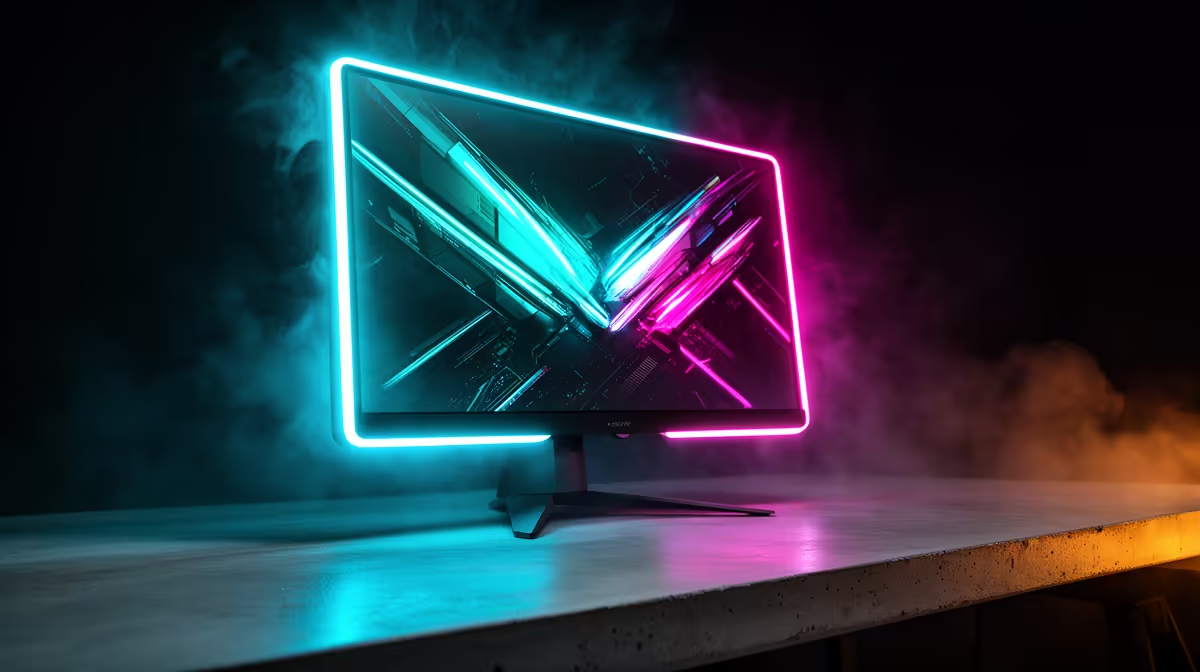
For 4K gaming on a tight rand budget, target a 27 to 28 inch IPS panel at 144Hz with FreeSync Premium Pro for R8,000 to R11,000. For esports on a tight budget, a 24 to 25 inch 1080p IPS at 144Hz to 165Hz with 1ms GtG is available from around R2,500 to R4,000 and outperforms everything at those framerates.
4K on a Budget: Which Specs to Prioritise and Which to Skip 💰
Not every 4K monitor spec justifies its price premium. The ones that matter most for value-conscious SA buyers are refresh rate (minimum 144Hz for 4K gaming to be meaningful above 60fps console-tier output), adaptive sync (FreeSync Premium Pro for AMD GPU owners, G-Sync Compatible for NVIDIA owners), and a 1ms GtG IPS panel. Specs that add cost without proportional benefit in this bracket include DisplayHDR 400 (too limited to be transformative), built-in speakers (rarely good), and 10-point touch screens (unnecessary for gaming).
Esports Monitor Specs That Deliver Real Performance Gains 🎮
For competitive FPS, battle royale, and RTS gaming, resolution is secondary to refresh rate and response time. A 1080p 240Hz IPS monitor priced between R4,500 and R7,000 will give a measurably sharper competitive experience than a 4K 60Hz panel in games like Valorant, CS2, or Apex Legends. The key specs for an esports monitor are: 240Hz or above refresh rate, 0.5ms to 1ms GtG response time, G-Sync Compatible or FreeSync Premium Pro certification, a low-input lag mode (usually a labelled preset in the OSD), and a size of 24 to 27 inches at 1080p. At 27 inches, 1440p at 165Hz to 240Hz is an excellent middle ground between esports performance and image sharpness.
Balancing 4K and Esports Needs on One Monitor 🔧
If buying one monitor to cover both use cases, a 27-inch 4K 160Hz IPS panel in the R10,000 to R13,000 range is the most practical choice. It runs at native 4K for story games and can be set to a scaled lower resolution at higher refresh rates for competitive play. Alternatively, a dual-mode panel that offers native 4K at 240Hz and switchable FHD mode at 480Hz sits in the R18,000 to R24,000 range and handles both modes without scaling artefacts. For most rand-conscious buyers, the single 4K 160Hz IPS is the better spend, leaving budget for a stronger GPU.
Use DLSS or FSR to Extend Your Monitor's Value ⚡
Running DLSS 4 Quality or FSR 4 Quality mode on your GPU lets a mid-range card output near-4K image quality at a fraction of the native 4K render load. This makes a 4K 144Hz monitor viable on a R13,000 to R16,000 GPU that would otherwise struggle to push 4K natively, extending the monitor's useful life before your next GPU upgrade.
FAQ
What is the minimum GPU for a 4K 144Hz monitor to be worthwhile in SA?
An RTX 5070 or RX 9070 XT is the practical minimum for 4K 144Hz gaming in demanding titles. Both GPUs support DLSS 4 or FSR 4 respectively, which helps reach and sustain higher framerates at 4K. Below this tier, a 1440p 165Hz monitor gives better per-rand performance.
Is a 24-inch 240Hz esports monitor better than a 27-inch 165Hz for competitive play?
At the same price point, yes. The higher refresh rate of 240Hz versus 165Hz provides a measurable advantage in fast-paced competitive titles where every frame of information counts. The size difference from 24 to 27 inches has minimal impact on competitive performance, though some players prefer the larger field of view at 27 inches.
How do I keep my esports monitor calibrated for the best colour and response?
Use the monitor's game preset or esports OSD mode, which typically maximises refresh rate and sets overdrive to Normal. Avoid custom colour settings that push brightness above 80 percent, as this can increase panel heat and colour drift over time on IPS panels.
Spec hunting for the best-value gaming monitor in SA?
Evetech stocks gaming monitors from entry-level esports panels through to premium 4K displays. Find the right spec at the right rand price in the Evetech monitor category.