Quick Answer
For a ZAR-based gaming PC setup, prioritise in this order: refresh rate matched to your GPU output, VRR certification matched to your GPU brand, panel size and resolution appropriate to your viewing distance, then colour gamut and HDR tier. Price anchors: R4,000 to R6,500 for 144Hz QHD, R6,500 to R9,500 for 240Hz to 300Hz QHD.
Refresh Rate: The Spec That Changes the Most About Gaming 🎮
Refresh rate has a larger perceptual impact than any other monitor specification. The jump from 60Hz to 144Hz is transformative. From 144Hz to 240Hz is meaningful for competitive players; from 240Hz to 300Hz is real but requires side-by-side comparison. Match refresh rate to GPU output: 100 to 180 fps average suits 144Hz to 165Hz; above 200 fps suits 240Hz; 250-plus fps reliably justifies 300Hz. Mismatching a 300Hz panel with a GPU averaging 120 fps wastes the R2,000 to R4,000 premium over a 165Hz equivalent.
Resolution and Size for SA Gaming Rooms 🖥️
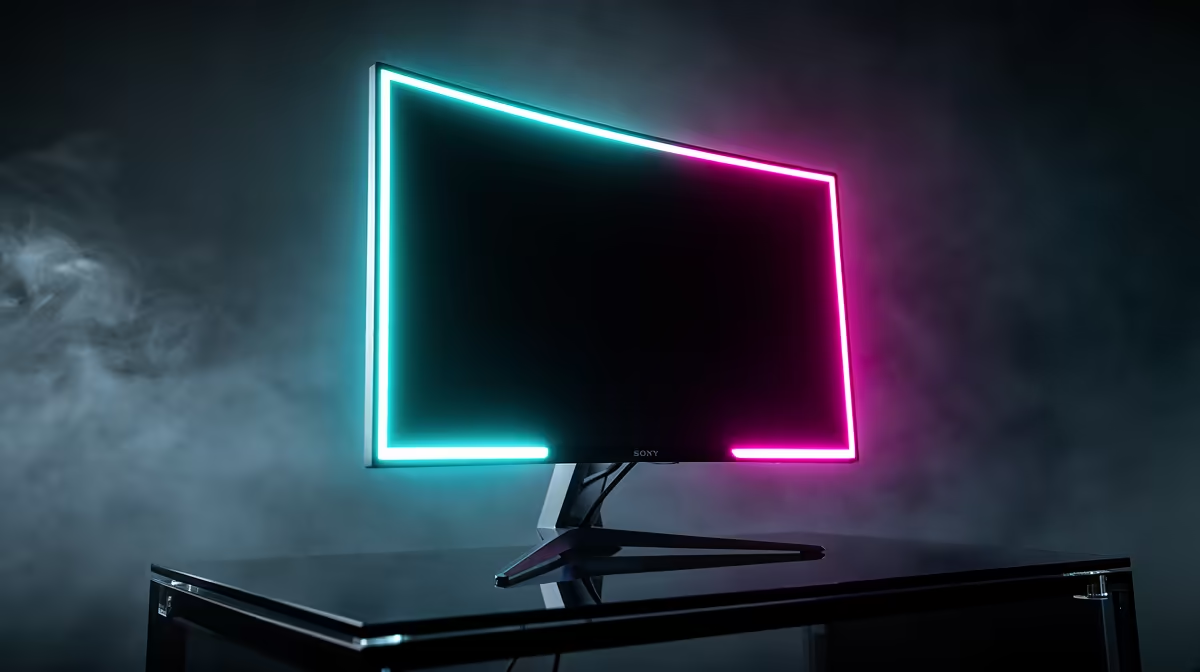
The most common gaming monitor sizes in SA are 24 inches, 27 inches, and 32 inches. For competitive gaming at a desk with a viewing distance of 50 cm to 70 cm, 27-inch QHD (109 PPI) is the most balanced choice: sharp enough to appreciate the resolution, small enough to see the full screen without head movement. For single-player and cinematic gaming where immersion matters more than competitive advantage, 32-inch QHD (92 PPI) or a 34-inch ultrawide QHD (109 PPI equivalent) creates a more enveloping field of view. For budget builds where GPU power is the limiting factor, 1080p at 27 inches (82 PPI) is a valid compromise but noticeably softer than QHD at the same size.
VRR, HDR Tier, and Panel Type Hierarchy 🔧
After refresh rate and resolution, VRR (G-Sync Compatible, FreeSync, or both) is the next essential specification. HDR tier matters only for HDR-optimised titles: DisplayHDR 400 at R4,000 to R6,500 offers minimal real HDR benefit; DisplayHDR 600 with local dimming from R7,500 improves dark-scene contrast noticeably. Panel type: Fast IPS for competitive gaming above 144Hz, VA for immersive single-player, OLED for premium budgets at R8,000 to R18,000. Colour gamut of 95% DCI-P3 or higher is included on most Fast IPS panels above R5,000.
Prioritise the GPU Before Upgrading the Monitor ⚡
The monitor displays what the GPU renders. A R8,000 high-refresh QHD monitor paired with a GPU averaging 80 fps delivers less gaming value than the same GPU paired with a R5,000 165Hz QHD monitor. In SA where total build budgets are constrained by rand-denominated hardware pricing, GPU-first investment produces the largest improvement per rand spent.
FAQ
What is the minimum refresh rate worth buying for gaming in South Africa today?
144Hz is the minimum worth targeting for any gaming-focused monitor purchase in 2026. 60Hz panels in the same price range as 144Hz panels are not worth choosing for gaming; the 144Hz experience is categorically better in motion clarity and VRR compatibility.
Should I prioritise a larger screen or a higher refresh rate for a ZAR budget?
For competitive gaming, prioritise refresh rate over size. A 24-inch 240Hz monitor is better for competitive play than a 32-inch 75Hz monitor at a similar price. For single-player gaming where immersion matters, prioritise size and resolution over refresh rate.
How do import exchange rates affect which monitor specs offer the best ZAR value?
Premium monitor features (OLED, 300Hz, local dimming HDR) carry the highest import markup, amplifying already-high prices in rands. Mid-tier specs at 144Hz to 240Hz QHD IPS are imported at higher volumes, normalising ZAR pricing. The R5,000 to R7,500 QHD mid-tier offers the best value density in the SA market.
Building a ZAR-optimised gaming PC setup and need to choose the right monitor?
Evetech stocks gaming monitors across every refresh rate and resolution tier. Browse the monitor section to find the panel that delivers the most gaming value for your build budget.