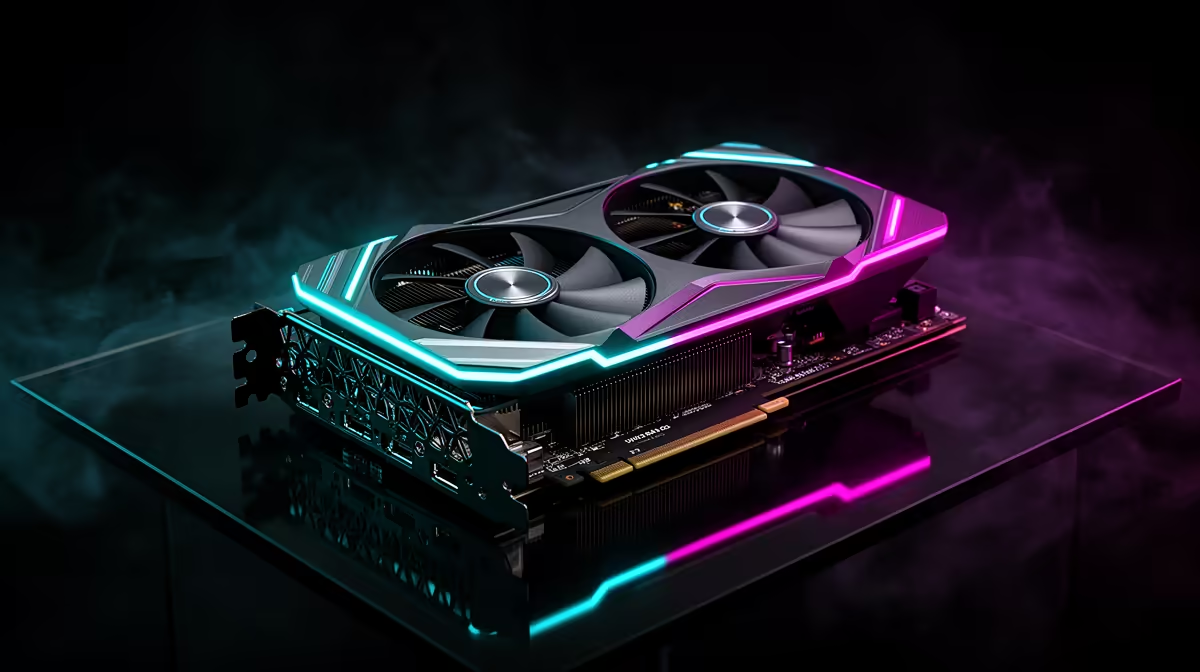
Generating video locally has moved from a research curiosity to something a well-specified desktop can actually do, and the best GPU for local AI video generation comes down to one number more than any other: VRAM. The two open models leading the field right now, LTX-2 and Wan 2.2, set very different memory bars, and matching a card to them is the difference between smooth 4K output and a crash before the first frame renders.
Quick Answer
For serious local AI video, the RTX 5090 with 32GB of VRAM is the strongest consumer pick, comfortably running LTX-2 at high resolutions and handling Wan 2.2 with room to spare. The RTX 4090 with 24GB is the capable step down, running Wan 2.2 and LTX-2 at 720p, particularly with fp8 quantisation. Both are available SA-priced locally.
The Two Models Setting the Bar
Understanding the workload tells you which card you need, so start with the models themselves.
LTX-2 was open-sourced in early 2026 and targets native 4K video with synced audio. Its official guidance asks for 32GB of VRAM or more, with even more recommended for stable 4K work. In practice it is flexible: with fp8 quantisation, 720p output runs on cards in the 12 to 24GB range, and 1080p sits comfortably on 24 to 32GB. That flexibility is what makes it approachable on consumer hardware.
Wan 2.2 is the other heavyweight. Its larger configurations generally want the full 24GB of an RTX 4090, and on that card a clip takes meaningfully longer to render than the same job on LTX-2. The smaller Wan 2.2 model fits comfortably on either the RTX 4090 or the RTX 5090.
RTX 5090: The Ceiling for Consumer Local Video
If your aim is the highest resolution and the least fuss, the RTX 5090 and its 32GB of VRAM is the card to target.
That memory ceiling matters because video generation scales hard with both resolution and clip length. The 32GB buffer meets LTX-2's stated minimum head-on, runs Wan 2.2 without sharding across multiple cards, and leaves headroom for longer or higher-resolution clips that would overflow a smaller card. For anyone treating local video as a regular workflow rather than an occasional experiment, the extra VRAM pays for itself in jobs that simply complete instead of failing.
RTX 4090: The Sensible Workhorse
The RTX 4090 and its 24GB remains a strong, more accessible choice, and for many creators it is the right one.
It runs LTX-2 at 720p, and at 1080p with quantisation, while handling Wan 2.2 in its standard form. The trade-off is render time and resolution ceiling: heavier jobs take longer, and native 4K LTX-2 work pushes against the 24GB limit where the 5090 does not. For learning the tooling, producing shorter clips, and working mainly at 720p and 1080p, it is plenty of card.
Where 24GB Starts to Bite
The pinch point is large Wan 2.2 configurations and sustained 4K LTX-2 generation, both of which want every megabyte of 24GB and benefit from the 5090's extra room. If your projects trend toward maximum resolution, plan for 32GB rather than fighting the limit later.
Choosing Between Them in SA
The decision is genuinely about workload, not prestige. Pick the RTX 5090 if you want native 4K, longer clips, and a card that runs both models without compromise. Pick the RTX 4090 if your output is mostly 720p and 1080p and you want the strongest value while still doing real video work.
Either way, treat this as a full system decision rather than just swapping a card: video generation leans heavily on system RAM, fast NVMe storage and a power supply rated for the card under sustained load. Every machine in the AI PC range at Evetech is specced with video-generation workloads in mind, and if you are sourcing the card separately, the GPU best sellers show what is moving locally and at what price.
What to Expect from Render Times
Video generation is slow compared to image generation, and the numbers are worth setting realistic expectations around before you buy.
On an RTX 5090, benchmarks for image-to-video inference show roughly a 45 percent improvement over the RTX 4090 on comparable workloads. In practice that can mean the difference between a 12-minute job and a 7-minute job, which compounds across a full day of iteration. For LTX-2 specifically, the 5090's bandwidth advantage, around 1.79 TB/s versus the 4090's roughly 1 TB/s, is the primary driver of that speed gap. The wider memory bus keeps tensor data moving fast even as the model processes long high-resolution sequences.
The RTX 4090 is not slow. It is still meaningfully faster than any card below 24GB because the model stays resident in VRAM rather than spilling to system memory and crawling. If your clips are short, mostly 720p, and you are not generating hundreds per week, the 4090 does the job without the 5090's premium price and its higher power demand.
One factor that often gets missed is the NVMe drive. LTX-2 model weights are large files that reload between sessions, and the difference between a fast Gen 4 NVMe and a slow SATA drive is noticeable at startup. Keep models on quick storage and the rest of the pipeline will not sit idle waiting for the card.
Frequently Asked Questions
How much VRAM do I really need for local AI video?
24GB is the practical floor for serious work and runs both LTX-2 and Wan 2.2 at 720p and 1080p with quantisation. 32GB, as on the RTX 5090, is what you want for stable native 4K and longer clips.
Can the RTX 4090 run LTX-2?
Yes, at 720p, and at 1080p with fp8 quantisation. Native 4K pushes against its 24GB limit, which is where the 32GB RTX 5090 has the clear advantage.
Is Wan 2.2 or LTX-2 heavier on the GPU?
On an RTX 4090, Wan 2.2 generally takes longer per clip and wants the full 24GB in its larger forms, while LTX-2 is faster and more flexible with quantisation. LTX-2's ceiling is higher for 4K but it scales down more gracefully.
Do I need more than the GPU?
Yes. Local video generation also relies on ample system RAM, fast NVMe storage for models and output, and a power supply rated for a high-end card. Build the whole machine around the GPU rather than dropping a card into an underpowered system.
Building a rig for local AI video? Explore the AI PC range at Evetech configured for LTX-2 and Wan 2.2 workloads, with SA pricing and support.