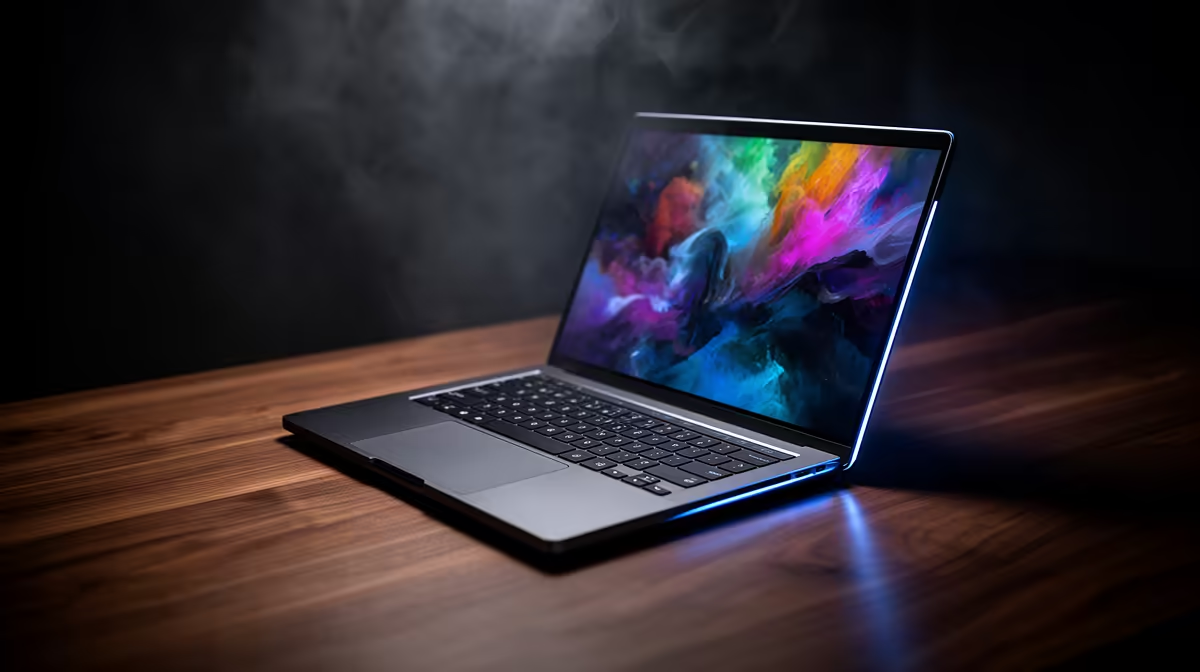
Studying 3D design means living inside software like Fusion 360, SolidWorks, Blender, and Rhino, and those programs punish an underpowered laptop with viewport lag, failed renders, and crashes mid-deadline. The best laptop for 3D design students is not the flashiest gaming machine; it is the one that clears the real minimum specs your coursework demands and then leaves a little headroom for the projects that get heavier every year.
Quick Answer
Target 16GB of RAM and a dedicated GPU with DirectX 11 support and at least 1GB of VRAM, which is the recommended baseline to run Fusion 360 comfortably. For SA students that practically means a laptop with a modern multi-core CPU, 16GB RAM, a discrete GPU, and an SSD. Expect to pay from around R18,000 to R30,000 depending on how much headroom you want for rendering.
What 3D Design Software Actually Demands
Before chasing specs, understand what the work asks of a machine. CAD and modelling software leans on three things: a fast CPU for calculations and history rebuilds, enough RAM to hold complex assemblies in memory, and a capable GPU to keep the viewport smooth as you orbit and zoom around a model.
Fusion 360, one of the most common student CAD tools, lists a recommended baseline of 16GB RAM and a DirectX 11 capable GPU with at least 1GB of VRAM. Treat that as a floor, not a target. The moment your assemblies grow, your render scenes get detailed, or you run simulation, you will be glad you bought above the minimum rather than exactly at it.
CPU: Cores And Clock Speed Both Matter
Modelling itself often relies on single-thread performance, so a high clock speed keeps the interface responsive. Rendering and simulation, on the other hand, scale across cores, so more cores cut your render times. A modern mid-range to upper mid-range processor with six or more cores hits a sensible balance for student work, fast enough to feel snappy while modelling, with enough cores to handle the occasional render without you walking away for an hour.
RAM: 16GB Is The Real Minimum
16GB is the baseline, full stop. With an operating system, a browser full of reference tabs, and a CAD package all open, 8GB simply runs out of room and forces constant swapping that stutters the viewport. If your budget stretches and you expect to do heavy assembly work or rendering, 32GB is the upgrade that ages best across a three or four year degree.
GPU: Dedicated, Not Integrated
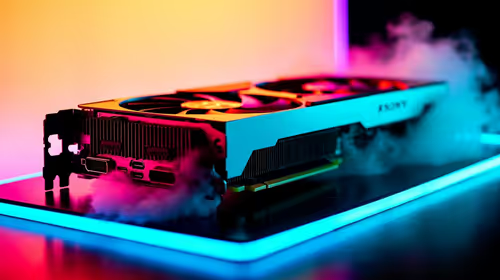
A discrete GPU is what keeps the viewport fluid and what many renderers tap for GPU-accelerated output. Integrated graphics can technically open these programs, but they bog down quickly on detailed scenes. A dedicated card with a healthy chunk of VRAM, well above the 1GB minimum, gives you smooth navigation and faster rendering, and it future-proofs you for the more demanding software you meet later in your studies.
Matching A Laptop To Your Year And Discipline
A first-year industrial design student sketching simple parts has different needs from a final-year student running photorealistic renders and simulations. If your course is CAD-heavy with light rendering, prioritise CPU clock speed and 16GB RAM. If you are deep into rendering, animation, or visual effects in Blender, prioritise a stronger GPU and push toward 32GB RAM.
Architecture and product design students should also weigh screen quality. A colour-accurate display with good resolution makes a real difference when you are judging materials, lighting, and proportion. A 15 or 16 inch panel with a sharp resolution is the practical sweet spot, big enough to work on, small enough to carry between res, lectures, and the design studio.
Storage And Portability
An SSD is non-negotiable. Project files, software installs, and texture libraries are large, and a mechanical drive will bottleneck load times badly. A 512GB SSD is a workable minimum, though 1TB saves you constant file-juggling if you work with big assets. On portability, remember you are carrying this thing across campus daily; a balance of performance and a battery that survives a full lecture block beats a heavy desktop-replacement brick you dread packing.
Budget Bands For SA Students
Pricing in Rand sets realistic expectations. Around R18,000 to R22,000 gets you a solid entry into proper 3D-capable territory: a capable CPU, 16GB RAM, an SSD, and an entry dedicated GPU that clears the Fusion 360 baseline with room to spare. From roughly R22,000 to R28,000 you move into stronger GPUs, faster CPUs, and the option of 32GB RAM, which is where rendering and heavier assemblies stop being a chore. Above R28,000 you are buying serious headroom for simulation, animation, and the most demanding coursework.
NSFAS-funded students working with the R5,200 allowance will need to top up significantly for a machine that genuinely handles 3D work, since the cheapest capable laptops sit well above that figure. It is worth planning for, because buying a machine that cannot run your software is a false economy that costs you in missed deadlines. Browsing the student laptop best sellers at Evetech shows you which models are moving right now and which spec tier each price point delivers.
A Note On Workflow Beyond The Laptop
Many 3D design courses now blend digital modelling with physical prototyping, so it is worth knowing that the same store carries the 3D printers you might use to turn a Fusion 360 model into a real part. A laptop that exports clean print-ready files and a printer that renders them physically is a complete student pipeline, and planning both together saves you buying mismatched gear later. The top accessories for students and makers cover the cables, mice, and peripherals that round out the setup without blowing what is left of a student budget.
Frequently Asked Questions
What is the minimum spec to run Fusion 360 as a student?
The recommended baseline is 16GB of RAM and a DirectX 11 capable GPU with at least 1GB of VRAM, paired with a modern multi-core CPU and an SSD. Meeting that floor lets the software run comfortably, but buying a little above it gives you headroom as your projects grow.
Is 8GB of RAM ever enough for 3D design?
No. With an operating system, reference browser tabs, and a CAD package open at once, 8GB runs out and forces constant swapping that stutters the viewport. 16GB is the working floor you should not go below, and 32GB is the smarter choice if you expect heavy assemblies or rendering.
Do I need a gaming laptop for 3D design?
Not specifically, but gaming laptops often hit the right spec mix of a strong CPU, dedicated GPU, and good cooling at competitive prices. What matters is the components, not the gaming branding. A workstation-class machine or a well-specced creator laptop works just as well.
How much should an SA student budget for a capable 3D laptop?
Realistically from around R18,000 for a solid entry machine that clears the software baseline, rising to R28,000 or more for rendering and simulation headroom. The NSFAS R5,200 allowance covers only a fraction of that, so plan to top up for a machine that genuinely handles the work.
Does screen quality matter for 3D design?
Yes, especially for product design, architecture, and rendering. A colour-accurate, sharp display helps you judge materials, lighting, and proportion accurately. A 15 or 16 inch panel with a high resolution is the practical balance between workspace and portability for daily campus use.
The right machine turns your coursework from a fight with lag into actual design time. Browse Evetech's laptop range, match the CPU, RAM, and GPU to your discipline and budget, and start your degree on hardware that keeps up with your software.